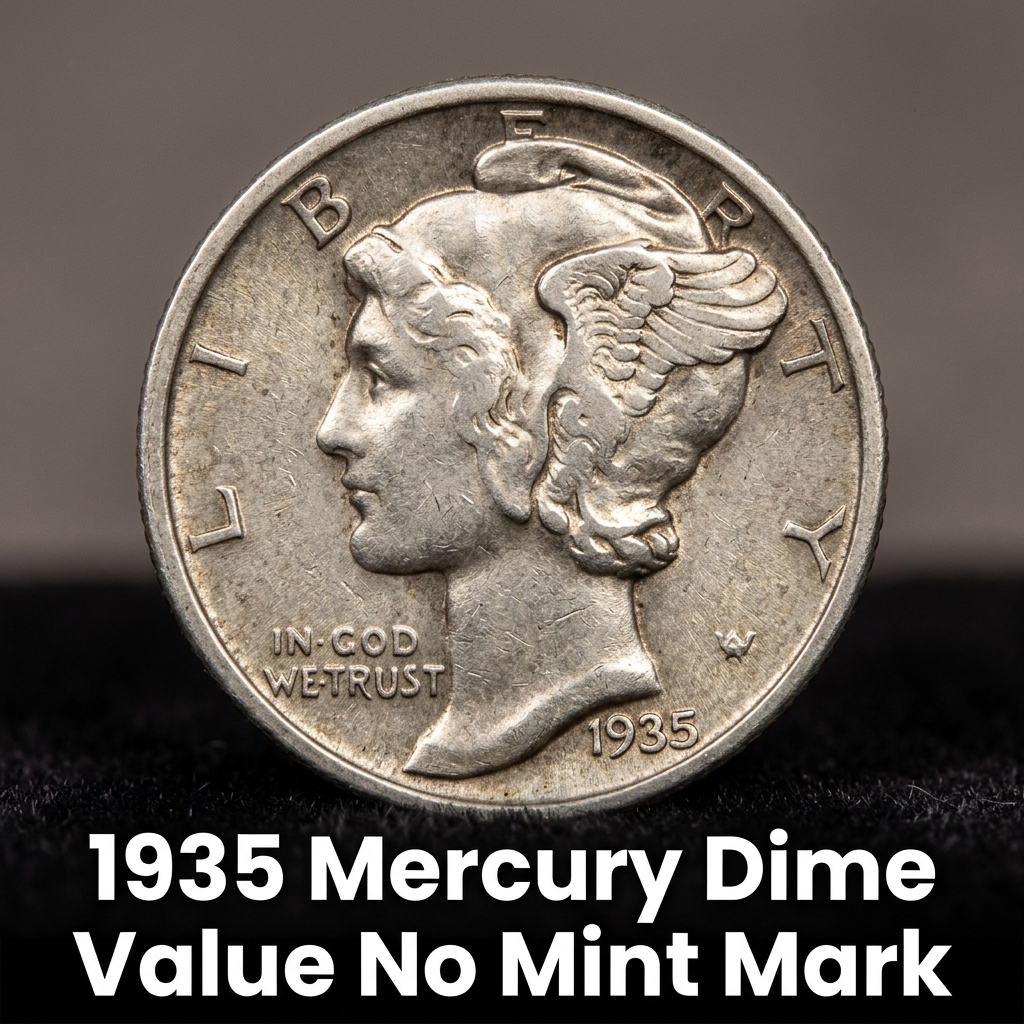
The 1935 Mercury Dime with no mint mark is worth anywhere from $3 to $5 in heavily circulated condition, climbing to $20–$50 in About Uncirculated grades, and potentially reaching $100 or more in pristine mint state examples. If you found one in a coin jar or old collection, you may be holding more than just a dime.
What Is the 1935 Mercury Dime and Why No Mint Mark Matters
The 1935 Mercury Dime — officially called the Winged Liberty Head Dime — was designed by Adolph A. Weinman and is widely considered one of the most beautiful coins ever produced by the U.S. Mint. The obverse features Liberty wearing a winged cap, often mistaken for the Roman god Mercury, which is how the coin got its popular nickname.
When a coin has no mint mark, it means it was struck at the Philadelphia Mint, which was the main production facility and did not use a mint mark during this era. In 1935, Philadelphia struck over 58 million Mercury Dimes, making them relatively common — but that doesn’t mean they’re worthless. Condition is everything with these coins.
If you’re not sure whether your coin has a mint mark or not, look at the reverse (tails side) near the bottom, just to the left of the “E” in “ONE.” A “D” means Denver, an “S” means San Francisco, and a blank space means Philadelphia. Using the best coin identifier app can help you quickly identify mint marks and coin details right from your smartphone.
1935 Mercury Dime Value by Grade
Coin value is almost entirely determined by its grade — how much wear it shows. A heavily circulated coin with flat details is worth very little, while an uncirculated example with sharp lines and luster can be worth significantly more. Here’s a general value breakdown for the 1935 Philadelphia (no mint mark) Mercury Dime:
| Grade | Description | Estimated Value |
|---|---|---|
| Good (G-4) | Heavy wear, major details visible | $3 – $4 |
| Fine (F-12) | Moderate wear, all lettering clear | $4 – $6 |
| Extremely Fine (EF-40) | Light wear on high points | $10 – $20 |
| About Uncirculated (AU-55) | Slight wear, most luster present | $25 – $50 |
| Mint State (MS-63) | Uncirculated, minor bag marks | $60 – $90 |
| Mint State (MS-65+) | Gem quality, full luster | $100 – $300+ |
For the most up-to-date auction results and certified coin prices, you can browse detailed 1935 Mercury Dime price data across all mint state grades to see what collectors are actually paying right now.
The Full Bands Detail and Why It Dramatically Increases Value
One of the most talked-about features among Mercury Dime collectors is the “Full Bands” (FB) designation. On the reverse of the coin, there are two horizontal bands wrapping around the fasces (the bundle of sticks and axe). If those bands are fully separated and sharply struck, the coin earns the FB designation from grading services like PCGS or NGC.
A 1935 Mercury Dime graded MS-65 might sell for around $100–$150. That same coin graded MS-65 FB (Full Bands) could easily fetch $400 to $600 or more. The difference is enormous, and it all comes down to the sharpness of the strike.
Full Bands coins are especially prized because they’re harder to find — even many uncirculated examples don’t show fully separated bands. If you think your coin might qualify, it’s worth getting it professionally graded.
Silver Content and Melt Value
One thing many people don’t realize is that Mercury Dimes are made of 90% silver. Each coin contains 0.07234 troy ounces of pure silver. That means even a heavily worn 1935 Mercury Dime with no collector premium has real intrinsic value based on the silver market.
At a silver price of around $30 per troy ounce (prices fluctuate daily), the melt value of a 1935 Mercury Dime is roughly $2.17. So even the most worn examples are worth more than face value — and probably more than most people expect when they find one tucked away in an old drawer.
This silver floor value makes Mercury Dimes a popular target for both coin collectors and precious metals investors. If you want a complete breakdown of the full 1935 Mercury Dime value including silver melt and grade-by-grade estimates, there are excellent resources available online.
How to Check Your 1935 Mercury Dime’s Value Quickly
If you’ve got an old dime and want to know what it’s worth in seconds, CoinHix is one of the fastest ways to look it up. The app gives you real-time price data based on actual sales, so you’re not guessing. Just enter the coin’s details — year, mint mark, and approximate condition — and you’ll get a solid value range instantly.
For visual identification, especially if you’re not sure about the mint mark or the coin’s grade, CoinHix also lets you scan coins with your camera. It’s free, straightforward, and designed for everyday collectors and curious finds alike. Whether you’re at a flea market or sorting through grandma’s old belongings, having a reliable app in your pocket makes the whole process much easier.
FAQ
Q: Is a 1935 Mercury Dime with no mint mark rare?
A: Not particularly. Philadelphia struck over 58 million of them in 1935, making it one of the more common dates in the Mercury Dime series. That said, high-grade examples — especially those with Full Bands — are genuinely scarce and can be worth hundreds of dollars.
Q: How do I know if my 1935 dime is real silver?
A: All Mercury Dimes minted from 1916 through 1945 are made of 90% silver. You don’t need a special test — if it’s a genuine Mercury Dime from 1935 with no signs of being a modern replica, it contains silver. A magnet test helps: real silver is not magnetic, so if a magnet sticks, it’s likely a fake.
Q: Should I clean my 1935 Mercury Dime before selling it?
A: Absolutely not. Cleaning a coin — even gently — can permanently damage its surface and drastically reduce its value to collectors. Grading services like PCGS and NGC will note any cleaning and lower the coin’s grade accordingly. Leave the coin exactly as you found it, and let a buyer or appraiser assess it in its natural state.