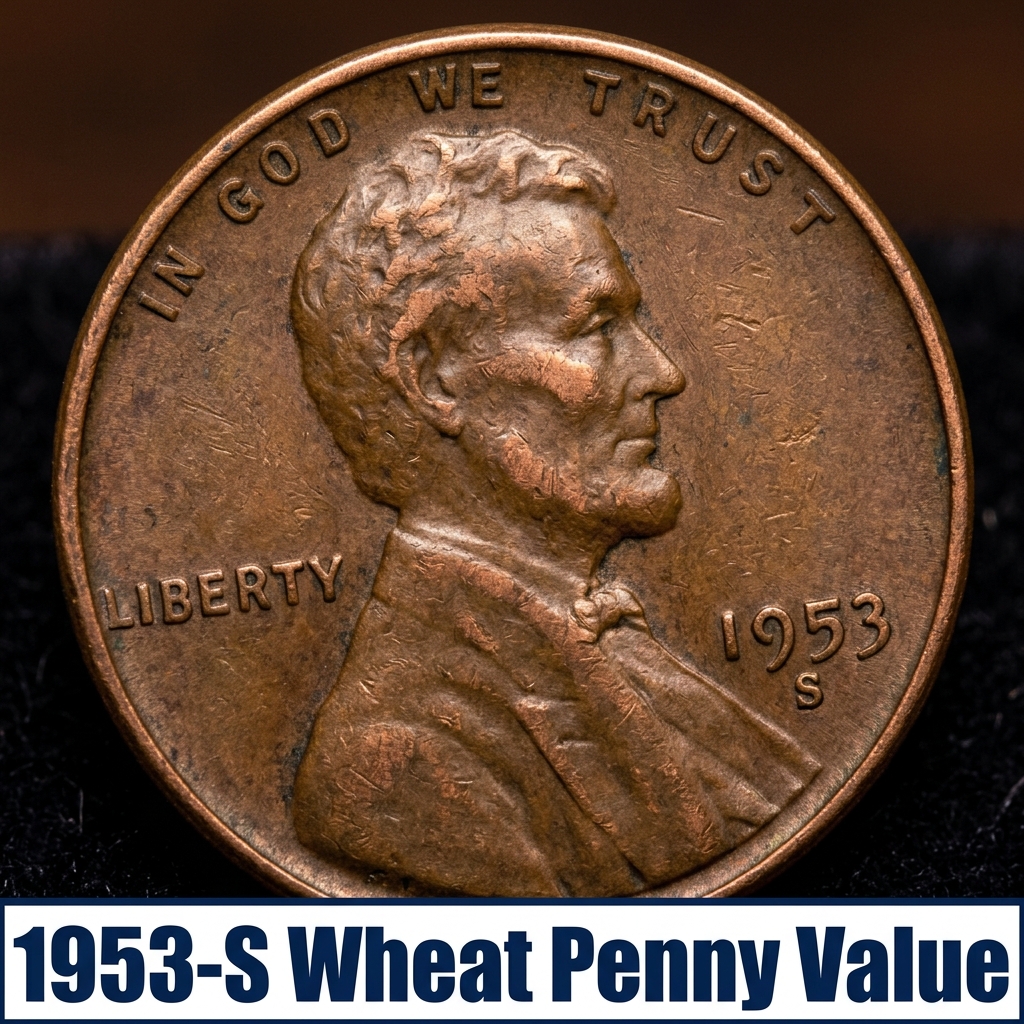
The 1953-S Wheat Penny is worth anywhere from $0.10 in heavily worn condition to over $10 in well-preserved circulated grades, and certified mint state examples can fetch $25 or more depending on their quality. If you found one of these coins in a jar or an old collection, you’re in luck — it’s one of the more collectible Lincoln Wheat cents from the early 1950s.
What Makes the 1953-S Wheat Penny Special
The 1953-S Lincoln Wheat Penny was struck at the San Francisco Mint and carries the small “S” mintmark just below the date on the obverse. That year, the San Francisco facility produced approximately 181 million of these cents — a sizeable mintage, but collectors still seek out well-preserved examples. The coin features Victor David Brenner’s classic design: Abraham Lincoln’s portrait on the front and two stalks of wheat flanking the words “ONE CENT” on the reverse. This “Wheat Penny” design ran from 1909 to 1958, making any coin from that era a piece of American numismatic history. If you want to get a quick read on what your coin looks like and whether it might have extra value, using the best coin identifier app is a smart first step before you head to a dealer or auction site. A good app can help you identify mint marks, spot doubling errors, and compare your coin’s condition to known examples in seconds.
1953-S Wheat Penny Value by Grade
Condition — or “grade” in coin collecting terms — is the single biggest factor that determines how much your 1953-S Wheat Penny is worth. A coin graded Good (G-4) with heavy wear might only bring $0.10 to $0.25, while a Fine (F-12) example typically sells for around $0.35 to $0.50. Very Fine (VF-20 to VF-35) coins are where things get more interesting, usually fetching $0.75 to $2. Extremely Fine (EF-40 to EF-45) examples can bring $2 to $5. Once you cross into the Mint State (MS) territory — coins that were never circulated — values jump considerably. An MS-63 Red example might sell for $8 to $15, and a gem MS-65 Red can easily reach $25 to $50 at auction. For the most current market data, you can check out the 1953-S Wheat Penny mint state red pricing data to see how recent sales are trending.
| Grade | Description | Estimated Value |
|---|---|---|
| Good (G-4) | Heavy wear, flat features | $0.10 – $0.25 |
| Fine (F-12) | Moderate wear, details visible | $0.35 – $0.50 |
| Very Fine (VF-30) | Light to moderate wear | $0.75 – $2.00 |
| Extremely Fine (EF-45) | Slight wear on high points | $2.00 – $5.00 |
| MS-63 Red | Uncirculated, minor marks | $8.00 – $15.00 |
| MS-65 Red | Gem uncirculated, sharp strike | $25.00 – $50.00 |
| MS-67 Red | Superb gem, rare at this level | $100.00+ |
Error Coins and Varieties That Boost the 1953-S Penny Value
Not every 1953-S Wheat Penny is equal. Some examples carry minting errors or die varieties that can dramatically increase their worth. The most commonly searched variety is the 1953-S Doubled Die Obverse, where doubling is visible on the lettering or date under magnification. These error coins can sell for $50 to $200 or more depending on how strong the doubling is and the overall grade. Repunched mintmark (RPM) varieties — where the “S” mintmark was punched into the die more than once and shifted — are also popular with collectors and can add a premium of $5 to $30 over normal examples. Before you assume your coin is just an ordinary cent, take a close look with a loupe or use CoinHix to scan the coin and check for known varieties. The app has a growing database of error coins and can flag potential premium specimens right from your phone.
How to Sell or Get Your 1953-S Wheat Penny Appraised
If you think your 1953-S Wheat Penny is worth more than a few dollars, you have several good options. Online platforms like eBay are great for seeing real-world sale prices — just filter by “sold listings” to see what buyers have actually paid, not just what sellers are asking. For coins in Mint State condition, consider submitting to a third-party grading service like PCGS or NGC. A certified grade adds buyer confidence and often results in higher sale prices. Local coin shops and coin shows are also excellent places to get a free or low-cost appraisal. You can also review a detailed breakdown of 1953 penny values by mint mark and grade to understand exactly where your coin falls in the market before selling. And remember — CoinHix lets you track coin prices over time, so you can decide when the market is right to sell.
FAQ
Q: How do I know if my 1953-S Wheat Penny is real?
A: Check that the mintmark “S” is present just below the date on the obverse side. Genuine coins have a consistent weight of 3.11 grams and are made of 95% copper. If you’re unsure, a digital scale and a magnifying glass can help, or you can scan it with CoinHix for a quick authentication check.
Q: Is a 1953-S Wheat Penny rare?
A: With a mintage of about 181 million, the 1953-S is not considered rare in circulated grades. However, high-grade examples graded MS-65 Red or better are genuinely scarce and sought after by collectors, making them worth significantly more than a typical worn example.
Q: What should I do if my 1953-S Wheat Penny looks uncirculated?
A: Do not clean it — cleaning destroys value. Store it in a protective coin flip or holder, then compare it to grading photos online or use a coin identification app to estimate its grade. If it appears to be MS-63 or higher, consider professional grading through PCGS or NGC to maximize its resale value.