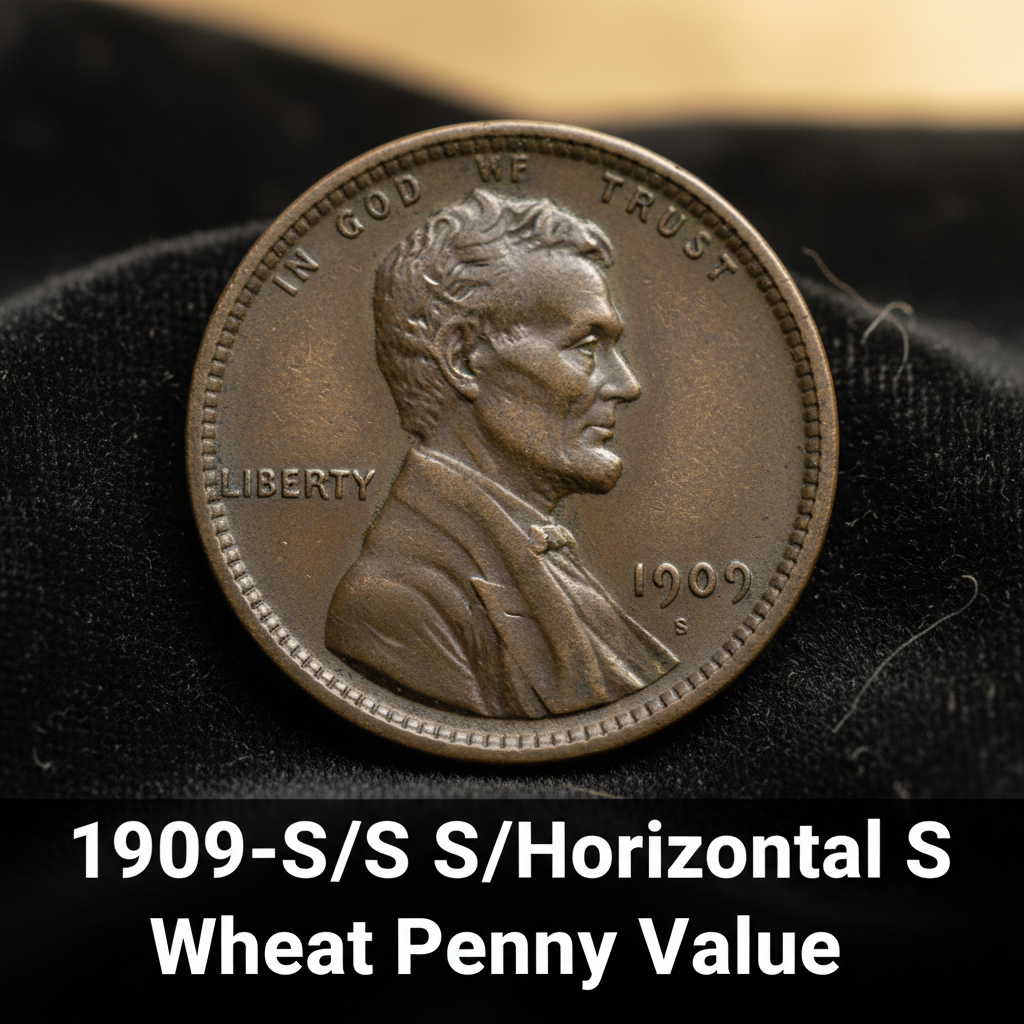
The 1909-S/S and 1909-S/Horizontal S Wheat Penny are among the most fascinating Lincoln cent varieties ever struck, worth anywhere from $100 in heavily worn condition to well over $2,000 in high mint state grades. If you found one of these in an old coin collection or inherited jar of pennies, you may be sitting on a serious piece of American numismatic history.
What Makes the 1909-S/S and S/Horizontal S So Special
The year 1909 was a landmark moment for American coinage. It marked the introduction of the Lincoln cent, replacing the Indian Head penny that had circulated since 1859. The San Francisco Mint struck a limited number of these early Lincoln cents, and in the process, a few dramatic die errors crept into production.
The 1909-S/S is a repunched mintmark variety — the “S” mintmark was punched into the die twice, slightly offset, leaving a doubled ghost image beneath the primary letter. The even rarer 1909-S/Horizontal S shows that the second punch was rotated roughly 90 degrees, making the underlying mintmark appear to lie on its side. Both varieties are listed in the best coin identifier app databases and are actively tracked by serious collectors. These aren’t just curiosities — they’re legitimately sought-after coins that command strong premiums over standard 1909-S cents. To properly identify which variety you have, you’ll need a magnifying loupe of at least 5x to 10x power and a steady light source aimed at the mintmark area just below the date.
How to Identify Your Variety
Identifying these varieties requires careful examination of the mintmark. On a standard 1909-S Lincoln cent, the “S” appears cleanly punched beneath the date. On the S/S variety, you’ll notice a faint secondary “S” slightly north, south, or to one side of the primary mintmark. On the S/Horizontal S, the secondary punch shows a sideways “S” shape — almost like a stylized “Z” or a backward curve lying flat beneath the upright letter.
Look for the top serif of the underlying horizontal “S” peeking out from the northwest corner of the primary mintmark. Many collectors use CoinHix to cross-reference their finds before sending coins to a grading service. Both varieties are recognized by PCGS and NGC, the two leading third-party grading companies, and attribution is typically noted directly on the certified slab.
1909-S/S and S/Horizontal S Wheat Penny Value by Grade
Values vary significantly depending on condition. Even a heavily worn example of these varieties carries meaningful collector value. Here’s a general price table based on current market trends:
| Grade | 1909-S/S Value | 1909-S/Horizontal S Value |
|---|---|---|
| Good (G-4) | $100 – $150 | $150 – $250 |
| Fine (F-12) | $200 – $350 | $300 – $500 |
| Very Fine (VF-20) | $400 – $600 | $600 – $900 |
| Extremely Fine (EF-40) | $700 – $1,000 | $1,000 – $1,500 |
| Mint State (MS-63+) | $1,500 – $2,500+ | $2,000 – $4,000+ |
For the most up-to-date auction results and dealer pricing, you can browse 1909 Wheat Penny price data across mint state grades directly on CoinHix’s coin pricing database.
Should You Get It Certified
If you believe you have a genuine 1909-S/S or S/Horizontal S, professional certification is absolutely worth considering. PCGS and NGC charge submission fees, but a certified example typically sells for significantly more than a raw (uncertified) coin of the same grade. Buyers at auction and on reputable coin marketplaces trust slabbed coins, and the variety attribution on the holder removes any doubt.
Before spending money on submission, it makes sense to do your homework. The CoinHix app lets you look up current certified populations and recent sale prices so you know whether your coin’s grade range justifies the cost. You can also review detailed value information for key-date early Lincoln and Indian Head cents to better understand how 1909-S varieties compare to related coins from the same era.
Tips for Preserving Your Coin’s Value
One of the most common mistakes new collectors make is cleaning their coins. Never scrub, polish, or rinse a wheat penny with any chemical or abrasive. Even gentle cleaning strips original surface luster and can reduce a coin’s grade — and its value — dramatically. Store your coin in a non-PVC flip or a hard plastic holder away from humidity and temperature swings. Handling by the edges only is standard practice. If you’re unsure about anything, the CoinHix app provides a beginner-friendly interface to help you understand grading basics before you touch anything.
FAQ
Q: How do I know if my 1909-S penny is the S/S or S/Horizontal S variety and not just a regular 1909-S?
A: You need to examine the mintmark under magnification. A regular 1909-S has a single clean “S.” The S/S shows a second “S” overlapping or offset from the first. The S/Horizontal S shows a secondary punch that appears rotated about 90 degrees, visible as a horizontal curve beneath the upright letter. If you’re unsure, a professional dealer or grading service can attribute it for you.
Q: Are these varieties rare enough to be worth getting graded even in worn condition?
A: Yes, in most cases. Even a Good-grade example of either variety is worth $100 or more, and the certification cost is a reasonable investment if it helps you sell with confidence. Variety attribution on a certified slab also protects you as a seller by confirming authenticity.
Q: Where is the best place to sell a 1909-S/S or S/Horizontal S Wheat Penny?
A: Major online coin auction platforms like Heritage Auctions, Stack’s Bowers, or eBay (with proper documentation) are popular choices. A certified coin from PCGS or NGC will attract more competitive bidding. Local coin shows and established dealers are also solid options, especially if you want a fast, in-person transaction.