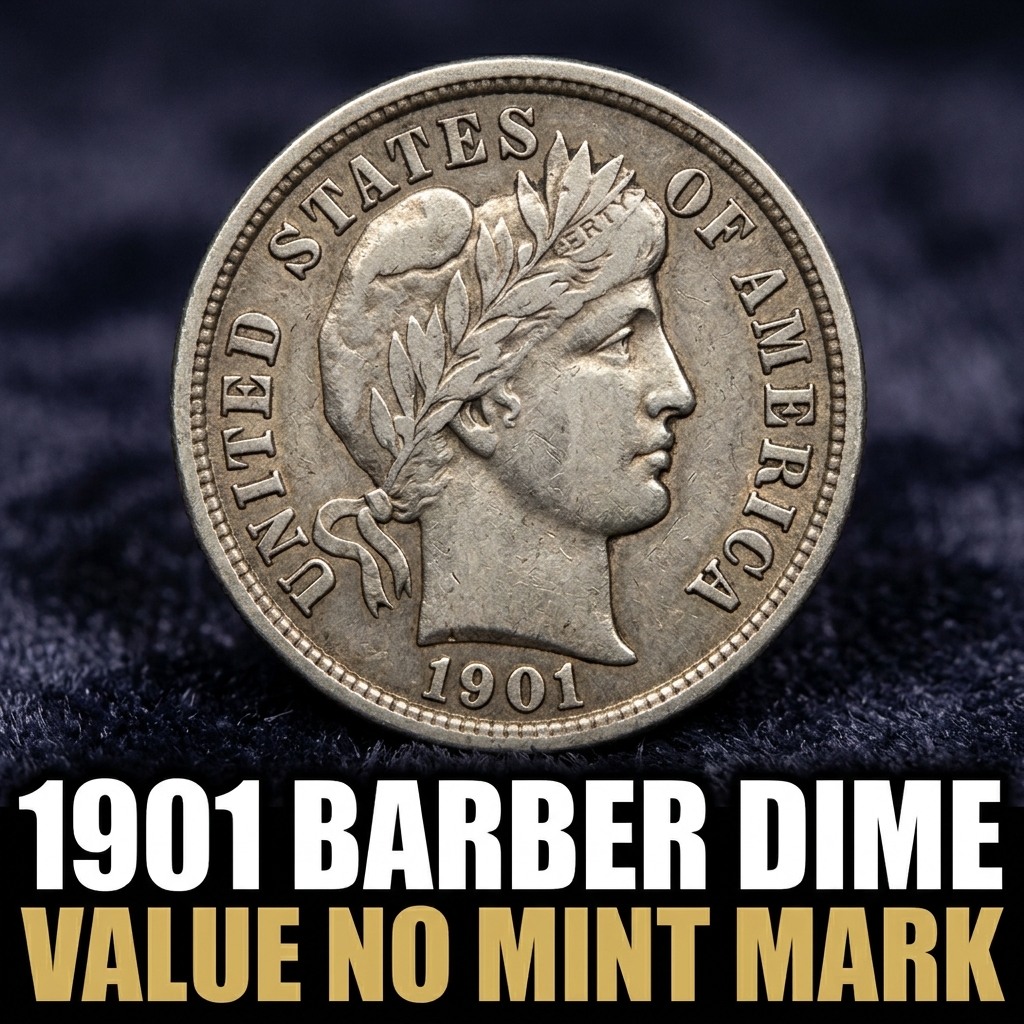
The 1901 Barber Dime with no mint mark is worth anywhere from $3 to $5 in heavily worn condition, climbing to $30 or more in fine shape, and potentially hundreds of dollars in uncirculated grades. If you found one of these silver coins tucked away in an old collection or at the bottom of a drawer, you’re holding a piece of genuine American history — and it may be worth more than you think.
What Is the 1901 Barber Dime?
The 1901 Barber Dime was struck at the Philadelphia Mint — and since Philadelphia was the main federal mint at the time, coins produced there carry no mint mark at all. That’s why you’ll see “no mint mark” used to describe these coins. The coin was designed by Charles E. Barber, the U.S. Mint’s Chief Engraver, and features Lady Liberty wearing a Roman-style wreath and cap on the obverse, with a heraldic eagle on the reverse. These dimes were made of 90% silver, giving them a base melt value even in the worst condition. The Philadelphia Mint struck 18,859,665 of these dimes in 1901, making it a relatively common date in the Barber Dime series — but condition still plays a massive role in what your coin is actually worth. If you’re not sure what you have, using the best coin identifier app can help you quickly identify your coin before you start researching its value.
1901 Barber Dime Value by Grade
Coin grading is everything when it comes to figuring out what your 1901 Barber Dime no mint mark is actually worth. A coin that’s been passed through thousands of hands will show heavy wear — the hair details on Liberty’s head will be nearly flat, and the lettering may be soft. That’s called “Good” grade, and it represents the low end of value. As condition improves through Fine, Very Fine, and Extremely Fine grades, the value rises noticeably. Uncirculated examples — coins that never saw daily use — are the real prizes.
Here’s a quick breakdown of estimated values based on grade:
| Grade | Description | Estimated Value |
|---|---|---|
| Good (G-4) | Heavy wear, major details visible | $3 – $5 |
| Fine (F-12) | Moderate wear, some detail in hair | $8 – $15 |
| Very Fine (VF-20) | Light wear, most details clear | $20 – $35 |
| Extremely Fine (EF-40) | Slight wear on high points only | $40 – $65 |
| About Uncirculated (AU-50) | Trace wear, nearly full luster | $75 – $110 |
| Mint State (MS-60 to MS-65) | No wear, original mint luster | $150 – $500+ |
For a more detailed look at current market prices, check out this complete guide to 1901 Barber Dime values across all grades and mint marks.
Silver Content and Melt Value
Even if your 1901 Barber Dime no mint mark is in rough shape, it still has real intrinsic value. Each Barber Dime contains 0.07234 troy ounces of pure silver. With silver prices fluctuating around $25–$30 per troy ounce in recent years, that puts the melt value of even the most worn example somewhere between $1.80 and $2.20. That’s a floor — your coin will almost always be worth more to a collector than its raw silver content. Still, it’s good to know your baseline. CoinHix is a great tool for checking live silver melt values alongside collector premiums, all in one place.
What Makes a 1901 Barber Dime More Valuable
Not all 1901 Barber Dimes with no mint mark are created equal. Several factors can push your coin’s value significantly higher. First and most important is condition — a coin graded MS-65 by PCGS or NGC can sell for $400 to $600 at auction, while the same coin in MS-63 might bring $150 to $200. Strike quality matters too; a sharply struck coin with full details in Liberty’s hair is far more desirable. Eye appeal — things like original luster, minimal contact marks, and no cleaning — can make a big difference. Collectors hate cleaned coins; a coin that’s been polished or dipped improperly will be worth less than a naturally worn example. If you want a fast and accurate assessment without visiting a coin shop, CoinHix lets you scan your coin and get an instant grade estimate right from your phone.
How to Sell Your 1901 Barber Dime
If you’ve decided you want to sell, you have several good options. Online auction platforms like eBay are popular for common-date Barber Dimes, and you can see what similar coins have recently sold for using completed listing filters. Local coin shows and dealers are another solid choice, especially for coins in lower grades where shipping costs could eat into your profit. For higher-value examples — anything in AU or Mint State — consider submitting to a professional grading service like PCGS or NGC before selling, as a certified grade dramatically increases buyer confidence and often the final sale price. CoinHix can also help you connect with fair-market buyers and get a sense of realistic offers before you commit to any sale.
—
FAQ
Q: Is the 1901 Barber Dime with no mint mark rare?
A: Not particularly. The Philadelphia Mint produced nearly 19 million of them in 1901, making it one of the more common dates in the Barber Dime series. However, finding one in high uncirculated grades is genuinely rare and worth serious money.
Q: How do I know if my 1901 dime has been cleaned?
A: Cleaned coins often look unnaturally bright or show fine hairline scratches under a magnifying glass. The surfaces may look too shiny compared to the coin’s age. A coin with original surfaces will have a more muted, consistent tone — sometimes called “original skin” by collectors.
Q: Where can I get my 1901 Barber Dime graded professionally?
A: PCGS (Professional Coin Grading Service) and NGC (Numismatic Guaranty Company) are the two most trusted grading services in the hobby. Submitting through an authorized dealer or directly on their websites is straightforward. For a quick preliminary assessment before spending money on grading, CoinHix is a convenient starting point.