The 1969-S Washington Quarter is worth anywhere from $0.25 in heavily circulated condition to over $15 or more in pristine mint state grades, with some proof versions fetching significantly higher prices depending on quality and eye appeal.
Whether you found one in a change jar or inherited a coin collection, this San Francisco-struck quarter deserves a closer look. If you want a quick identification, try the best coin identifier app to scan your coin and get instant details before diving deeper into valuation.
—
What Makes the 1969-S Washington Quarter Special
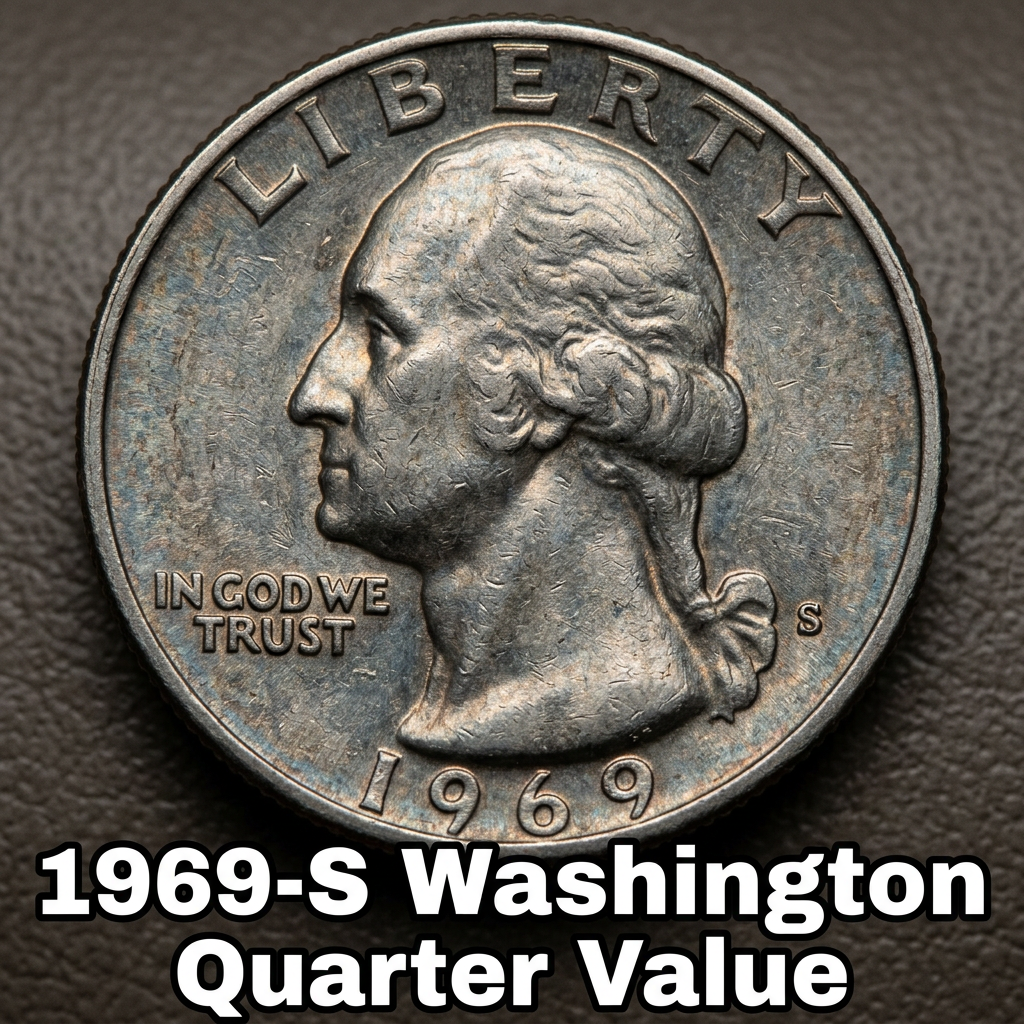
The 1969-S Washington Quarter was struck at the San Francisco Mint, which is represented by the small “S” mintmark you’ll find on the obverse (front) of the coin, just to the right of Washington’s neck. San Francisco produced two types of 1969-S quarters: business strike coins intended for general circulation, and specially made proof coins with mirror-like finishes aimed at collectors.
The coin follows the classic Washington Quarter design introduced in 1932. The obverse features a left-facing portrait of George Washington designed by John Flanagan, while the reverse displays a heraldic eagle. By 1969, these quarters were made of a copper-nickel clad composition — not silver — since the U.S. Mint had switched away from 90% silver in 1965.
Understanding which version you have matters enormously for value. A regular business strike 1969-S coin in worn condition is worth face value to a couple of dollars, but a deep cameo proof specimen can command $10 to $30 or more. The “S” mintmark alone signals San Francisco production, which historically attracts collector interest.
—
1969-S Washington Quarter Value by Grade and Type
Coin grading is the biggest factor in determining what your 1969-S quarter is worth. Coins are graded on the Sheldon scale from 1 to 70, with higher numbers meaning better condition. Here’s a straightforward breakdown of typical values:
| Grade / Condition | Type | Estimated Value |
|---|---|---|
| Good (G-4) | Business Strike | $0.25 – $0.50 |
| Fine (F-12) | Business Strike | $0.50 – $1.00 |
| Extremely Fine (EF-40) | Business Strike | $1.00 – $2.50 |
| Mint State (MS-63) | Business Strike | $4.00 – $8.00 |
| Mint State (MS-65) | Business Strike | $10.00 – $20.00 |
| Proof (PR-65) | Proof | $5.00 – $10.00 |
| Deep Cameo Proof (PR-69 DCAM) | Proof | $25.00 – $60.00+ |
For the most up-to-date auction results and market prices, you can browse detailed 1969-S Washington Quarter price data across all mint state grades to see exactly what collectors are paying right now.
—
Proof Coins vs. Business Strikes — Know the Difference
Many people who find a 1969-S quarter in a collection wonder why it looks shinier or more polished than typical coins. That’s often a sign you have a proof coin. The San Francisco Mint produced 2,934,631 proof quarters in 1969, sold directly to collectors in annual proof sets.
Proof coins have a distinct mirror-like background with frosted, raised design elements. When the contrast between the frosted figures and the shiny fields is especially strong, the coin earns the coveted “Cameo” or “Deep Cameo” designation — and those coins are worth the most.
Business strikes, on the other hand, were made for everyday use. While they’re less glamorous, an uncirculated business strike 1969-S quarter in gem condition (MS-65 or higher) can still be a solid find. The key is preservation — any coin that avoided heavy wear or contact marks holds far more value to a collector.
If you’re unsure which type you have, CoinHix offers a simple, reliable way to look up your coin’s specifications and estimated value using just your smartphone camera.
—
How to Check Your 1969-S Quarter’s Condition at Home
You don’t need to be a professional numismatist to get a general sense of what your coin is worth. Here are some practical tips:
Check the high points first. On Washington quarters, the cheekbone, the hair above the ear, and the eagle’s breast feathers wear down first. If those areas look flat or faded, the coin has seen circulation.
Look for luster. Uncirculated coins have a natural cartwheel shine when tilted under light. If that shine is dull or patchy, some wear has occurred.
Examine the surfaces under good lighting. Scratches, cleaning marks, or discoloration can significantly reduce a coin’s value — even if it otherwise looks nice.
Use a loupe or magnifier. A 5x to 10x magnifier helps you spot hairline scratches and other flaws invisible to the naked eye.
For a fast and accurate assessment, CoinHix lets you photograph your coin and compare it against graded examples so you can estimate its grade before visiting a dealer or submitting it for professional certification.
You can also find a comprehensive breakdown of 1969 quarter values including the S mint mark across all grades and varieties to cross-reference your coin’s worth.
—
FAQ
Q: Is the 1969-S Washington Quarter made of silver?
A: No. By 1969, the U.S. Mint had already stopped using silver in circulating quarters. The 1969-S Washington Quarter is made of a copper-nickel clad composition — 75% copper and 25% nickel bonded to a pure copper core. It contains no silver value.
Q: How do I know if my 1969-S quarter is a proof coin?
A: Proof coins typically have sharply defined details, a mirror-like reflective background, and frosted raised lettering and images. They were never meant for circulation and were sold in collector sets. If your coin looks exceptionally shiny with strong contrast between the design and background, it’s likely a proof. You can confirm this with CoinHix by scanning the coin for an instant identification.
Q: Where is the mintmark on a 1969-S Washington Quarter?
A: Look at the obverse (front) of the coin — the side with Washington’s portrait. The “S” mintmark is located just to the right of the base of Washington’s neck, below his ponytail. It’s small but visible without magnification under decent lighting.