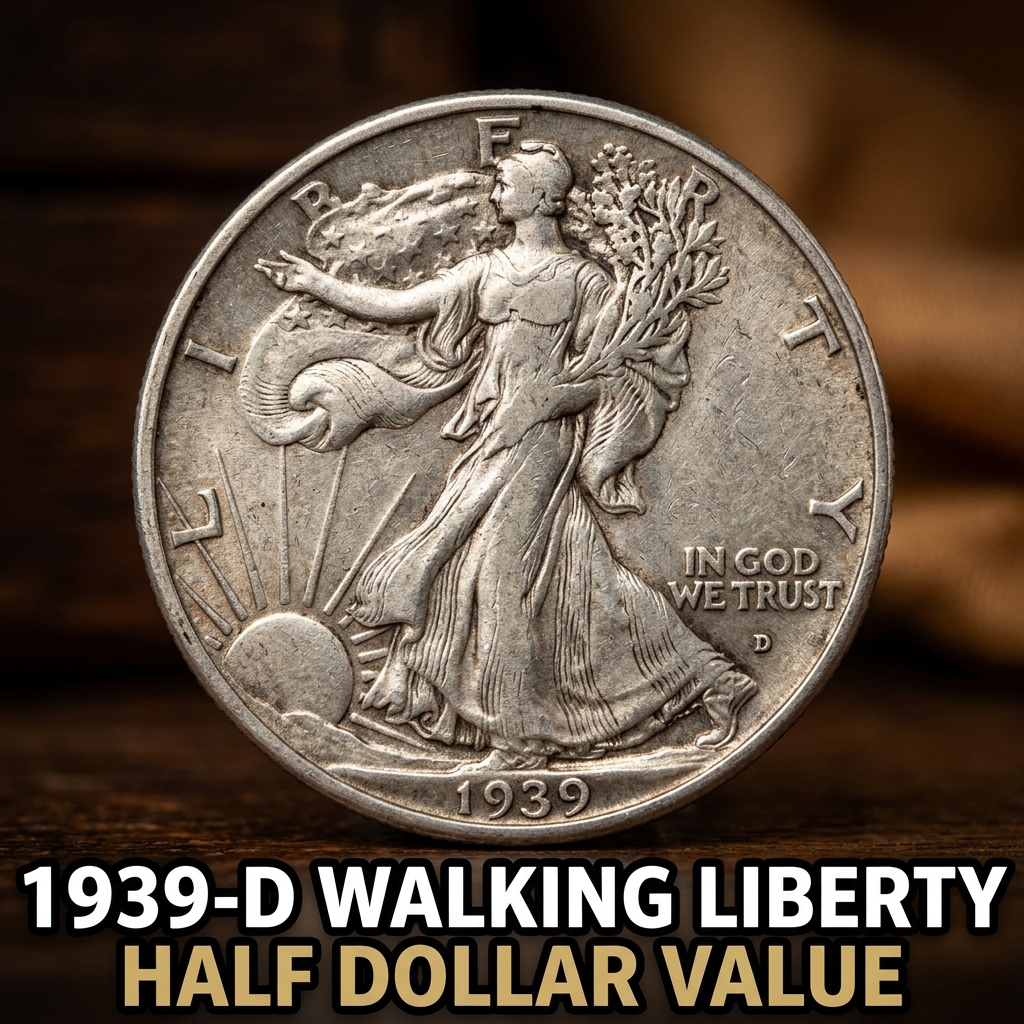
The 1939-D Walking Liberty Half Dollar is worth anywhere from $15 in heavily worn condition to well over $500 or more in high mint state grades. If you’ve found one of these beautiful silver coins tucked away in a drawer or old collection, you’re holding something that serious collectors genuinely want.
What Makes the 1939-D Walking Liberty Half Dollar Special
The Walking Liberty Half Dollar series is widely considered one of the most beautiful coin designs in American history. Designed by Adolph Weinman and first minted in 1916, the design features Lady Liberty draped in an American flag, striding confidently toward the sunrise. The reverse shows a majestic eagle perched on a mountain rock.
The “D” mint mark on the 1939-D tells you this coin was struck at the Denver Mint. That year, Denver produced 4,267,800 half dollars — a moderate mintage that makes this date moderately available in circulated grades but increasingly scarce in top mint state condition. If you’re not sure how to identify the mint mark or grade your coin, using the best coin identifier app can save you a lot of guesswork before you head to a dealer.
Each 1939-D Walking Liberty Half Dollar contains 0.3617 troy ounces of pure silver, so even a heavily worn example has real melt value as a silver coin. But the collector premium far exceeds the silver value in most grades.
1939-D Walking Liberty Half Dollar Value by Grade
Coin value depends heavily on condition, or “grade.” Here’s a straightforward breakdown of what the 1939-D is worth across common grade levels. You can also explore detailed 1939-D Walking Liberty Half Dollar price data by grade to track current market trends more closely.
| Grade | Description | Estimated Value |
|---|---|---|
| Good (G-4) | Heavy wear, major details visible | $15 – $18 |
| Very Good (VG-8) | Moderate to heavy wear | $18 – $22 |
| Fine (F-12) | Moderate wear, some detail | $22 – $30 |
| Very Fine (VF-30) | Light to moderate wear | $30 – $45 |
| Extremely Fine (EF-45) | Light wear on high points | $50 – $75 |
| About Uncirculated (AU-55) | Trace wear, nearly full luster | $80 – $120 |
| Mint State (MS-63) | Uncirculated, minor marks | $150 – $250 |
| Mint State (MS-65) | Gem uncirculated | $400 – $600+ |
How to Grade Your 1939-D Walking Liberty Half Dollar at Home
You don’t need to be a professional numismatist to get a rough sense of what you have. Start by looking at Liberty’s hand, arm, and the stripes on her gown — these are the highest points on the coin and the first places to show wear. If those details are flat and smooth, your coin is likely in Good to Fine condition. If you can still see the individual stripes and fingers clearly with light wear only on the very peaks, you’re looking at an Extremely Fine or better example.
Luster is another key factor. Mint state coins have a cartwheel-like shine that rolls across the surface when you tilt them under light. Any coin that has been used in circulation will have lost that original luster to varying degrees.
For a quick scan, CoinHix is a fantastic free tool that lets you photograph your coin and get an instant grade estimate right from your phone. It’s especially useful if you’re sorting through a large collection and want to flag the high-value pieces first.
Where to Sell Your 1939-D Walking Liberty Half Dollar
Once you know what you have, you’ll want to get a fair price. For circulated examples in Good to Very Fine grades, local coin dealers and coin shows are perfectly reasonable options — just get at least two or three offers before committing. For nicer examples in EF or AU condition, consider submitting to PCGS or NGC for professional grading before selling, as a certified coin almost always commands a stronger price.
Online platforms like eBay and Heritage Auctions are excellent for reaching a national buyer pool, especially for mint state coins. For a quick estimate of recent sale prices before listing, check the 1939 Walking Liberty Half Dollar value breakdown to see what comparable examples have actually sold for. And once again, the CoinHix app gives you real-time price comparisons so you’re never walking into a negotiation blind.
Is the 1939-D Worth Getting Professionally Graded
Professional grading by PCGS or NGC adds authentication and protects your investment, but it only makes financial sense in certain situations. The grading fee typically runs $30–$50 per coin for standard service. That means for coins worth less than $75, the cost of grading eats too deeply into your profit. However, if your 1939-D appears to be in About Uncirculated or Mint State condition, professional grading is almost always worth it. A certified MS-65 example can be worth two to three times what an ungraded coin of similar quality fetches on the open market.
Not sure if your coin crosses the threshold? Snap a photo with CoinHix and let the app give you an honest initial assessment before spending money on submission fees.
FAQ
Q: How much silver is in a 1939-D Walking Liberty Half Dollar?
A: The 1939-D Walking Liberty Half Dollar is composed of 90% silver and 10% copper, with a total silver content of 0.3617 troy ounces. At current silver prices around $27–$30 per ounce, the melt value alone is roughly $10–$11, which sets a natural floor on the coin’s worth regardless of condition.
Q: What does the “D” mint mark mean on a 1939 Walking Liberty Half Dollar?
A: The “D” stands for the Denver Mint, one of three facilities that struck Walking Liberty Half Dollars in 1939. The other two were Philadelphia (no mint mark) and San Francisco (S). You’ll find the mint mark on the obverse of the coin, on the lower left side near the date.
Q: Is a 1939-D Walking Liberty Half Dollar rare?
A: It’s not considered rare in circulated grades, but it becomes genuinely scarce in gem mint state condition. With just over 4.2 million minted, it’s more common than some earlier Walking Liberty dates but harder to find in MS-65 or above. That’s where the real collector value jumps significantly.