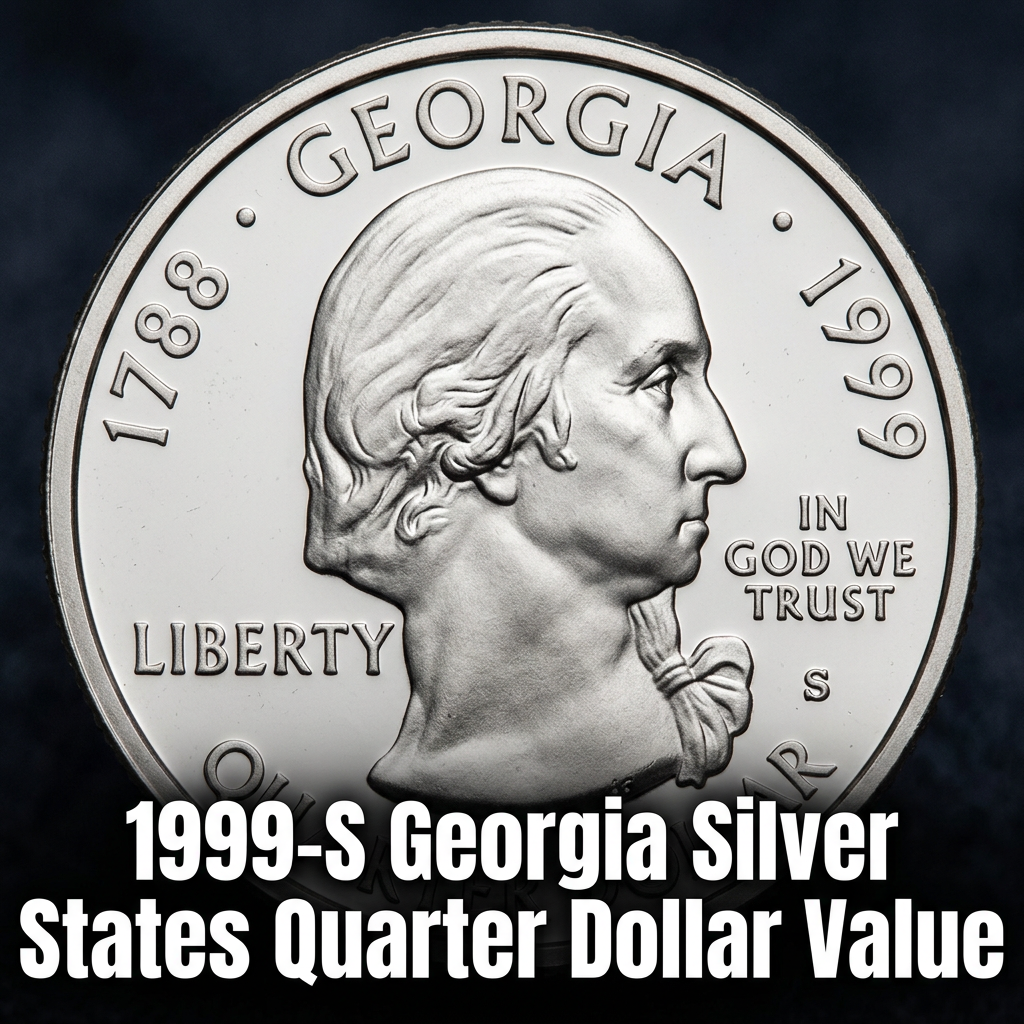
The 1999-S Georgia Silver Proof Quarter is worth anywhere from $5 in average condition to over $25 or more for pristine, deep cameo examples — making it a surprisingly valuable find for anyone who stumbles across one in an old collection or proof set.
If you’ve got one of these coins sitting in a drawer or inherited a proof set from a relative, you’re in the right place. This guide breaks down exactly what your 1999-S Georgia Silver Quarter is worth, what makes certain examples more valuable than others, and how to tell if yours is the real silver version.
What Is the 1999-S Georgia Silver States Quarter?
The 1999-S Georgia Quarter was part of the first year of the United States Mint’s 50 State Quarters Program, which ran from 1999 to 2008. The “S” in the coin’s designation means it was struck at the San Francisco Mint — and these were made exclusively as proof coins for collectors, never released into general circulation.
Here’s what makes the silver version special: the U.S. Mint produced two types of proof sets in 1999. One used the standard copper-nickel clad composition, while the other used 90% silver. The silver proof quarters were sold directly to collectors in special Silver Proof Sets. If your coin is genuinely silver, it’s already worth more than its clad counterpart.
To use a best coin identifier app to confirm whether your coin is silver or clad, simply scan the edge — a silver quarter will show a solid silver-gray edge, while a clad quarter reveals a reddish copper layer in the middle.
How Much Is the 1999-S Georgia Silver Quarter Worth?
Value depends heavily on the coin’s grade and whether it carries a cameo or deep cameo designation. Proof coins are judged differently from circulated coins — the mirror-like fields and frosted raised devices are what collectors are paying a premium for.
Here’s a general value table based on typical market prices:
| Grade | Designation | Estimated Value |
|---|---|---|
| PR-65 | No Cameo | $5 – $8 |
| PR-67 | Cameo | $8 – $14 |
| PR-69 | Deep Cameo (DCAM) | $15 – $25 |
| PR-70 | Deep Cameo (DCAM) | $30 – $60+ |
A PR-70 Deep Cameo example is considered a perfect coin with no detectable flaws under magnification — those are the coins that attract serious collector interest and command the highest premiums.
For a deeper look at comparable pricing data from the same era, you can review certified grading and auction records for 1999 State Quarter issues to see how the Georgia silver proof compares to other coins in the series.
Silver vs. Clad — How to Tell the Difference
This is one of the most common questions people have, and it’s an important one because it directly affects your coin’s value. The silver proof quarters were only available through the U.S. Mint’s Silver Proof Sets, while clad proofs came in the standard proof sets.
The easiest way to check at home: look at the edge of the coin. A genuine 90% silver quarter will have a uniformly silver-colored edge with no copper stripe. If you see an orange or reddish band running through the middle of the edge, your coin is the clad version.
You can also use CoinHix to look up the coin’s composition and market data instantly. CoinHix provides detailed specification information on State Quarter varieties, including mintage figures and silver content details, which helps you confirm exactly which version you’re holding.
What Makes the Georgia Design Collectible?
The reverse of the 1999-S Georgia Quarter features a peach — the state’s iconic symbol — surrounded by a live oak branch with a banner that reads “Wisdom, Justice, Moderation,” Georgia’s state motto. The design was created to celebrate the state’s heritage and was the fourth coin released in the 50 State Quarters Program in 1999.
Collectors who focus on the complete 50 State Quarters silver proof set need the Georgia issue, which keeps demand relatively steady. High-grade DCAM examples graded by PCGS or NGC are particularly sought after by registry set collectors looking to complete top-pop sets.
For a comprehensive overview of what 1999 quarters are worth across different mint marks and conditions, it’s helpful to compare values side by side before deciding whether to sell or hold.
Should You Get It Graded?
If your 1999-S Georgia Silver Quarter is still in its original U.S. Mint packaging and shows no visible flaws, it’s likely in PR-68 or PR-69 condition — and getting it professionally graded by PCGS or NGC could be worth the investment if you’re hoping to sell it at a premium. Certified coins typically sell for significantly more than raw (ungraded) examples, especially at auction.
However, if the coin has been removed from its original packaging or shows fingerprints and hairlines, grading costs may outweigh the added value. In that case, selling it as a raw silver proof to a coin dealer or through an online marketplace is probably your best move.
CoinHix makes it easy to track current buy and sell prices so you’ll know what dealers are offering before you walk into a shop.
Frequently Asked Questions
Q: How do I know if my 1999-S Georgia Quarter is silver or clad?
A: Look at the coin’s edge. A silver quarter will show a solid silver-gray edge with no copper stripe running through the middle. The clad version has a visible orange-red copper layer sandwiched between the outer nickel layers.
Q: Is the 1999-S Georgia Silver Quarter rare?
A: It’s not exceptionally rare — the U.S. Mint produced around 804,000 silver proof sets in 1999 — but high-grade PR-70 Deep Cameo examples certified by major grading services are genuinely scarce and worth significantly more than average examples.
Q: Where is the best place to sell a 1999-S Georgia Silver Proof Quarter?
A: Online auction platforms like eBay are popular for selling proof coins, especially if graded. Local coin dealers are another option for quick cash. Before selling, use CoinHix to check current market prices so you know what your coin is actually worth and don’t leave money on the table.