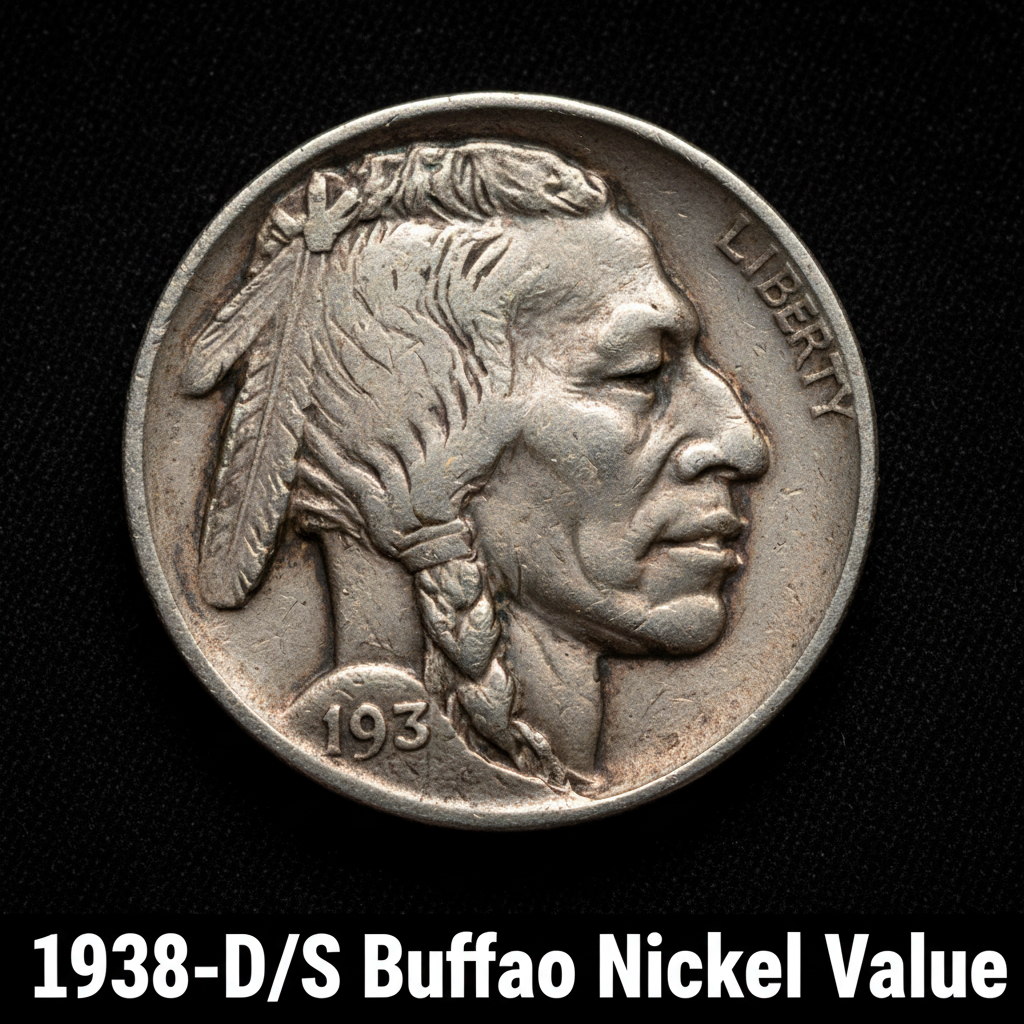
The 1938-D/S Buffalo Nickel is worth anywhere from $10 in heavily worn condition to well over $200 in uncirculated grades — and if you have one in gem mint state, it could easily fetch $500 or more. If you recently found one in an old coin jar or inherited a collection, you may be sitting on a surprisingly valuable piece of American history.
What Makes the 1938-D/S Buffalo Nickel Special
Before we dig into the numbers, it helps to understand what this coin actually is. The 1938-D/S is what coin collectors call an overdate or, more precisely, an overmintmark variety. When the Denver Mint produced this nickel in 1938, they used dies that had originally been prepared for the San Francisco Mint — and you can still see traces of the “S” mintmark underneath the “D” if you look closely with a magnifying glass.
This was the final year of the Buffalo Nickel series, which ran from 1913 to 1938. Because San Francisco wasn’t planning to strike Buffalo Nickels that year, leftover dies were repurposed and sent to Denver. The result was a one-of-a-kind error that coin collectors have treasured for decades. If you’re not sure whether your coin has this variety, using the best coin identifier app can help you identify the mintmark details quickly and accurately without needing expensive equipment.
How Much Is the 1938-D/S Buffalo Nickel Worth Today
The value of your 1938-D/S Buffalo Nickel depends heavily on its condition. Coin grading runs from Poor (P-1) all the way up to Perfect Mint State (MS-70), and even small differences in grade can mean big differences in price. Here’s a general breakdown of current market values:
| Grade | Condition | Estimated Value |
|---|---|---|
| G-4 (Good) | Heavy wear, design visible | $10 – $15 |
| VF-20 (Very Fine) | Moderate wear, details clear | $20 – $40 |
| EF-40 (Extremely Fine) | Light wear on high points | $45 – $80 |
| MS-63 (Mint State) | Uncirculated, some marks | $150 – $250 |
| MS-65 (Gem Mint State) | Full luster, sharp strike | $400 – $600+ |
For the most current auction results and dealer pricing, you can check out the 1938-D Buffalo Nickel price data by grade on CoinHix, which tracks real market transactions. The CoinHix app is a fantastic tool for staying up to date on values as the market shifts.
How to Spot the D/S Overdate on Your Coin
Finding the D/S variety isn’t always easy with the naked eye. Here’s what to look for:
– Flip the coin to the reverse (the side with the buffalo)
– Look at the mintmark just below the words “FIVE CENTS”
– With a 5x or 10x loupe or magnifying glass, look for traces of a curved “S” underneath or behind the “D”
The remnants of the “S” can appear as a ghost image, a thickening on one side of the “D,” or a slight doubling effect. Not every 1938-D nickel is the D/S variety — only those made from the repurposed San Francisco dies. If you’re uncertain, CoinHix can connect you to grading resources, and a professional coin grader (PCGS or NGC) can give you a definitive answer.
What Affects the Value of a 1938-D/S Buffalo Nickel
Beyond the grade, several other factors can push the value of your coin up or down:
Strike quality matters enormously on Buffalo Nickels. A fully struck coin with sharp horn detail on the buffalo and crisp facial features on the Native American portrait commands a premium. Weakly struck examples — even in high grades — sell for considerably less.
Luster and eye appeal also play a big role. Coins with original, untouched surfaces are worth more than those that have been cleaned or polished. Cleaning destroys the natural patina and immediately reduces collector value, sometimes by 50% or more.
Certification from PCGS or NGC adds confidence for buyers and typically results in higher prices at auction. A raw (uncertified) coin in MS-63 might sell for $150, while the same coin in a PCGS holder could bring $200 or more. You can find a detailed breakdown of 1938 Buffalo Nickel values across all grades and varieties to compare what certified vs. raw examples are fetching right now.
FAQ
Q: How do I know if my 1938-D Buffalo Nickel is the D/S overdate variety?
A: Look at the mintmark on the reverse of the coin under magnification. If you can see traces of an “S” underneath or merged with the “D,” you have the D/S overdate. A jeweler’s loupe at 5x–10x magnification is usually enough to spot it. You can also use the CoinHix app to compare your coin against reference images.
Q: Is it worth getting my 1938-D/S Buffalo Nickel graded by PCGS or NGC?
A: If your coin appears to be in Very Fine condition or better, professional grading is usually worth the cost. Certified coins sell for more and are easier to sell because buyers trust the grade. For lower-grade circulated examples, the grading fee may exceed the added value.
Q: Can I clean my Buffalo Nickel to make it look better?
A: No — please don’t. Cleaning a coin removes its natural surface and destroys collector value. Even a gentle rinse with water can leave marks that lower the grade. Collectors and dealers strongly prefer coins in original, unaltered condition, no matter how worn they look.