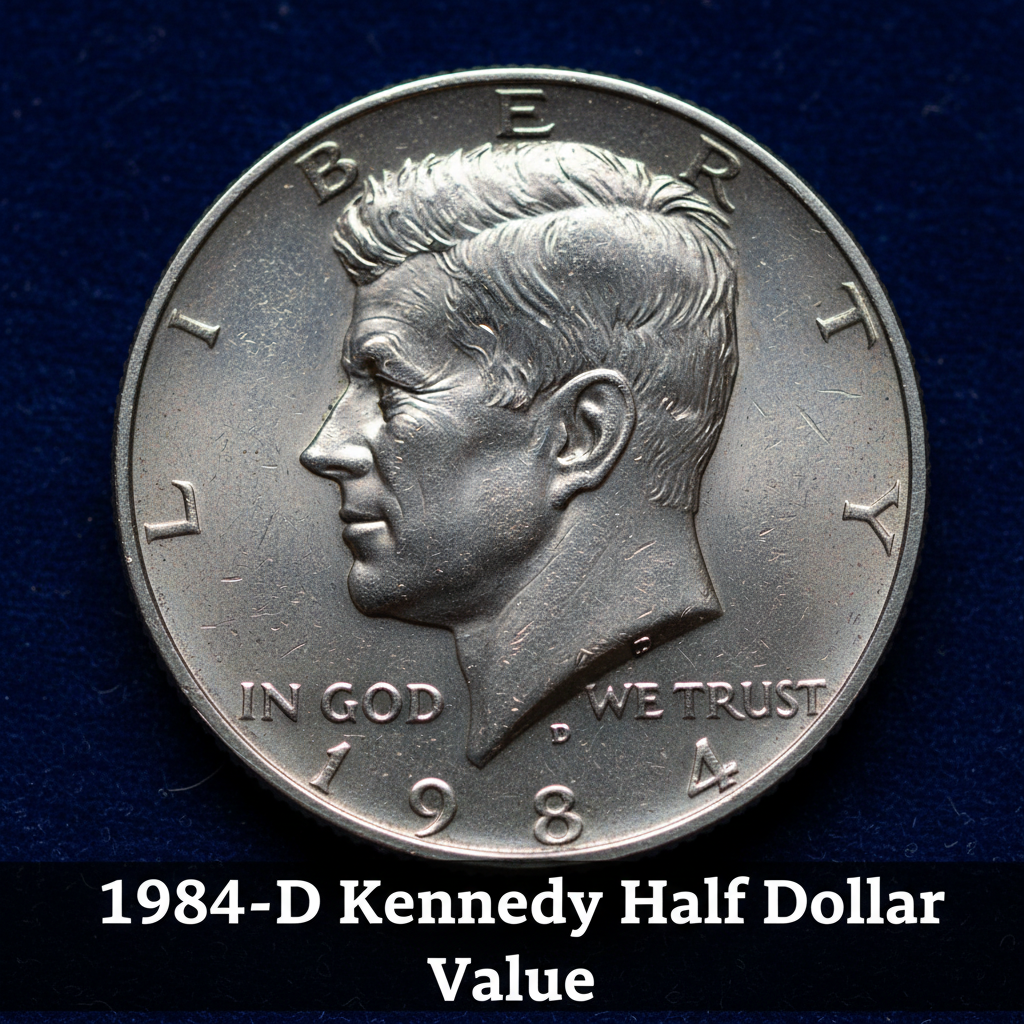
The 1984-D Kennedy Half Dollar is worth anywhere from face value (50 cents) in heavily circulated condition to around $10 or more in mint state grades, with top-certified examples occasionally reaching $30 or higher. If you found one in a drawer or old coin jar, you’re in the right place to find out exactly what it’s worth.
If you’re not sure what coin you’re holding, a quick scan with the best coin identifier app can help you identify it instantly before you dig into the value details below.
Background on the 1984-D Kennedy Half Dollar
The Kennedy Half Dollar has been a staple of American coinage since 1964, introduced as a tribute to President John F. Kennedy following his assassination in November 1963. By 1984, the series was well into its clad era — meaning the coin is composed of an outer layer of copper-nickel bonded to a copper core, not silver. The “D” mint mark tells you this particular coin was struck at the Denver Mint. In 1984, the Denver facility produced approximately 26,029,000 Kennedy Half Dollars, making it a relatively common coin in circulated grades. Don’t let that discourage you, though — condition is everything in coin collecting, and an uncirculated example can still fetch a decent premium over face value. If you’re curious about how this coin compares to others in the Kennedy series, exploring detailed 1984 Kennedy Half Dollar value information can give you a clearer picture of where your coin stands.
How Much Is the 1984-D Kennedy Half Dollar Worth?
The short answer: most 1984-D Kennedy Half Dollars you’ll find in pocket change or old coin collections are worth face value to maybe a dollar or two. The real value comes when a coin is in mint state (MS) condition — meaning it was never circulated and shows no signs of wear. Here’s a general value breakdown based on coin grade:
| Grade | Description | Estimated Value |
|---|---|---|
| Good (G-4) | Heavy wear, design visible | $0.50 (face value) |
| Fine (F-12) | Moderate wear | $0.50–$1 |
| Extremely Fine (EF-40) | Light wear on high points | $1–$2 |
| Mint State (MS-63) | Uncirculated, minor marks | $4–$8 |
| Mint State (MS-65) | Gem uncirculated | $10–$20 |
| Mint State (MS-67) | Superb gem, top grade | $30–$100+ |
For the most up-to-date auction results and certified coin sales, you can check current Kennedy Half Dollar MS grade price data to see what collectors are actually paying today.
What Affects the Value of Your 1984-D Half Dollar
Beyond the grade, a few other factors can push the value of a 1984-D Kennedy Half Dollar up or down. First is eye appeal — even within the same grade, coins with bright, original luster and no distracting spots or toning tend to sell for more. Coins that have been cleaned (polished or wiped with a cloth) are significantly less desirable to collectors and will sell for much less than an original-surface coin. Second is certification. Having your coin graded and encapsulated by a third-party grading service like PCGS or NGC adds credibility and often increases what buyers are willing to pay. Finally, errors matter. While major mint errors on 1984-D halves are uncommon, die cracks, off-center strikes, or doubling on design elements can make an otherwise ordinary coin worth multiples of its standard value. Use CoinHix to quickly check whether your coin might fall into an error category — the app covers thousands of known varieties across U.S. coinage.
Should You Hold Onto or Sell Your 1984-D Kennedy Half Dollar
For most people, a circulated 1984-D Kennedy Half Dollar isn’t going to fund a vacation. But if you happen to have a roll of uncirculated coins from 1984, or a gem-quality specimen that’s been safely stored for decades, you could be sitting on something worth submitting for grading. The key is knowing what you have before you spend it or sell it for a dollar at a garage sale. Apps like CoinHix make it easy to photograph your coin, identify the mint mark and year, and get an instant estimated value — all from your phone. It’s a practical tool whether you’re a first-time finder or a seasoned collector building a Kennedy set.
Tips for Finding the Value of Other Coins in Your Collection
If you’ve got more coins beyond your 1984-D half dollar, it’s worth doing a quick inventory. Kennedy Half Dollars from the 1960s (especially 1964 silver and 1965–1969 40% silver issues) are worth considerably more than their face value due to metal content alone. Older halves — Barber, Walking Liberty, and Franklin types — can be worth anywhere from a few dollars to several hundred depending on condition and date. The fastest way to sort through a mixed collection is to use a dedicated coin tool. CoinHix lets you scan and catalog multiple coins quickly, giving you a running total of your collection’s estimated value without requiring any coin expertise.
Frequently Asked Questions
Q: Is the 1984-D Kennedy Half Dollar made of silver?
A: No. The 1984-D Kennedy Half Dollar is made of a clad composition — 75% copper and 25% nickel on the outer layers, with a pure copper core. Silver Kennedy Half Dollars were only produced in 1964 (90% silver) and 1965–1969 (40% silver). The 1984-D has no silver content and carries no precious metal premium.
Q: How do I tell if my 1984-D half dollar is uncirculated?
A: Look at the high points of the design — Kennedy’s cheekbone, hair, and the eagle’s breast feathers on the reverse. If these areas show no flat, dull wear and the coin still has its original mint luster (a slight cartwheel shine when you tilt it under light), it’s likely uncirculated. For a more definitive answer, consider submitting it to a grading service or running it through a coin identification tool like CoinHix for a quick assessment.
Q: Where can I sell my 1984-D Kennedy Half Dollar?
A: Options include eBay (great for reaching collectors directly), local coin shops, coin shows, and online marketplaces like APMEX or Great Collections. For circulated examples, a coin dealer will likely offer face value or close to it. For higher-grade coins, online auction platforms often yield the best return, especially if the coin is already certified by PCGS or NGC.