The 2004-S Michigan State Quarter is worth anywhere from $1.50 in circulated condition to over $15 or more for top-grade proof specimens. If you’ve found one of these coins in your change jar or inherited a collection, you’re in the right place to find out exactly what it’s worth.
Whether you’re a casual finder or a budding collector, tools like the best coin identifier app can help you quickly identify and evaluate coins like this Michigan quarter before you decide to sell or hold onto them.
What Is the 2004-S Michigan State Quarter?
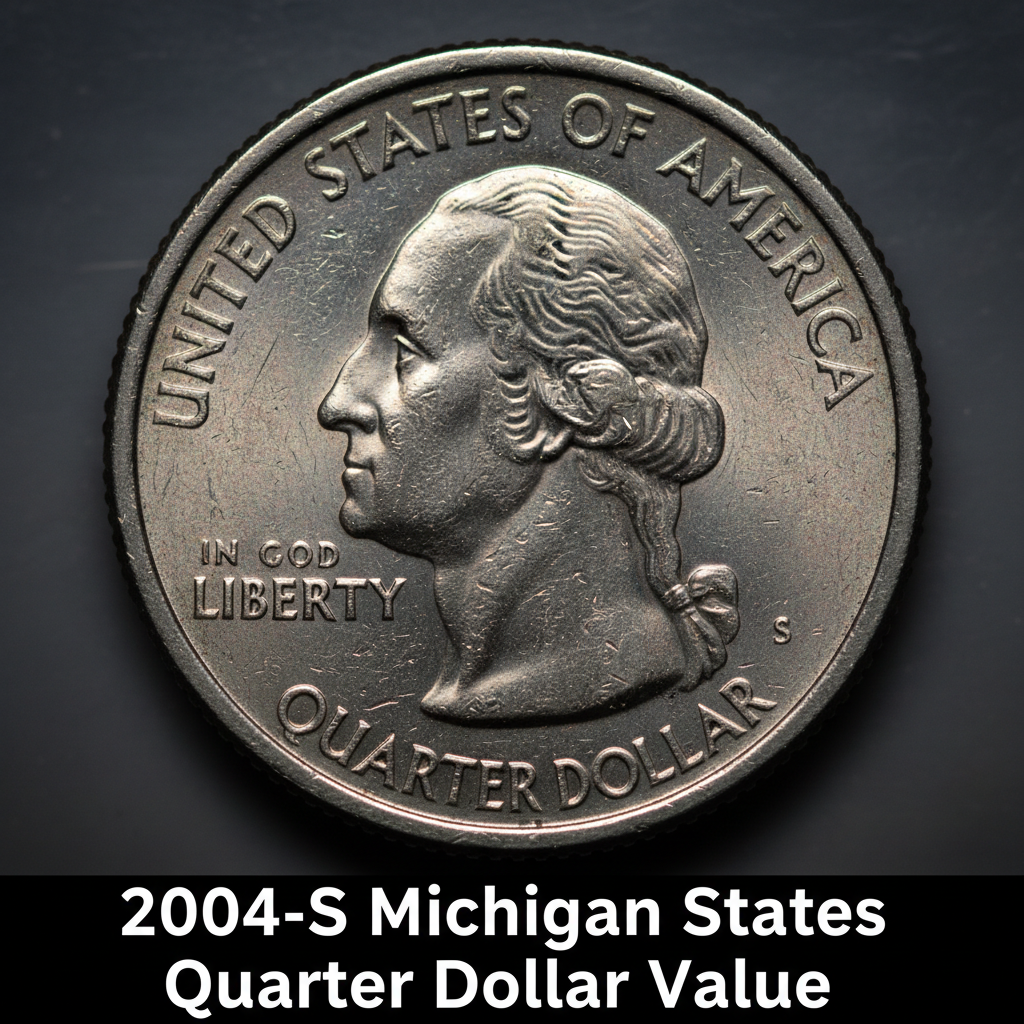
The 2004-S Michigan State Quarter is part of the United States Mint’s 50 State Quarters Program, which ran from 1999 to 2008. The “S” mint mark tells you this coin was struck at the San Francisco Mint, and it was produced specifically as a proof coin for collectors — not intended for everyday circulation. The reverse design features a stunning outline of the state of Michigan along with the Great Lakes, which surround the state on multiple sides. The coin carries the inscription “Great Lakes State” and the year 2004. Because these were made as proof coins, they tend to have sharp, mirror-like fields and frosted devices, making them visually striking. The obverse shows the classic portrait of George Washington. While these coins weren’t meant to circulate, some do end up in general collections or even loose change boxes, which is why knowing the value matters.
2004-S Michigan Quarter Values by Grade and Type
The value of a 2004-S Michigan State Quarter depends heavily on its grade, the type of proof finish, and whether it has been certified by a grading service like PCGS or NGC. Here’s a general breakdown:
| Grade / Type | Estimated Value |
|---|---|
| Proof (PR65) | $3 – $5 |
| Proof (PR67) | $6 – $10 |
| Proof (PR69 Deep Cameo) | $10 – $15 |
| PR70 Deep Cameo (PCGS/NGC) | $30 – $60+ |
| Silver Proof (PR69 DCAM) | $15 – $25 |
For the most accurate and up-to-date pricing, you can browse recent 2004 Michigan State Quarter auction results and market prices to see how this coin is performing in today’s collector market.
Silver vs. Clad Proof — Does It Make a Difference?
Yes, absolutely. The U.S. Mint offered two versions of the 2004-S proof quarters: the standard clad proof and the silver proof. The clad version is made of copper-nickel, while the silver proof contains 90% silver. The silver proof is naturally more valuable due to its precious metal content and its appeal to both coin collectors and silver stackers. Even at lower grades, the silver proof tends to fetch more on the market. In 2004, silver proof sets were sold separately from the standard proof sets at a premium. If you’re unsure which version you have, look at the edge of the coin — a silver coin will have a solid silver-gray edge, while a clad coin will show the copper-colored core sandwiched between outer layers. Using CoinHix can also help you narrow down what version you’re looking at and what collectors are currently paying for it.
Errors and Varieties That Can Boost Value
While the 2004-S Michigan State Quarter was a proof issue with generally high production quality, errors do occasionally occur. The most interesting variety associated with the 2004 Michigan quarter is the “Extra Leaf” error found on some Wisconsin quarters from the same year — though that’s a different state issue. For Michigan, keep an eye out for doubled die obverse or reverse, off-center strikes, or planchet errors. These can significantly increase the value of an otherwise common proof coin. A standard proof might be worth $5, but an error coin could easily fetch $50 to $100 or more depending on the severity and eye appeal. If you want to check whether your coin matches any known error varieties, the full 2004 quarter value breakdown including error coins and silver proofs is a great resource to bookmark.
How to Get the Best Price for Your 2004-S Michigan Quarter
If you’re thinking about selling your 2004-S Michigan State Quarter, there are a few smart steps to take. First, assess the condition — is the coin in its original proof packaging, or has it been handled? Coins still in their original U.S. Mint packaging tend to command better prices. Second, consider getting high-grade specimens certified by PCGS or NGC, as a certified PR70 DCAM will sell for much more than an uncertified coin of the same grade. Third, use platforms like eBay, Heritage Auctions, or APMEX to compare recent sales. And if you want an instant value estimate before listing, CoinHix gives you real-time price data for state quarters including the 2004-S Michigan issue — it’s a handy tool to have in your collector’s toolkit. For broader research, CoinHix also lets you track price trends over time so you can time your sale strategically.
FAQ
Q: Is the 2004-S Michigan State Quarter rare?
A: It’s not considered rare in the traditional sense — the San Francisco Mint produced millions of these proof coins. However, top-grade examples certified PR70 Deep Cameo are much harder to find and can command significant premiums among collectors.
Q: How do I tell if my 2004-S Michigan quarter is silver or clad?
A: Look at the edge of the coin. A silver proof will have a uniform silver-gray edge, while a clad proof will show a copper-colored stripe running through the middle of the edge. You can also weigh it — a silver quarter weighs approximately 6.25 grams, compared to 5.67 grams for the clad version.
Q: Where is the best place to sell a 2004-S Michigan State Quarter?
A: For certified high-grade coins, Heritage Auctions or Stack’s Bowers are excellent options. For raw or lower-grade coins, eBay is a solid choice with a large buyer base. Always check recent sold listings to price your coin competitively before listing.