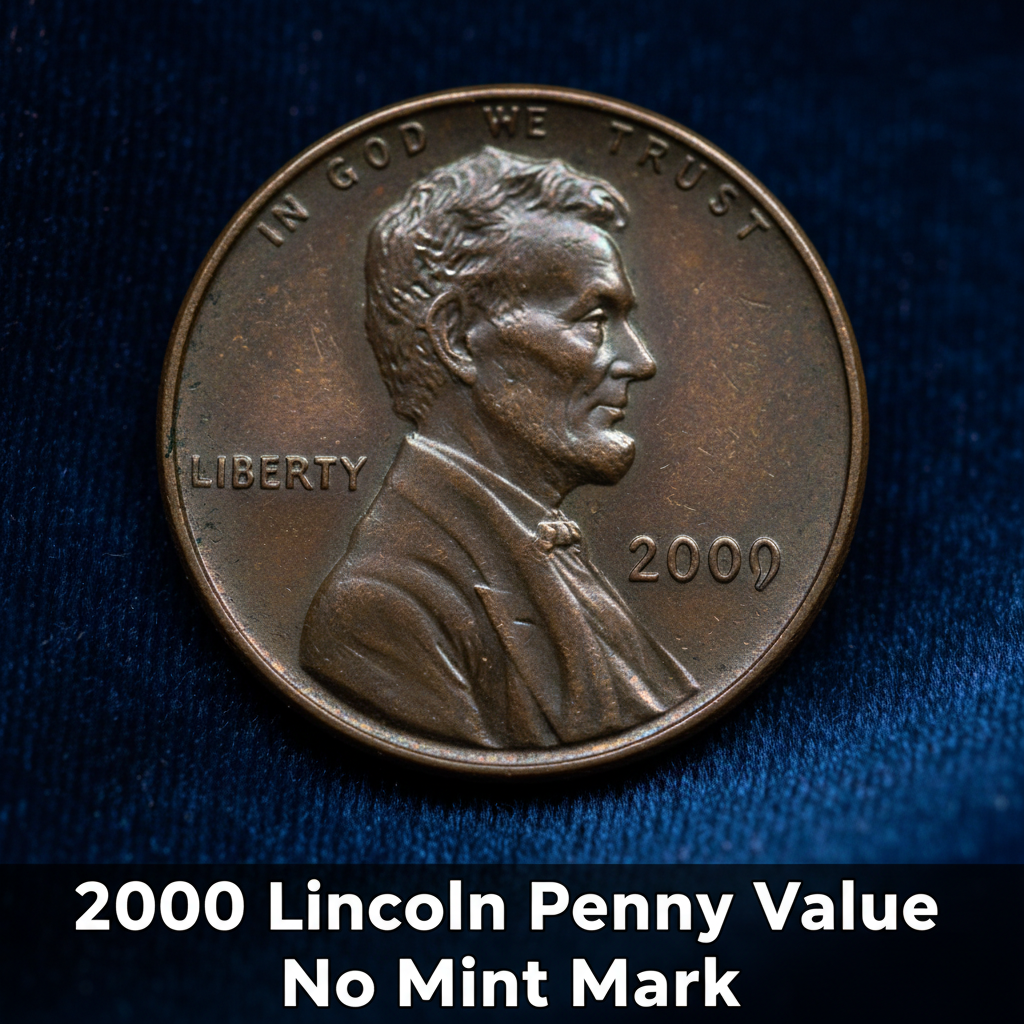
The 2000 Lincoln Penny with no mint mark is worth anywhere from face value in heavily worn condition to around $10 or more in perfect uncirculated grades. Most examples you find in pocket change are worth only a cent, but high-grade specimens can surprise you.
If you recently came across one of these coins and want to know exactly what you’re holding, you’re in the right place. Millions of 2000 Lincoln cents were struck at the Philadelphia Mint — which is why they carry no mint mark at all — making them common but still worth understanding. Using the best coin identifier app on your phone is one of the easiest ways to get a quick read on what your coin might be worth before you dig deeper.
—
What Is the 2000 Lincoln Penny With No Mint Mark?
The 2000 Lincoln cent with no mint mark was produced at the Philadelphia Mint in Pennsylvania. Philadelphia has historically not placed a mint mark on Lincoln cents (with a few exceptions in earlier years), so the absence of a letter beneath the date is completely normal and expected for coins made there.
In the year 2000, the Philadelphia Mint struck over 14.3 billion Lincoln cents — yes, billion with a “B.” That staggering number means these coins are extremely common in any grade below Mint State 65. Because so many were made, the vast majority are worth only their face value of one cent when found in circulated condition. However, collectors still seek out pristine, uncirculated examples with sharp details and bright red luster, and those can carry a small but real premium.
The coin features the classic obverse design by Victor David Brenner, showing Abraham Lincoln’s portrait with the date 2000 on the left and the motto “IN GOD WE TRUST” above. The reverse shows the Lincoln Memorial with “E PLURIBUS UNUM” and “ONE CENT” inscribed. This design was used from 1959 through 2008, making the 2000 issue part of a long, beloved series.
—
How Much Is the 2000 No Mint Mark Penny Worth?
Value depends almost entirely on condition. Circulated coins — the ones you find in your change — are generally worth face value. Uncirculated coins in lower Mint State grades (MS60 to MS64) may fetch anywhere from $0.10 to $1.00. The real value jumps in the highest grades.
Here is a simple value breakdown based on condition:
| Grade | Condition | Estimated Value |
|---|---|---|
| Good (G-4) | Heavily worn | $0.01 |
| Fine (F-12) | Moderate wear | $0.01 |
| Extremely Fine (EF-40) | Light wear | $0.05 – $0.15 |
| MS-63 (Red) | Uncirculated | $0.50 – $1.00 |
| MS-65 (Red) | Gem Uncirculated | $3.00 – $6.00 |
| MS-67 (Red) | Superb Gem | $10.00 – $30.00+ |
For a more detailed look at graded auction results and certified coin prices, check out the 2000 Lincoln Penny MS Red price data on CoinHix — it pulls from real market sales and gives you an accurate picture of what collectors are actually paying.
—
Are There Any Valuable Errors on the 2000 Lincoln Penny?
This is where things get interesting. Even though a standard 2000 Philadelphia cent is common, error coins can be worth real money. Some errors to look for include:
– Doubled Die Obverse (DDO): Look for doubling on Lincoln’s eye, the date, or the lettering. A significant doubled die can add $20 to $100 or more to the coin’s value.
– Off-Center Strikes: If Lincoln’s image is noticeably off-center (especially 20% or more), these sell for $10 to $50 depending on how dramatic the shift is.
– Broadstruck Coins: A coin struck without the retaining collar will be wider than normal and is worth a small premium.
– Die Caps and Brockages: These are rarer and can be worth hundreds of dollars to the right collector.
If you think you’ve spotted an error, CoinHix is a fantastic tool to reference error coin values quickly. The app gives you a solid baseline so you’re not going in blind when listing a coin online or taking it to a dealer.
—
How to Grade Your 2000 Penny at Home
Grading a coin sounds technical, but you can get a rough idea at home with just a loupe or magnifying glass. Start by looking at Lincoln’s cheekbone, jaw, and the high points of his hair. On a circulated coin, these areas show flat, dull wear. On an uncirculated coin, you’ll see full original luster — that bright, slightly shiny surface with “cartwheel” effect when tilted under light.
For Lincoln cents, color also matters to graders:
– Red (RD): 95% or more original red surface — the most valuable
– Red-Brown (RB): Mix of red and brown toning
– Brown (BN): Mostly brown, the least valuable in high grades
The 2000 penny is a copper-plated zinc coin, so it can tone quickly. Finding a fully red example in MS-65 or higher is genuinely harder than it sounds, which is why those grades carry a premium.
For a full breakdown of 2000 penny values across all mint marks and varieties, the 2000 penny value guide at CoinValueApp is a helpful resource that covers everything from circulated grades to top-pop specimens.
—
FAQ
Q: Is the 2000 Lincoln penny with no mint mark rare?
A: No, it is one of the most common coins in modern U.S. history. Over 14 billion were minted in Philadelphia alone. In circulated grades, it is worth face value. Rarity only comes into play with high-grade certified examples or confirmed error coins.
Q: What does “no mint mark” mean on a 2000 penny?
A: It means the coin was made at the Philadelphia Mint. Philadelphia traditionally does not add a “P” mint mark to Lincoln cents (though the Denver Mint uses “D”). Finding a 2000 penny with no letter under the date is completely normal, not unusual.
Q: How can I find out if my 2000 penny is worth more than face value?
A: Start by checking the coin for errors like doubling, off-center strikes, or unusual die marks. Then assess the condition — look for original red luster and sharp details. You can also scan your coin with CoinHix, which uses image recognition to help identify variety and give estimated values based on real market data. It’s a fast, beginner-friendly way to get started.