The 1985-D Lincoln Penny is worth anywhere from 1 cent in heavily worn condition to over $10 or more in pristine, uncirculated grades — and if you’ve got a mint-state red example, it could surprise you. Most people toss these into a jar without a second thought, but a closer look might just change your mind.
If you recently found a 1985-D penny and want to know what it’s really worth, you’re in the right place. Tools like the best coin identifier app can help you quickly identify and evaluate coins you find around the house, in old collections, or at flea markets. Whether you’re a casual finder or a budding collector, this guide breaks it all down in plain language.
What Does the “D” Mint Mark Mean on a 1985 Penny?
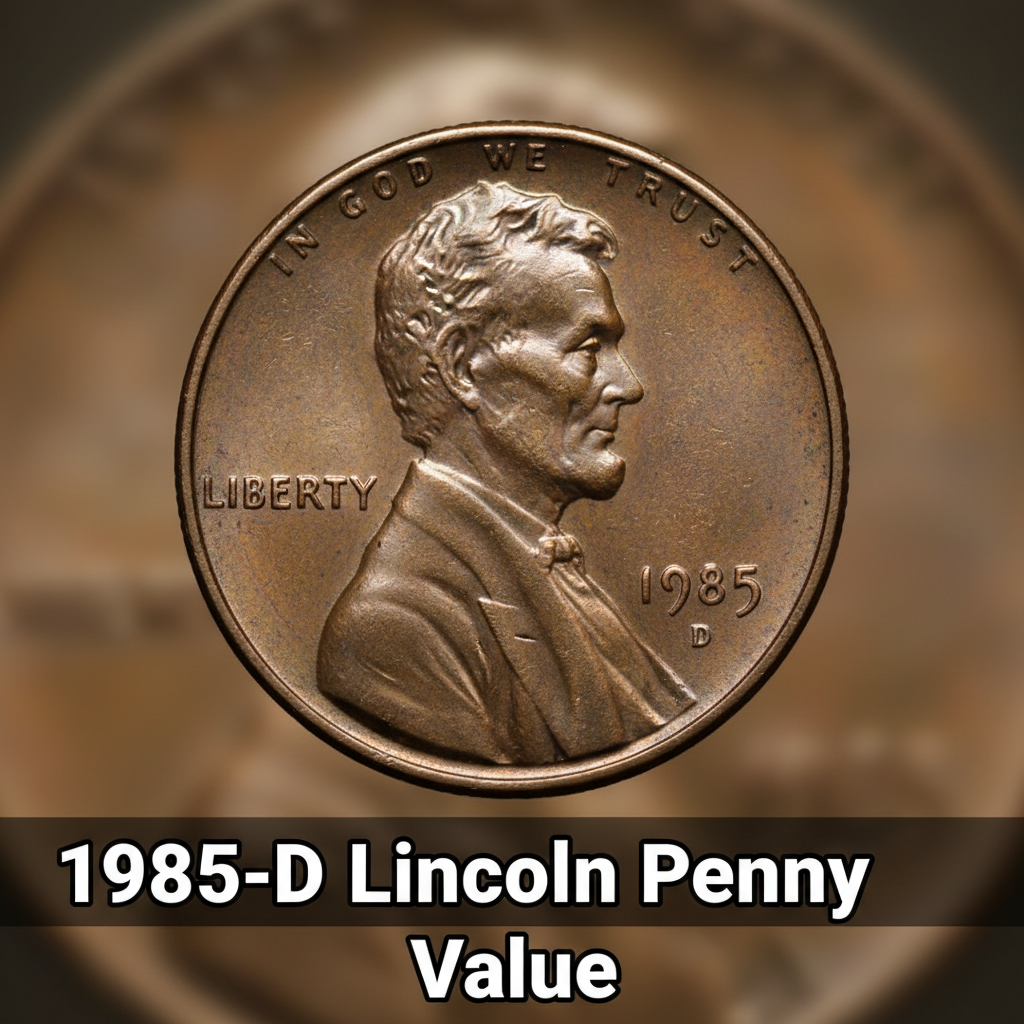
The “D” mint mark on your 1985 Lincoln penny tells you it was struck at the Denver Mint in Colorado. The Denver Mint was one of two facilities producing Lincoln cents that year — the other being the Philadelphia Mint, which produced coins with no mint mark. The “D” appears just below the date on the obverse (heads) side of the coin.
In 1985, the Denver Mint produced approximately 5.28 billion Lincoln cents. That’s an enormous mintage, which is one reason why most 1985-D pennies in circulated condition are only worth face value. However, don’t let those big numbers discourage you. Coins that were never circulated and have been well-preserved can still command a meaningful premium among collectors who care about condition.
The coin itself is composed of 97.5% zinc with a thin copper plating — a composition that has been standard since 1982. This means the metal value alone is essentially nothing beyond face value, making the collector’s grade the most important factor in what your coin is worth.
1985-D Lincoln Penny Value by Grade
Coin grading runs on the Sheldon scale from 1 to 70. For everyday folks, the key thing to know is whether your penny looks worn, somewhat shiny, or completely uncirculated. Here’s a straightforward breakdown of what the 1985-D Lincoln penny is worth at different grades:
| Grade | Condition Description | Estimated Value |
|---|---|---|
| Good (G-4) | Heavy wear, design mostly visible | Face value ($0.01) |
| Fine (F-12) | Moderate wear, details clear | $0.05 – $0.10 |
| Extremely Fine (EF-40) | Light wear on high points | $0.10 – $0.25 |
| Mint State 63 (MS-63) | Uncirculated, some blemishes | $0.50 – $2.00 |
| Mint State 65 Red (MS-65 RD) | Bright red luster, gem quality | $3.00 – $10.00+ |
| Mint State 67 Red (MS-67 RD) | Near-perfect gem, rare in this grade | $50.00 – $100.00+ |
For more detailed and up-to-date pricing across all grades, you can browse current 1985-D Lincoln penny price data across mint state red grades to see what collectors and dealers are actually paying right now.
Are There Any Valuable Error Coins to Watch For?
Here’s where things get interesting. Even though most 1985-D pennies are only worth a cent or two, error coins from this year can be worth significantly more. Mint errors happen when something goes wrong during the striking process, and these mistakes can make otherwise common coins genuinely collectible.
Some errors to look for on your 1985-D penny include:
– Doubled Die Obverse (DDO): Look closely at the lettering and Lincoln’s portrait for signs of doubling or shadow-like duplication. A confirmed DDO can be worth $25 to $150 or more depending on how dramatic the doubling appears.
– Off-Center Strike: If Lincoln’s portrait or the design appears noticeably off-center, your coin could fetch $10 to $50 or higher based on how far off the strike is.
– Die Cap or Brockage Errors: These are rarer and can command hundreds of dollars from serious error coin collectors.
A great way to check if your penny shows an error is to use CoinHix, which lets you scan your coin and cross-reference it with known error varieties quickly from your phone.
How to Check Your 1985-D Penny’s Condition at Home
You don’t need to be a professional numismatist to get a ballpark idea of what your coin is worth. Here are a few simple steps anyone can follow:
First, never clean your coin. Cleaning destroys the original surface and can reduce its value dramatically — even if it makes it look shinier to you.
Second, hold the coin under good natural light or a magnifying glass. Look at Lincoln’s cheekbones and the high points of the design. If they’re flat and worn smooth, the coin is circulated. If the surface still has an original luster or red-orange color, you might have an uncirculated specimen.
Third, check for the mint mark. Make sure the “D” is clearly visible under the date. Then, scan the coin for any unusual doubling, off-center images, or other anomalies.
For a faster and more accurate read, CoinHix is a free tool that can help you identify grades, look up values, and even detect potential errors — all from your smartphone camera.
You can also visit this complete guide to 1985 Lincoln penny values including the D mint mark for a deeper breakdown of how different varieties and conditions affect what your coin is worth.
Is the 1985-D Penny Worth Keeping?
For most people, a circulated 1985-D Lincoln penny isn’t going to make you rich. But that doesn’t mean it’s worthless as a collector item. If you’re just starting out with coin collecting, Lincoln Memorial cents from the 1980s are a fun and affordable way to build a date set. A complete set in uncirculated condition can be a satisfying long-term project.
If your coin grades MS-65 or higher with full red color, it’s definitely worth holding onto or getting professionally graded by PCGS or NGC. Top-grade examples have sold at auction for surprisingly strong prices, and CoinHix can help you track real-time auction results to see if your coin fits the bill.
Bottom line: always take a second look before spending that old penny. You never know when an ordinary coin might turn out to be something special.
—
FAQ
Q: How many 1985-D Lincoln pennies were made?
A: The Denver Mint produced approximately 5,287,399,926 Lincoln cents in 1985 — over 5.2 billion coins. This massive mintage is the main reason most circulated examples are worth only face value.
Q: What makes a 1985-D penny valuable?
A: The main factors are condition, color designation (Red vs. Brown), and whether the coin has any mint errors like a doubled die or off-center strike. High-grade, full-red examples graded MS-65 RD or better by PCGS or NGC can be worth $10 to $100 or more depending on the specific grade.
Q: Should I get my 1985-D penny professionally graded?
A: If your coin appears completely uncirculated with strong red color and no visible marks, it may be worth submitting to a professional grading service like PCGS or NGC. For a quick first look, using CoinHix to scan and evaluate your coin can save you time and help you decide if professional grading is worth the cost.