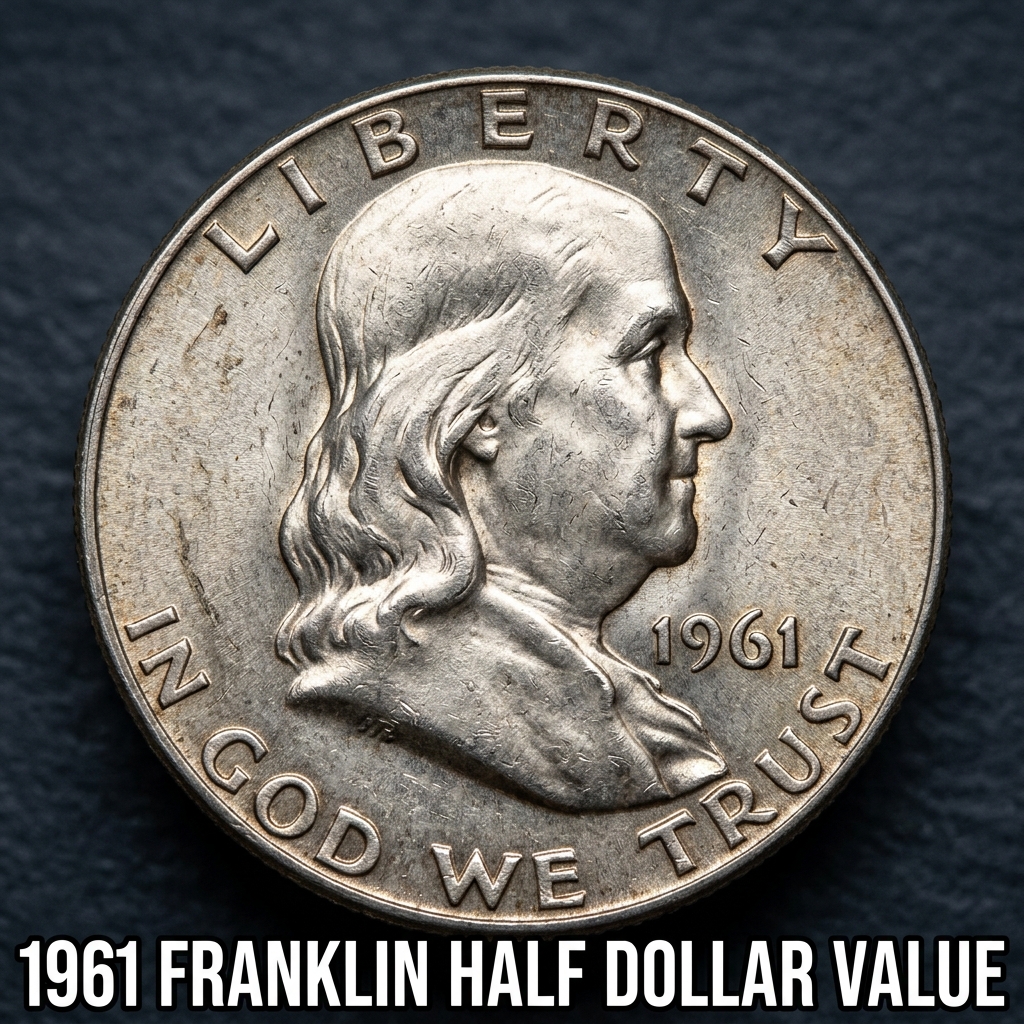
The 1961 Franklin Half Dollar is worth anywhere from about $10 in heavily worn condition to well over $100 in mint state — and rare high-grade examples have sold for thousands at auction. If you’ve got one sitting in a drawer or inherited a collection, this guide will help you figure out exactly what you’re holding.
What Makes the 1961 Franklin Half Dollar Special
The Franklin Half Dollar series ran from 1948 to 1963, and the 1961 issue is one of the more commonly encountered dates. That said, “common” doesn’t mean worthless — especially when it comes to coin condition and mint marks. These coins are 90% silver, which means even a worn example carries real metal value based on the silver spot price.
If you’re just getting started and aren’t sure what you’re looking at, using the best coin identifier app can help you quickly identify the coin, its mint mark, and get a ballpark value before you dive deeper. Apps like CoinHix make it especially easy — just snap a photo and it does the heavy lifting for you.
The 1961 Franklin Half Dollar was minted at two facilities: Philadelphia (no mint mark) and Denver (D mint mark on the reverse). Both are silver, both are collectible, but the Denver version is generally a bit easier to find in higher grades.
1961 Franklin Half Dollar Value by Grade and Mint Mark
Coin value depends heavily on condition. Here’s a breakdown of what you can expect to get for a 1961 Franklin Half Dollar based on its grade:
| Grade | 1961 (Philadelphia) | 1961-D (Denver) |
|---|---|---|
| Good (G-4) | $10 – $12 | $10 – $12 |
| Fine (F-12) | $11 – $13 | $11 – $13 |
| Extremely Fine (EF-40) | $12 – $15 | $12 – $15 |
| About Uncirculated (AU-50) | $14 – $18 | $14 – $18 |
| Mint State (MS-60) | $18 – $25 | $18 – $25 |
| Mint State (MS-65) | $60 – $120 | $45 – $90 |
| Proof (PR-65) | $30 – $55 | N/A |
For a more detailed look at 1961 Franklin Half Dollar mint state price data and recent auction results, CoinHix keeps an up-to-date database that tracks real sales — a great resource for collectors and sellers alike.
How to Identify Your 1961 Franklin Half Dollar
Start by flipping the coin to the reverse side (the back). Look just above the Liberty Bell near the bottom — if you see a small “D,” you’ve got a 1961-D from Denver. No mint mark means Philadelphia. Both versions were produced in large quantities: Philadelphia struck about 8.3 million coins, and Denver produced around 20.2 million.
Another thing to look for is the “Full Bell Lines” (FBL) designation. On high-grade examples, the horizontal lines at the bottom of the Liberty Bell are sharp and unbroken. Coins that meet this standard get an FBL designation and can be worth significantly more — sometimes two to three times the regular MS-65 price.
Inspecting these details carefully matters a lot when figuring out the true 1961 Franklin Half Dollar value. Even small differences in sharpness and luster can swing the price by hundreds of dollars at the top end of the grading scale.
Silver Value and Why It Matters
Even if your coin is worn down to the point where collectors wouldn’t give it a second look, it still has intrinsic silver value. The 1961 Franklin Half Dollar contains 0.3617 troy ounces of pure silver. With silver currently trading around $28–$30 per ounce, that gives any 1961 Franklin Half Dollar a base melt value of roughly $10–$11 just from the metal alone.
This is why coin dealers will still pay for heavily circulated examples — they’re buying the silver content. If you’re trying to decide whether to sell individually or in bulk, this detailed 1961 Half Dollar value resource walks you through current silver prices and how they affect your coin’s worth in real time.
For quick on-the-go checks, CoinHix lets you monitor silver melt values right alongside collector prices, so you always know the floor value of what you’ve got.
FAQ
Q: Is the 1961 Franklin Half Dollar rare?
A: Not particularly — it was made in large numbers, and millions survive today. However, high-grade examples with Full Bell Lines are genuinely scarce and can bring strong prices at auction.
Q: Where is the mint mark on a 1961 Franklin Half Dollar?
A: Look on the reverse side of the coin, just above the Liberty Bell near the bottom edge. A “D” means it was made in Denver. No letter means it came from Philadelphia.
Q: Should I clean my 1961 Franklin Half Dollar before selling it?
A: No — never clean a coin you plan to sell. Cleaning removes the natural patina and surface luster that collectors value, and it can reduce the coin’s grade — and its price — significantly. Sell it as-is for the best result.