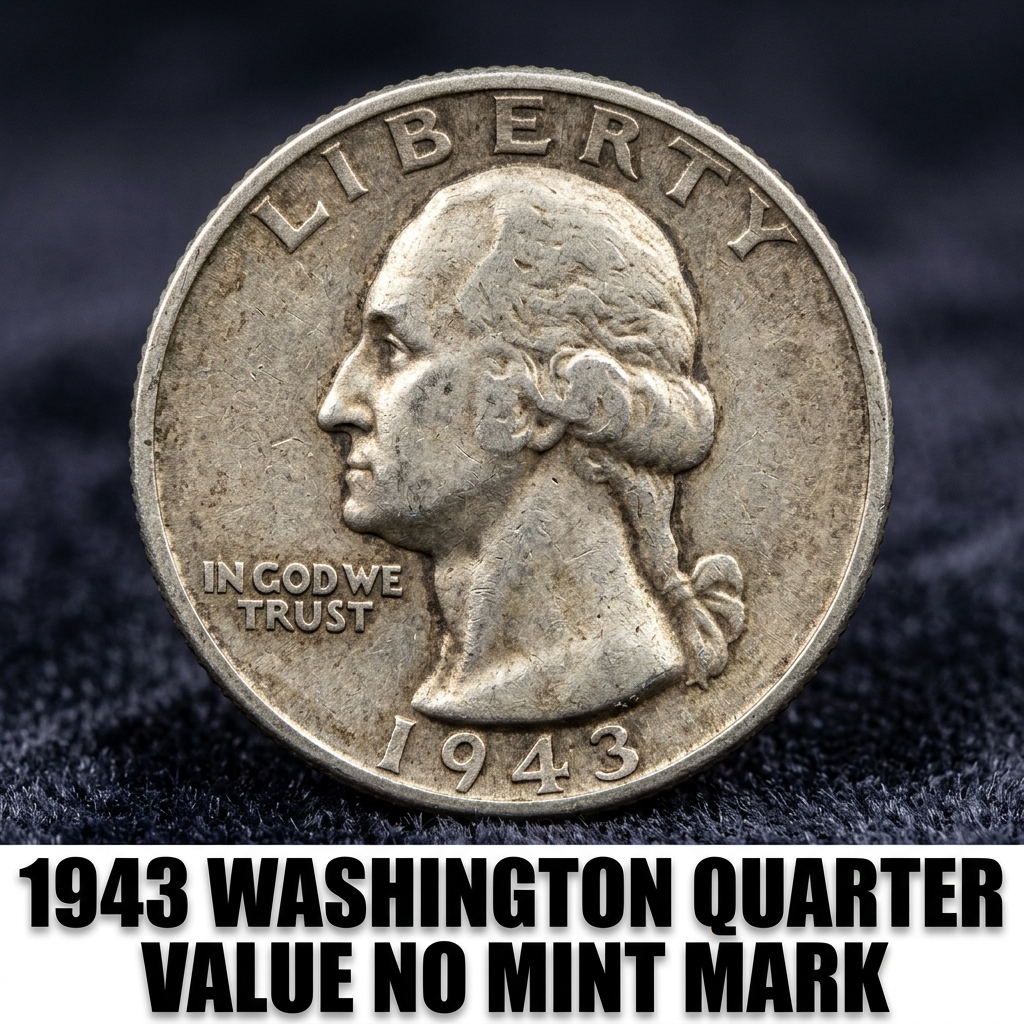
The 1943 Washington Quarter with no mint mark is worth anywhere from $5 in heavily worn condition to over $150 or more in high mint state grades, making it a surprisingly valuable find for anyone who stumbles across one in an old coin jar or inherited collection. If you’ve got one in hand, keep reading — you may be holding more than pocket change.
What the No Mint Mark Means on a 1943 Quarter
When you see a 1943 Washington Quarter with no mint mark, that tells you it was struck at the Philadelphia Mint. During this era, Philadelphia didn’t stamp its coins with a “P” — that practice didn’t become standard until much later. So the absence of a mint mark isn’t a mistake or a rare error; it simply means your coin came from Philly, which was the largest and most prolific mint in the country at the time.
This is important context for anyone using a best coin identifier app to identify their coins. Many people panic when they don’t see a mint mark, thinking something is off. In reality, Philadelphia-minted coins from this period are perfectly normal and still collectible.
In 1943, the Philadelphia Mint produced over 99 million Washington Quarters. That’s a large mintage, which is one reason why circulated examples aren’t worth thousands of dollars. But don’t let that discourage you — condition, luster, and strike quality still play a huge role in determining value, especially for coins preserved in better grades.
How Much Is a 1943 Washington Quarter Worth Today
The 1943 Washington Quarter value no mint mark varies widely depending on its condition. A coin that’s been circulating for decades will show heavy wear on Washington’s hair details and the eagle’s feathers on the reverse. These heavily worn coins — graded Good (G-4) to Fine (F-12) — typically sell for around $5 to $8.
Once you get into the Extremely Fine (EF-40) range, prices start to climb toward $10 to $15. In About Uncirculated (AU-50 to AU-58) condition, expect values between $15 and $30. The real jump happens in Mint State grades. An MS-63 example might bring $35 to $60, while a gem MS-65 can easily top $100 or more.
Here’s a quick reference table styled for clarity:
| Grade | Description | Estimated Value |
|---|---|---|
| G-4 (Good) | Heavy wear, major details visible | $5 – $7 |
| F-12 (Fine) | Moderate wear, readable legends | $7 – $10 |
| EF-40 (Extremely Fine) | Light wear on high points | $10 – $15 |
| MS-63 (Mint State) | Uncirculated, minor blemishes | $35 – $60 |
| MS-65 (Gem) | Strong luster, sharp strike | $100 – $150+ |
For the most up-to-date pricing, you can browse current 1943 Washington Quarter prices across mint state grades to see how the market is moving in real time.
Silver Content and Its Role in Base Value
One thing every owner of a 1943 Washington Quarter should know: this coin is 90% silver. That means even in the most worn, beat-up condition, it has intrinsic metal value. As of current silver prices, a 90% silver quarter contains roughly 0.1808 troy ounces of pure silver.
That silver melt value acts as a floor — your coin will never be worth less than its metal content, no matter what. When silver prices are high, even a junky-looking 1943 quarter might be worth $4 to $5 just for the metal alone.
CoinHix makes it easy to track silver melt values alongside collector premiums. The app updates automatically so you always know what your silver coins are worth in today’s market — which is especially handy when silver prices swing.
How to Check the Condition of Your 1943 Quarter
Grading coins takes practice, but here are a few things to look for on your 1943 Washington Quarter. On the obverse (front), check Washington’s hair above his ear — on a well-worn coin, these strands will be flat and merged together. On a better-preserved coin, you’ll see clear, separate lines.
On the reverse, look at the eagle’s breast feathers and the top of its wings. Full detail in these areas indicates a higher-grade coin. Also, look for any mint luster — that cartwheel shimmer you see when you tilt an uncirculated coin under light. If the luster is fully intact, you’ve got something worth getting graded professionally.
If you’re not sure how to assess your coin, the CoinHix app includes a grading guide and photo comparison tool that makes it simple for beginners to get a realistic estimate without needing to visit a dealer right away.
For a detailed breakdown of what your specific coin might be worth, this comprehensive 1943 quarter value guide covers all mint marks and condition levels in one place.
Should You Get It Graded or Sell As-Is
If your 1943 Washington Quarter looks uncirculated or nearly so, professional grading through PCGS or NGC is worth considering. A certified MS-65 coin in a holder typically sells for significantly more than a raw coin of the same quality, because buyers trust the grade.
However, for circulated coins in Good to Extremely Fine condition, the cost of grading ($30 or more per coin) usually exceeds the added value. In those cases, selling raw to a local dealer or through an online platform makes more financial sense.
CoinHix can help you compare both routes — the app lets you see recent sale prices for raw versus certified examples so you can make a smart decision before spending money on grading fees.
—
FAQ
Q: Is a 1943 Washington Quarter with no mint mark rare?
A: No, it’s not considered rare. The Philadelphia Mint struck over 99 million of them in 1943. However, coins in gem uncirculated condition (MS-65 and above) are much scarcer and can be worth $100 or more.
Q: How do I know if my 1943 quarter is silver?
A: All 1943 Washington Quarters are made of 90% silver, regardless of mint mark. You can confirm this by checking the edge — a silver quarter has a solid silver-gray edge with no copper stripe. If you see a copper stripe, it’s a later clad coin, not a 1943.
Q: Where is the mint mark located on a 1943 Washington Quarter?
A: The mint mark appears on the reverse of the coin, just to the right of the ribbon tied around the eagle’s neck. If you see nothing there, the coin was minted in Philadelphia. A “D” means Denver, and an “S” means San Francisco.