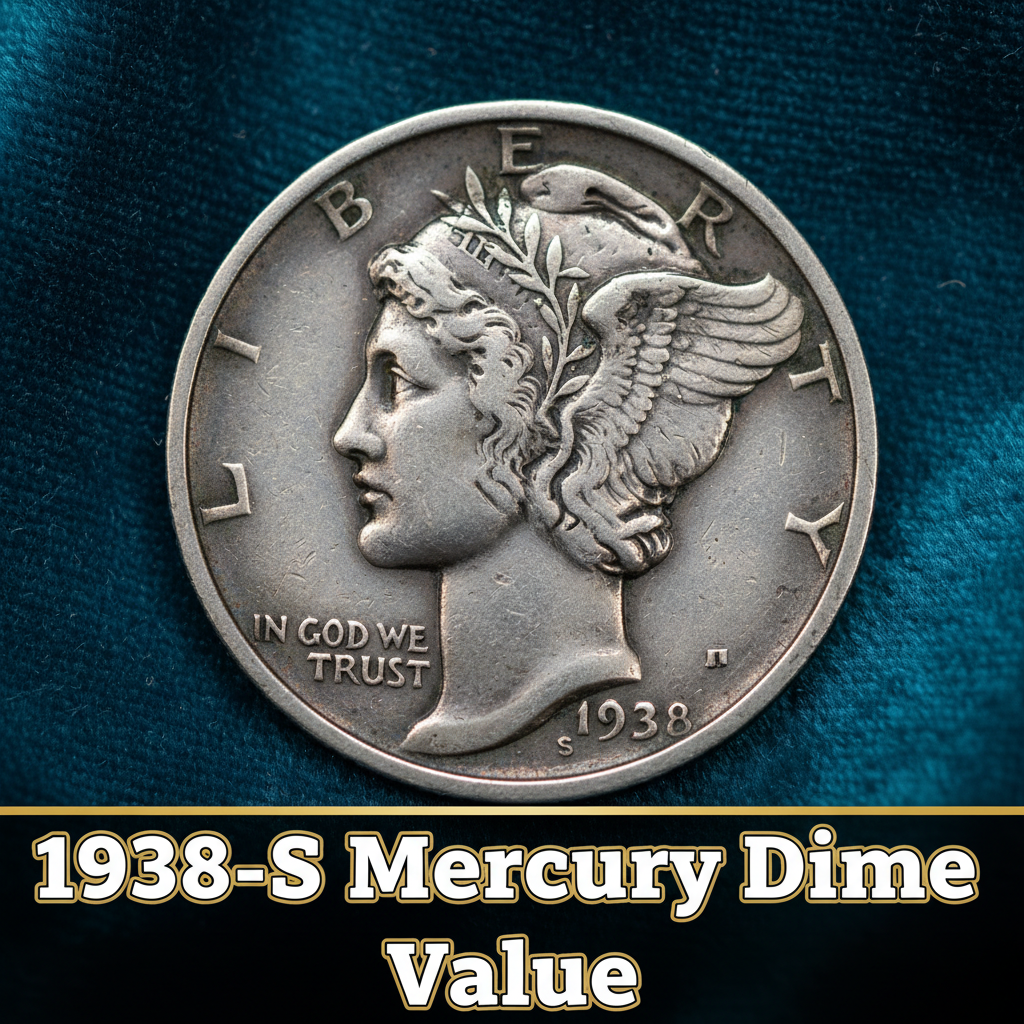
The 1938-S Mercury Dime is worth anywhere from $3 to $5 in heavily worn condition, but well-preserved examples can fetch $20 to $50 or more — and top-grade mint state coins have sold for several hundred dollars at auction. If you found one of these in an old coin jar or inherited collection, you might be sitting on more than pocket change.
What Makes the 1938-S Mercury Dime Special
The 1938-S Mercury Dime was struck at the San Francisco Mint during one of the most beloved eras of American coinage. Designed by Adolph A. Weinman and first issued in 1916, the Mercury Dime — officially called the Winged Liberty Head Dime — features a young Liberty wearing a winged cap, often mistaken for the Roman god Mercury. The reverse showcases a fasces bundled with an olive branch, symbolizing strength and peace.
The “S” mintmark on this coin places its origin at the San Francisco Mint, which produced 8,090,000 dimes that year. While that’s not a tiny mintage, many of these coins were spent and circulated heavily, making high-grade survivors harder to find than you might expect. That’s exactly why condition plays such a massive role in determining value.
If you want a quick and easy way to identify and evaluate your coin without any numismatic experience, the best coin identifier app can scan your coin using your phone’s camera and give you an instant grade estimate — a great first step before taking your coin to a dealer.
1938-S Mercury Dime Value by Grade
Coin value is almost entirely driven by condition, or “grade.” Here’s a straightforward breakdown of what a 1938-S Mercury Dime is typically worth across different grades:
| Grade / Condition | Description | Estimated Value |
|---|---|---|
| Good (G-4) | Heavy wear, design visible | $3 – $4 |
| Fine (F-12) | Moderate wear, details clear | $4 – $6 |
| Extremely Fine (EF-40) | Light wear on high points | $10 – $18 |
| About Uncirculated (AU-55) | Slight wear, most luster intact | $20 – $35 |
| MS-63 (Mint State) | No wear, minor marks | $40 – $65 |
| MS-65 and above | Gem quality, full luster | $100 – $400+ |
For the most up-to-date pricing data, you can check out current 1938-S Mercury Dime prices in mint state grades sourced from recent auction results and dealer listings.
The Full Split Bands Detail and Why It Matters
One feature that significantly bumps up the value of a 1938-S Mercury Dime is what collectors call “Full Split Bands” or FSB. On the reverse of the coin, the horizontal bands wrapped around the fasces should show a clear, complete separation — a sign that the coin was struck with exceptional pressure and has seen little to no wear.
Coins certified as MS-65 FB (Full Bands) can be worth two to three times more than the same grade without that designation. A non-FB MS-65 might sell for around $60, while an MS-65 FB example could command $150 or more. This single detail is one of the most important things to look for when assessing whether your 1938-S dime is a regular find or a genuine collector’s prize.
CoinHix makes it easy to understand these nuances even if you’re new to coin collecting. The app breaks down grade designations and special attributes in plain language, helping you figure out exactly what you’ve got before you decide to sell or hold onto it.
How to Find Your 1938-S Mercury Dime’s Value
If you’re trying to get a solid value estimate for your 1938-S Mercury Dime, the best approach combines a few simple steps. First, examine your coin under good lighting — look for the “S” mintmark on the reverse, just to the right of the “E” in ONE. Then assess the coin’s surface condition honestly: Is the design sharp or worn flat? Are there any scratches or discoloration?
Once you have a rough grade in mind, use a reliable resource to find matching values. A detailed breakdown of what the 1938 Mercury Dime is worth across all mint marks and grades can help you compare where your coin falls. From there, you might want to get it professionally graded by PCGS or NGC if you suspect it’s in mint state — grading fees are usually worth it for coins potentially worth $50 or more.
CoinHix also allows you to track recent sale prices and compare your coin against verified auction data, giving you a realistic sense of what buyers are actually paying in today’s market — not just theoretical price guide numbers.
Silver Content and Melt Value
Even a heavily worn 1938-S Mercury Dime has intrinsic value because it’s made of 90% silver. Each coin contains 0.07234 troy ounces of pure silver. With silver prices typically ranging between $28 and $35 per ounce, that gives every Mercury Dime a melt value of roughly $2.00 to $2.50 at minimum. This means even the most beat-up example is worth more than ten cents — and likely more than a dollar just for the metal alone.
—
Frequently Asked Questions
Q: How do I know if my dime is a 1938-S and not a 1938 or 1938-D?
A: Look on the reverse side of the coin, just to the right of the “E” in ONE. If you see a small “S,” it was made in San Francisco. A “D” means Denver, and no mintmark at all means it came from Philadelphia.
Q: Is a 1938-S Mercury Dime rare?
A: It’s not considered rare in lower grades since nearly 8.1 million were minted. However, high-grade mint state examples — especially those with Full Split Bands — are significantly harder to find and genuinely scarce in the collector market.
Q: Should I clean my 1938-S Mercury Dime before selling it?
A: Absolutely not. Cleaning a coin, even gently, removes the natural patina and can drastically reduce its value. Collectors and grading services can easily spot a cleaned coin, and it will be graded lower as a result. Leave it exactly as you found it.