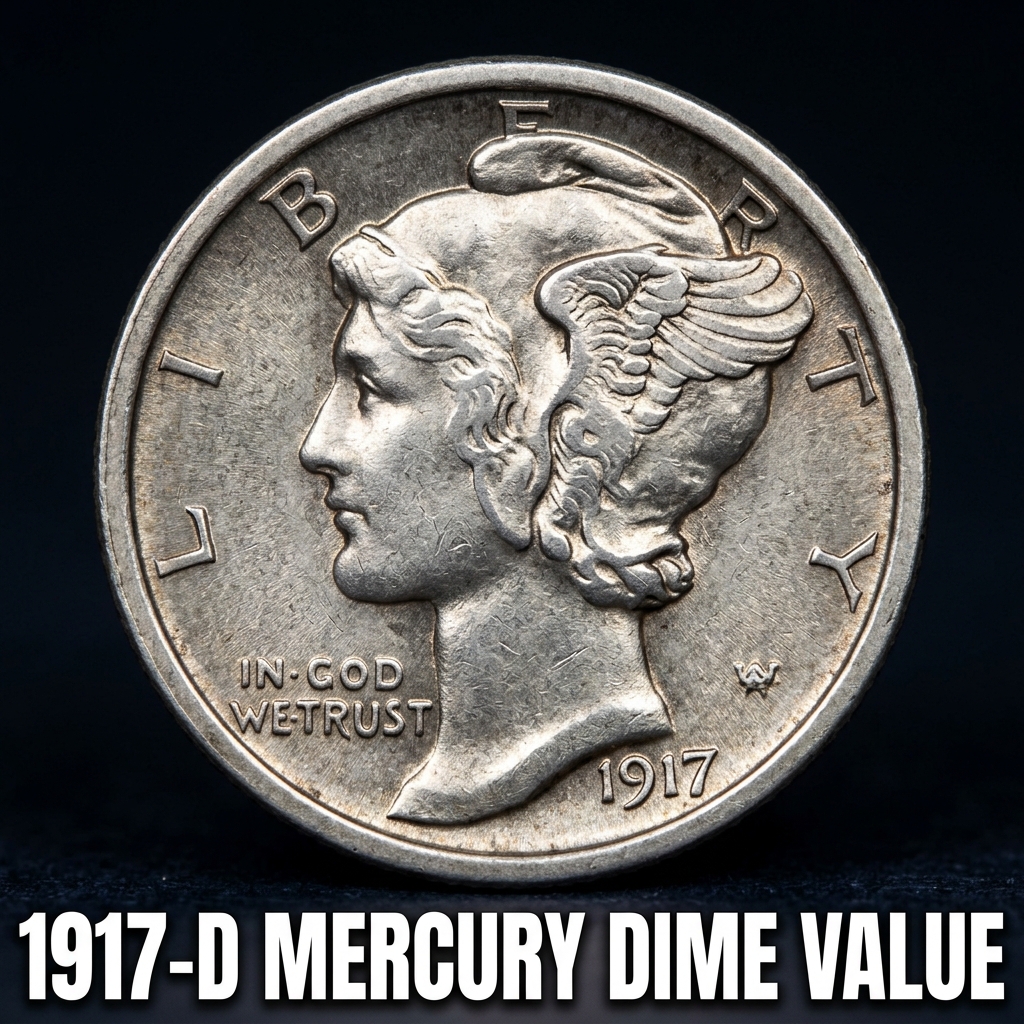
The 1917-D Mercury Dime is worth anywhere from $5 in heavily worn condition to well over $1,000 in high mint state grades. If you found one in an old coin collection or tucked away in a drawer, you’re holding a piece of early American history — and potentially a coin worth serious money.
What Makes the 1917-D Mercury Dime Special
The 1917-D Mercury Dime was struck at the Denver Mint during the very first year the Mercury Dime design was issued in multiple mint locations. Designed by Adolph Weinman, this coin features Liberty wearing a winged cap — often mistaken for the Roman god Mercury, which is how the nickname stuck. The “D” mintmark appears on the reverse, just to the left of the “E” in “ONE.” This was only the second year of the Mercury Dime series, meaning any 1917-D example carries solid historical weight and collector appeal. Denver Mint production for this year reached 9,402,000 coins — a respectable mintage but not so high that it floods the market. If you’re curious about what exactly you’re holding, using the best coin identifier app can help you confirm the mint mark, date, and overall coin details before getting a value estimate.
1917-D Mercury Dime Value by Grade
The condition of your coin — known as its “grade” in numismatic terms — has the biggest impact on its value. A coin that’s been circulated heavily will show flattened details on Liberty’s hair and the bands on the fasces, and it’s worth far less than one that has been well-preserved over the past century. Uncirculated examples, especially those with fully split bands (FSB) on the fasces reverse, command significant premiums from serious collectors.
Here’s a general value breakdown for the 1917-D Mercury Dime:
| Grade | Description | Estimated Value |
|---|---|---|
| G-4 (Good) | Heavy wear, major details visible | $5 – $7 |
| VG-8 (Very Good) | Moderate wear, clear lettering | $7 – $10 |
| F-12 (Fine) | Even wear, design elements visible | $10 – $16 |
| VF-20 (Very Fine) | Light to moderate wear | $16 – $25 |
| EF-40 (Extremely Fine) | Slight wear on high points | $30 – $55 |
| MS-63 (Uncirculated) | No wear, some contact marks | $175 – $350 |
| MS-65 (Gem Uncirculated) | Sharp strike, minimal marks | $700 – $1,200+ |
For the most current auction prices and dealer data, you can check out real-time 1917-D Mercury Dime price records across mint state grades to see what collectors are actually paying right now.
How to Tell If Your 1917-D Mercury Dime Is Worth More
Beyond basic grade, there are a couple of factors that can seriously boost your coin’s value. First, look at the reverse of the coin under good lighting or a magnifying glass. The fasces — the bundled rods with an ax — has horizontal bands crossing it. If those bands are fully separated and sharply defined, your coin qualifies as “Full Bands” (FB), a designation that can double or even triple its value compared to a non-FB example of the same grade. Second, originality matters. Coins that have been cleaned or polished are worth less to collectors, even if they look shiny. Natural, undisturbed surfaces are always preferred. CoinHix is a great tool for researching these finer details, as it tracks certified coin sales and helps you understand exactly how much the FB designation adds to value.
Where and How to Sell a 1917-D Mercury Dime
Once you know what you have, you’ll want to choose the right selling channel. For worn examples worth under $20, a local coin shop or eBay listing is usually your best bet. For higher-grade coins — especially MS-63 or above — consider having your coin certified by PCGS or NGC before selling. A graded coin in a slab commands far more buyer confidence and often sells for significantly more at auction. You can get a full picture of the complete 1917 Mercury Dime value guide including all mint marks and grades before deciding how to proceed. Using CoinHix alongside certified auction records can also give you realistic price expectations so you don’t undersell.
Quick Tips Before You Do Anything With Your Coin
Before selling, trading, or even cleaning your 1917-D Mercury Dime, keep these things in mind. Never clean a coin — even gentle rubbing removes microscopic metal and permanently reduces collector value. Store it in a non-PVC coin holder to prevent chemical damage. If you think you might have a high-grade example, get it professionally graded first. And always get more than one opinion on value. Download CoinHix to quickly compare your coin’s estimated worth against real market data — it’s one of the easiest ways for everyday people to get a handle on what their old coins are actually worth without having to visit a dealer first.
FAQ
Q: How do I know if my Mercury Dime is from the Denver Mint?
A: Look at the reverse side of the coin, just to the left of the “E” in “ONE DIME.” If you see a small “D” mintmark there, your coin was struck at the Denver Mint. No mintmark means it came from Philadelphia.
Q: Is a 1917-D Mercury Dime worth getting professionally graded?
A: It depends on the condition. If your coin shows heavy wear and is only worth $5–$15, grading fees won’t make financial sense. But if your coin looks uncirculated or near-uncirculated, professional grading by PCGS or NGC could significantly increase its resale value.
Q: What’s the most valuable 1917-D Mercury Dime ever sold?
A: Top-grade examples graded MS-67 or higher with Full Bands have sold at major auctions for several thousand dollars. The cleaner and sharper the coin, the more it’s worth — gem specimens with exceptional strike quality are rare and highly sought after by advanced collectors.