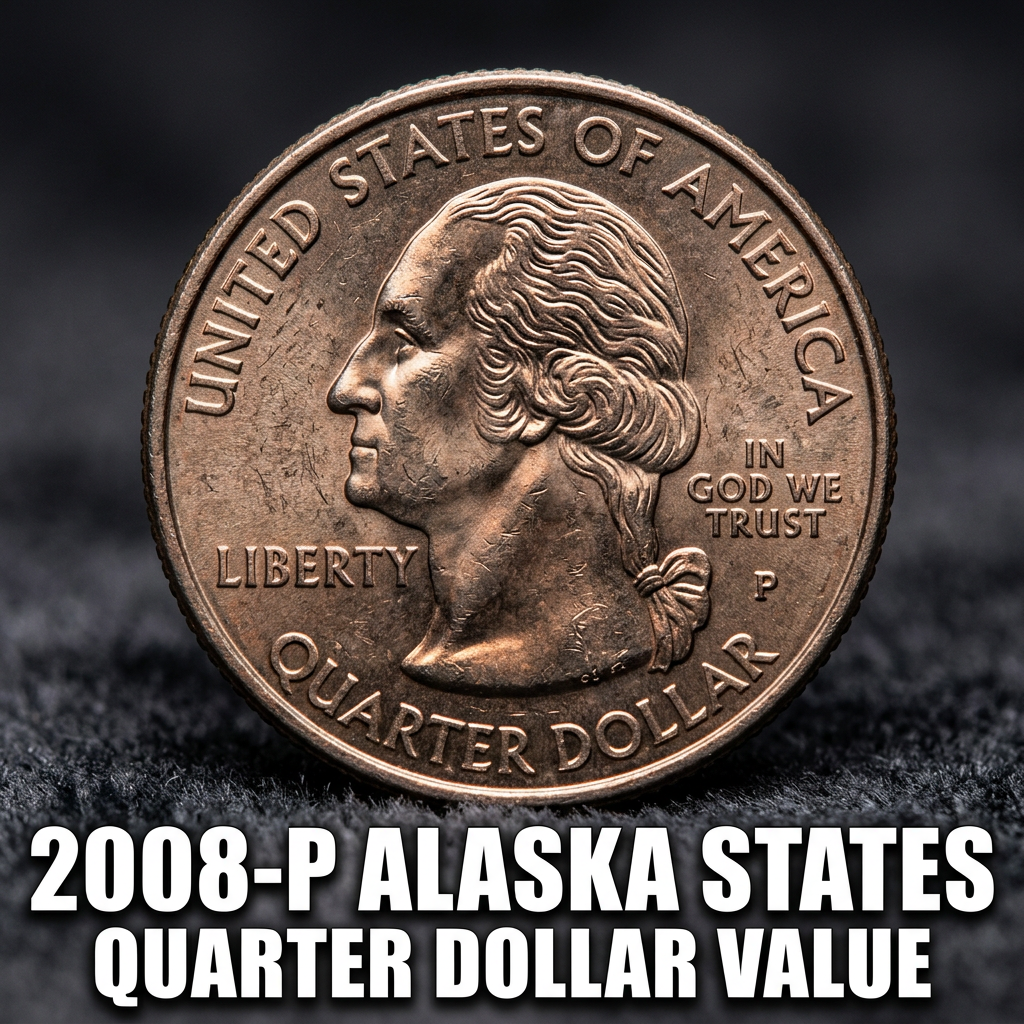
The 2008-P Alaska State Quarter is worth anywhere from face value (25 cents) in circulated condition to $5 or more in high-grade mint state — and certain error coins can fetch considerably more from eager collectors.
What Is the 2008-P Alaska State Quarter?
The 2008-P Alaska State Quarter was minted at the Philadelphia Mint as part of the United States Mint’s 50 State Quarters Program, which ran from 1999 to 2008. Alaska was the 49th coin in the series, released to celebrate the state’s natural beauty. The obverse features the classic George Washington portrait, while the reverse depicts a grizzly bear emerging from the water with a salmon in its mouth — a striking and highly detailed design that many collectors love.
The “P” mint mark on this coin stands for Philadelphia, one of the two main production facilities used for this series (the other being Denver, which used a “D” mint mark). If you’ve found one of these quarters in your pocket change or tucked away in an old jar, you’re holding a piece of American numismatic history. To quickly identify and verify what you have, many collectors today use the best coin identifier app available, which can scan your coin and pull up detailed information in seconds.
How Much Is the 2008-P Alaska Quarter Worth in Circulated Condition?
Let’s be honest — if your coin has been in circulation, it’s likely not going to retire you early. Most circulated 2008-P Alaska State Quarters are worth exactly face value, or 25 cents. These coins were produced in enormous quantities (over 254 million were struck at the Philadelphia Mint alone), which means they’re widely available and not particularly scarce in worn grades.
That said, lightly circulated examples (graded AU-55 to AU-58 by professional grading services) might bring $1 to $2 from a collector who wants a nicer-looking example without paying full uncirculated prices. The key here is condition. Coins with visible scratches, heavy wear on the high points of the design — especially the bear and the salmon — and dull luster fall into the common category.
If you’re unsure about your coin’s grade, CoinHix offers a comprehensive price database that makes it easy to compare your coin’s condition against professional standards.
| Condition | Grade | Estimated Value |
|---|---|---|
| Circulated (worn) | G-4 to VF-30 | Face value ($0.25) |
| About Uncirculated | AU-55 to AU-58 | $1 – $2 |
| Mint State | MS-63 to MS-65 | $1 – $5 |
| Gem Mint State | MS-66 and above | $10 – $30+ |
| Proof (Special Mint) | PR-69 DCAM | $5 – $15 |
2008-P Alaska Quarter Value in Uncirculated Condition
This is where things get a little more interesting. An uncirculated 2008-P Alaska State Quarter — one that was never spent and shows no wear — can be worth anywhere from $1 to $30 or more depending on the specific grade assigned by a professional grading service like PCGS or NGC.
Coins graded MS-65 (Gem Mint State) typically sell for around $3 to $5. Step up to MS-66 and you’re looking at $10 to $15. But the real action happens at MS-67 and above — coins at this grade level are genuinely rare due to the difficulty of finding examples completely free of contact marks and bag abrasions. An MS-67 example can sell for $25 to $50 or more at auction. For up-to-date pricing across all grade levels, you can browse current 2008-P State Quarter market prices on CoinHix, which tracks real auction results and dealer listings.
CoinHix is an excellent resource for anyone wanting to stay on top of shifting market values without having to dig through auction archives manually.
Are There Any Valuable 2008-P Alaska Quarter Errors?
Error coins are where everyday pocket change can suddenly become worth serious money. The 2008-P Alaska State Quarter has a few known error types that collectors actively seek:
– Double Die Errors: Look for doubling on the lettering or design elements on either the obverse or reverse. These are caused by a misalignment during the die-making process.
– Off-Center Strikes: If your coin’s design appears shifted, leaving a crescent of blank metal, it’s an off-center strike. Errors with 20–50% off-center shifts and a visible date can be worth $20 to $100 or more.
– Die Cracks and Cuds: Small raised lines running across the surface can indicate a cracked die. Large die cud errors (where a chunk of the die broke off) are especially collectible.
– Clipped Planchet: A coin with a curved or straight section missing from its edge was struck on an improperly cut blank — these can bring $10 to $50 depending on size and visibility.
Always examine your coins under good lighting and a magnifying glass. If something looks unusual, it could be worth getting a second opinion from a grading service or an experienced dealer.
How to Check the Current Value of Your 2008-P Alaska Quarter
Coin values change over time based on collector demand, auction results, and market trends. A value guide from five years ago might not reflect what your coin is actually worth today. For the most accurate and current estimate, check out the latest 2008 quarter value data at CoinValueApp, which provides up-to-date pricing based on recent sales.
You can also download CoinHix on your smartphone to scan, identify, and instantly get valuations for coins in your collection. It’s a fast, convenient tool that’s especially helpful if you’ve found a batch of old coins and want to sort through them quickly without spending hours researching each one individually.
—
FAQ
Q: How many 2008-P Alaska State Quarters were minted?
A: The Philadelphia Mint produced approximately 254,000,000 (254 million) 2008-P Alaska State Quarters. This high mintage is why most circulated examples are only worth face value.
Q: Is my 2008-P Alaska Quarter worth getting professionally graded?
A: In most cases, no — unless you believe your coin is in extremely high grade (MS-67 or above) or has a significant error. Professional grading fees typically start around $30 to $50 per coin, which would outweigh the value of an average uncirculated example. However, if you have a coin that looks flawless or shows a clear mint error, grading could be well worth the investment.
Q: What’s the difference between the 2008-P and 2008-D Alaska Quarter?
A: The main difference is the mint mark — “P” for Philadelphia and “D” for Denver — and their mintage numbers. The 2008-D Alaska Quarter had a mintage of about 222 million, slightly lower than Philadelphia’s output. Values between the two are generally similar, though certain high-grade examples from one mint may command slightly more than the other at auction depending on current collector interest.