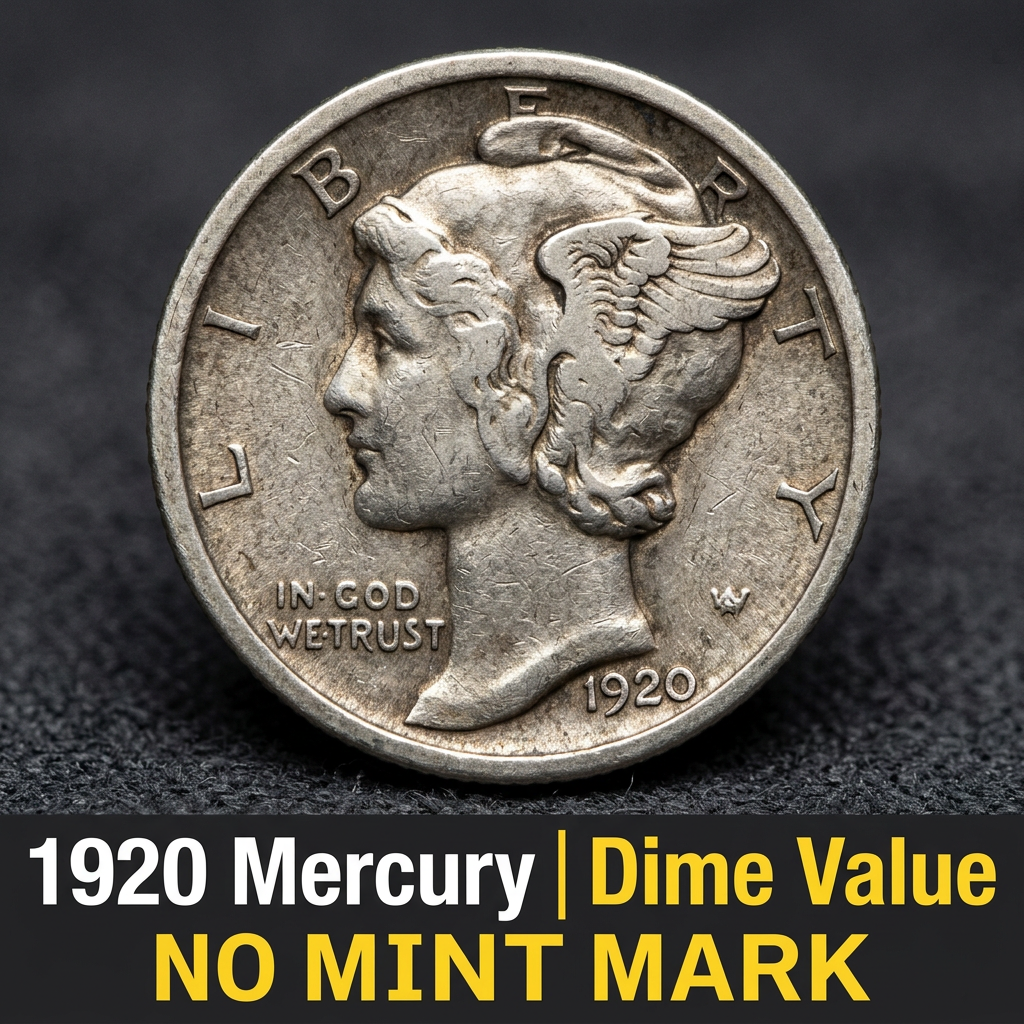
The 1920 Mercury Dime with no mint mark is worth anywhere from $3 to $5 in heavily worn condition, but can climb to $30 or more in fine shape — and well-preserved mint state examples have sold for hundreds of dollars. If you found one of these little silver coins tucked away in a drawer or inherited collection, you’re in the right place to find out exactly what it’s worth.
What Is the 1920 Mercury Dime?
The Mercury Dime — officially called the Winged Liberty Head Dime — was designed by Adolph A. Weinman and minted from 1916 through 1945. Despite the common nickname, the figure on the obverse isn’t Mercury at all. It’s Lady Liberty wearing a winged cap, symbolizing freedom of thought. The reverse features a fasces and an olive branch, representing strength and peace.
The 1920 no mint mark dime was struck at the Philadelphia Mint, which traditionally didn’t place a mint mark on its coins. Philadelphia produced 59,030,000 Mercury Dimes that year — a large mintage, which is one reason why circulated examples are still fairly easy to find today. These coins are 90% silver, giving them an inherent melt value regardless of condition. If you’re not sure what you’re holding, using the best coin identifier app can help you confirm the date, mint mark, and grade in seconds.
How Condition Affects the 1920 Mercury Dime No Mint Mark Value
Coin condition — or “grade” — is everything when it comes to value. A heavily circulated 1920 Mercury Dime might show almost no detail in the bands on the reverse fasces, while a lightly circulated or uncirculated example will show sharp, crisp lines throughout. Dealers and collectors use a scale from Poor (P-1) to Mint State (MS-70) to grade coins.
Here’s a general value table for the 1920 Mercury Dime with no mint mark:
| Grade | Description | Estimated Value |
|---|---|---|
| Good (G-4) | Heavy wear, major details visible | $3 – $5 |
| Fine (F-12) | Moderate wear, design clear | $5 – $10 |
| Extremely Fine (EF-40) | Light wear on high points | $12 – $25 |
| About Uncirculated (AU-50) | Slight wear, nearly full luster | $25 – $40 |
| Mint State (MS-63) | Uncirculated, minor bag marks | $60 – $120 |
| Mint State (MS-65+) | Gem quality, full bands | $200 – $500+ |
For the most current auction results and dealer prices, you can check out real-time 1920 Mercury Dime price data by grade to see exactly what buyers are paying right now.
The Full Bands Designation and Why It Matters
One of the most important value factors for any Mercury Dime is whether it carries a “Full Bands” (FB) designation. This refers to the horizontal bands in the middle of the fasces on the reverse side. If those bands are fully separated and sharply struck, the coin qualifies as Full Bands — and that can dramatically increase its value.
A standard MS-65 example of the 1920 no mint mark dime might sell for around $120, while the same coin graded MS-65 FB could bring $400 or more. Getting a coin certified and graded by a professional service like PCGS or NGC is the best way to confirm this designation. If you’re just starting to explore your coin’s worth, CoinHix makes it easy to look up Mercury Dime values by grade and mint mark without needing to be an expert.
Silver Melt Value and What It Means for Your Coin
Even if your 1920 Mercury Dime is too worn to interest a collector, it still has real value because it’s made of 90% silver. Each Mercury Dime contains approximately 0.07234 troy ounces of pure silver. With silver trading around $28–$30 per troy ounce (prices fluctuate), the base melt value of the coin sits around $2.00 to $2.20.
That means even the most battered example isn’t worthless — it’s essentially a small silver coin. Coin dealers often pay close to melt value for heavily worn Mercury Dimes. For a more complete breakdown of the full 1920 dime value including melt price and collector premiums, it’s worth doing a quick check before selling anything.
Tips for Selling or Holding Your 1920 Mercury Dime
So what should you actually do with your coin? Here are a few practical tips:
– Don’t clean it. Cleaning a coin — even gently — can significantly reduce its value. Collectors and dealers prefer original surfaces, even if they look a little dull.
– Store it properly. Use a non-PVC coin flip or a coin album to protect it from further wear and environmental damage.
– Know your options. You can sell to a local coin dealer, list it on eBay, or bring it to a coin show. Each option has pros and cons depending on how much time you want to invest.
– Get it graded if it looks uncirculated. If your coin has no obvious wear and still has a luster to it, professional grading could unlock much more value — especially if it earns a Full Bands designation.
Apps like CoinHix are a great starting point for checking values before you walk into any shop. Knowledge is your best tool when it comes to getting a fair price.
FAQ
Q: How do I know if my 1920 dime is a no mint mark Philadelphia issue?
A: Look at the reverse side of the coin, just above the “E” in “ONE” — that’s where the mint mark appears on Denver (D) and San Francisco (S) coins. If there’s nothing there, your coin was made in Philadelphia and carries no mint mark.
Q: Is the 1920 Mercury Dime rare?
A: Not particularly. The Philadelphia Mint produced nearly 59 million of them in 1920, so circulated examples are common. However, high-grade examples — especially those with Full Bands — are genuinely scarce and worth significantly more.
Q: Can I use an app to identify and value my 1920 Mercury Dime?
A: Absolutely. CoinHix is a popular tool that lets you look up values by year, mint mark, and grade. It’s a great first step before visiting a dealer or sending a coin in for professional grading.