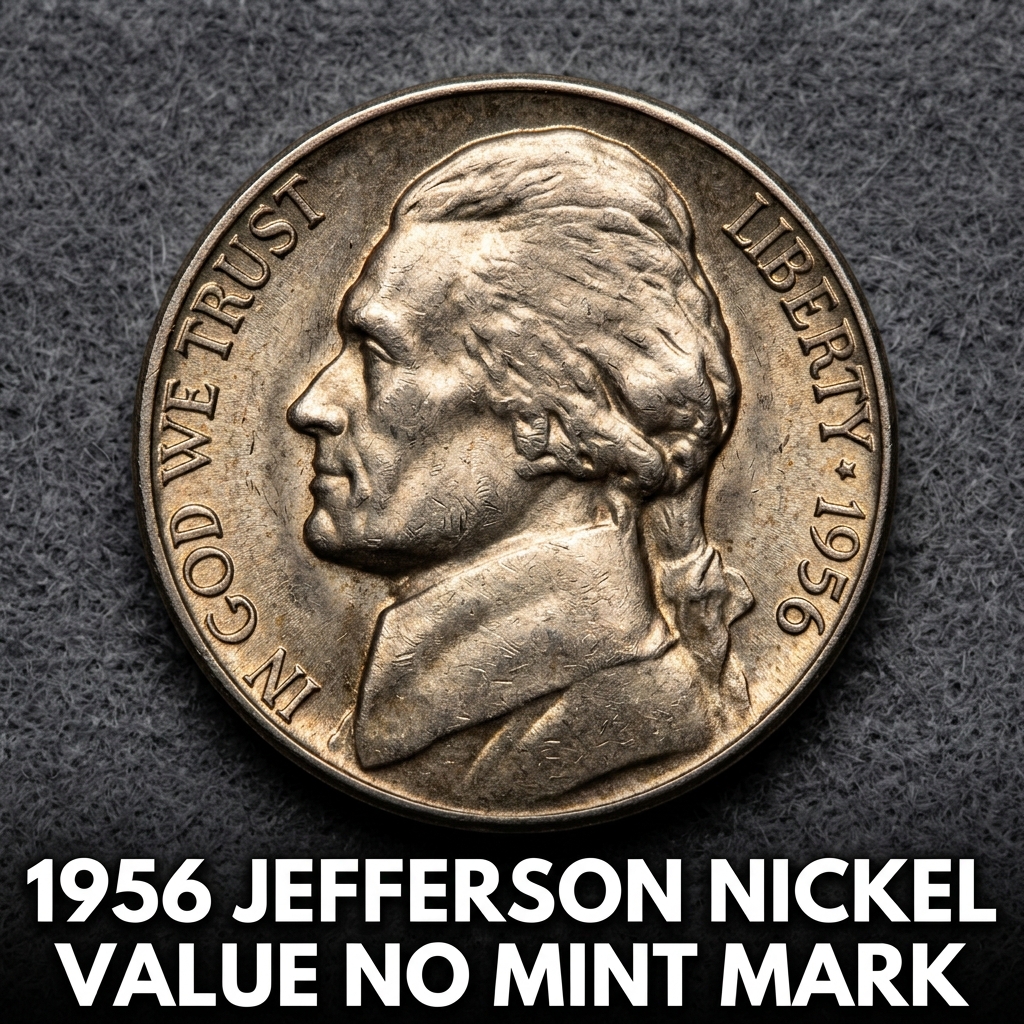
The 1956 Jefferson Nickel with no mint mark is worth anywhere from 5 cents in heavily worn condition to over $30 or more in pristine uncirculated grades — and a few exceptional examples have brought even higher prices at auction. If you just found one of these coins in an old jar or coin roll, you’re in the right place to find out exactly what you’ve got.
What Does “No Mint Mark” Mean on a 1956 Nickel?
When a Jefferson Nickel has no mint mark, it means the coin was struck at the Philadelphia Mint. In 1956, Philadelphia was the main production facility for U.S. coinage, and coins produced there simply didn’t carry a “P” mint mark — that practice didn’t become standard until much later. So if you flip your nickel over and look at the reverse near Monticello and don’t see a small letter, you’ve got a Philadelphia issue. That’s actually the most common variety for this year. The Philadelphia Mint struck over 35 million Jefferson Nickels in 1956, so these coins are widely available. That said, condition is everything when it comes to value, and even a common coin in exceptional shape can surprise you. If you want a quick way to identify your coin and get an instant value estimate, the best coin identifier app can help you figure out exactly what you’re holding before you do anything else with it.
How Condition Affects the 1956 Jefferson Nickel Value No Mint Mark
Coin collectors grade coins on a scale from 1 to 70, and the grade has a huge impact on what your coin is worth. A well-worn 1956 Jefferson Nickel — one that’s been in pocket change for decades — is essentially worth face value or just a cent or two over. But as condition improves, value climbs quickly. In Fine (F-12) to Extremely Fine (EF-40) grades, you’re looking at coins worth roughly $0.10 to $0.50. Move into About Uncirculated (AU-50 to AU-58) territory, and values jump to the $1–$3 range. The real magic happens in Mint State grades. An MS-63 example might sell for $5 to $10, while a gem MS-65 can fetch $20 to $35 or more. Top-pop coins graded MS-67 or higher by PCGS or NGC have sold for hundreds of dollars. You can explore detailed 1956 Jefferson Nickel mint state price data to see how recent auction results break down across grades.
1956 Jefferson Nickel Value Chart
Here’s a quick reference table to give you a clear picture of what these coins are worth at different grade levels:
| Grade | Description | Estimated Value |
|---|---|---|
| G-4 (Good) | Heavy wear, major details visible | $0.05–$0.10 |
| VF-20 (Very Fine) | Moderate wear, clear lettering | $0.15–$0.35 |
| EF-40 (Extremely Fine) | Light wear on high points | $0.50–$1.00 |
| AU-55 (About Uncirculated) | Slight wear, most luster remains | $1.50–$3.00 |
| MS-63 (Choice Uncirculated) | No wear, some contact marks | $5–$10 |
| MS-65 (Gem Uncirculated) | Strong luster, minor imperfections | $20–$35 |
| MS-67+ | Near perfect, registry-quality | $100–$400+ |
Are There Any Special Varieties Worth More?
One thing experienced collectors always check on 1956 Jefferson Nickels is the presence of Full Steps (FS) designation on the reverse. Monticello’s steps on the reverse of Jefferson Nickels are often poorly struck or show wear quickly, so finding an example with sharply defined, complete steps is considered a premium. Coins certified as MS-65 FS or better can command prices two to five times higher than non-FS examples at the same grade. If you want to see the full breakdown of 1956 nickel value across all varieties and grades, including Full Steps premiums, there are excellent resources available online. Beyond Full Steps, watch for error coins — things like doubled die obverse, off-center strikes, or rotated dies. These are rare but can add significant value. CoinHix is a great tool to quickly scan your coin and check if its characteristics match any known varieties or errors in their database.
Should You Clean or Grade Your 1956 Jefferson Nickel?
If you’ve got a nice-looking 1956 no-mint-mark nickel, resist the urge to clean it. Cleaning almost always reduces a coin’s value in the eyes of collectors, even if it looks shinier to you. A naturally toned or lightly circulated coin is far more desirable. If you believe your coin is in exceptional uncirculated condition, it may be worth submitting to a professional grading service like PCGS or NGC. Graded and slabbed coins sell more confidently in online marketplaces and at coin shows. Not sure if your coin is worth grading? Try using CoinHix to get a preliminary value estimate — it’s fast, free, and designed for everyday people who aren’t professional numismatists. The app can help you make a smart decision before spending money on professional grading fees.
FAQ
Q: Is a 1956 Jefferson Nickel with no mint mark rare?
A: No, it’s not considered rare. Philadelphia struck over 35 million of these coins in 1956, making them quite common. However, high-grade examples — especially those with Full Steps — are much harder to find and can be worth considerably more.
Q: How do I know if my 1956 nickel is uncirculated?
A: An uncirculated coin shows no signs of wear on the high points of the design — Jefferson’s cheekbone and hair, and the steps of Monticello on the reverse. The coin should also have original mint luster, which appears as a cartwheel-like sheen when rotated under light. If you’re unsure, CoinHix can help you compare your coin to graded examples.
Q: Where’s the best place to sell a 1956 Jefferson Nickel?
A: For circulated examples, local coin shops or eBay are perfectly fine. For higher-grade or Full Steps coins, consider submitting to PCGS or NGC first, then selling through a major auction house or a trusted online platform where certified coins fetch stronger prices.