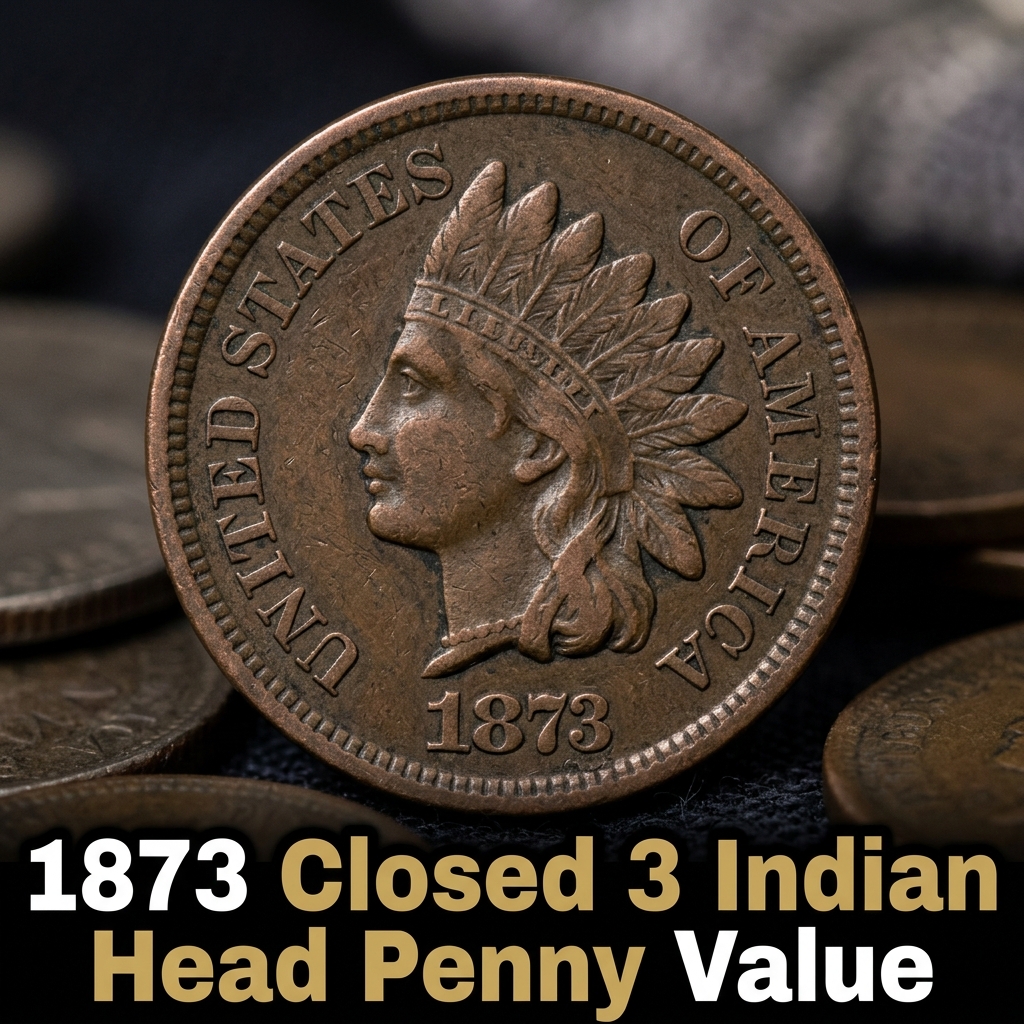
The 1873 Closed 3 Indian Head Penny is worth anywhere from $15 in heavily worn condition to over $500 or more in mint state grades, making it one of the more interesting varieties from the Indian Head series. If you found one of these coins in a drawer, old jar, or inherited collection, you’re sitting on something worth a closer look.
What Makes the 1873 Closed 3 Different?
The year 1873 is special in Indian Head Penny history because the U.S. Mint produced two distinct varieties: the Closed 3 and the Open 3. The difference comes down to how the numeral “3” in the date was engraved on the coin die. On the Closed 3 variety, the loops of the number 3 are nearly touching, making it look more like an 8 at first glance. On the Open 3, there’s a clear gap between the loops.
This kind of variety might sound minor, but to collectors it matters quite a bit. The Closed 3 was struck earlier in the year, and once mint officials noticed the digit looked too similar to an 8, they modified the die to create the Open 3 version. That backstory alone gives the Closed 3 variety extra historical appeal.
If you’re trying to identify whether your coin is the Closed 3 or Open 3 variety, a magnifying glass helps, but even better is using a reliable coin identification tool. The best coin identifier app can scan your coin and help you quickly distinguish between the two varieties before you spend time researching further.
How Much Is the 1873 Closed 3 Indian Head Penny Worth?
Value depends heavily on the coin’s condition, also known as its grade. A well-worn coin that’s been passed around for decades will bring far less than one that spent most of its life in a collection. Here’s a general breakdown of what you can expect:
| Grade / Condition | Estimated Value |
|---|---|
| Good (G-4) | $15 – $25 |
| Very Good (VG-8) | $30 – $50 |
| Fine (F-12) | $50 – $90 |
| Very Fine (VF-20) | $90 – $150 |
| Extremely Fine (EF-40) | $175 – $300 |
| Mint State (MS-60 and above) | $400 – $800+ |
For up-to-date price data on the related Open 3 variety and mint state grades, you can reference current auction and retail pricing for the 1873 Indian Head Penny in red mint state condition, which gives a strong benchmark for how the 1873 date performs across the market.
Key Factors That Affect Your Coin’s Value
Beyond the grade, a few other things can push the value of your 1873 Closed 3 Indian Head Penny higher or lower.
Color designation plays a big role in mint state coins. Copper cents are graded not just by surface detail but by how much original reddish color they’ve kept. A coin graded MS-63 Red (RD) is worth significantly more than the same coin graded MS-63 Brown (BN). Red coins are rarer because copper naturally tones over time.
Strike quality also matters. Some coins from this era show weaknesses on the details of the Indian’s feathers or the lettering on the reverse. A sharply struck coin with full details will command a premium.
Cleaning and damage can seriously hurt a coin’s value. If someone polished your coin at some point — even with good intentions — it likely carries an “environmental damage” or “cleaned” designation that makes it less desirable to collectors. Never clean old coins before getting them evaluated.
Using CoinHix is a smart move at this stage. CoinHix pulls together real market data and lets you see what coins in similar condition have actually sold for recently, so you’re not guessing.
Comparing the 1873 Closed 3 to Other Indian Head Penny Years
The Indian Head Penny series ran from 1859 to 1909, and while many years are common, 1873 stands out as one of the slightly scarcer dates. If you’re curious how this coin stacks up against other years in the series, it helps to have a reference point. For example, you can explore detailed value information for the 1898 Indian Head Penny, which represents a later, more common year in the series — making the contrast with the 1873 Closed 3 all the more clear.
Overall mintage for Indian Head Pennies in 1873 was around 11.6 million combined between the two varieties, which is modest compared to later dates that often topped 30 or 40 million. Fewer coins made means fewer survivors today, which supports stronger collector demand.
How to Get the Best Price for Your 1873 Closed 3 Penny
If you’re thinking about selling, don’t rush. Here are a few practical steps:
First, confirm the variety by examining the “3” in the date carefully under magnification. Then, assess the coin’s condition honestly — or better yet, consider having it professionally graded by PCGS or NGC if it looks to be in Very Fine or better condition. Professionally graded coins almost always sell for more and give buyers confidence.
Next, compare recent sold listings on eBay and major auction platforms. And if you want real-time valuations in your pocket, CoinHix makes it easy to check market prices on the go without digging through auction archives manually.
Coin shows and reputable dealers are also solid options, especially if your coin is in high grade. Avoid pawnshops for anything that might be genuinely valuable — they rarely specialize in coins and won’t offer fair numismatic prices.
FAQ
Q: How can I tell if my 1873 penny is the Closed 3 or Open 3 variety?
A: Look closely at the numeral “3” in the date with a 5x or 10x magnifying glass. On the Closed 3, the top and bottom curves of the 3 nearly touch in the middle, making it look almost like an 8. On the Open 3, there’s a visible gap between those curves. Good lighting and a steady hand help a lot.
Q: Is the 1873 Closed 3 Indian Head Penny rare?
A: It’s not extremely rare in the sense of being impossible to find, but it is considered scarcer than many other Indian Head Penny dates. Combined with the variety appeal, it tends to attract more collector interest and commands higher prices than common-date examples from the 1880s or 1890s.
Q: Should I have my 1873 Closed 3 penny professionally graded?
A: If your coin appears to be in Very Fine condition or better and shows no signs of cleaning or damage, professional grading from PCGS or NGC is likely worth the cost. A certified coin in a holder sells more reliably and often at a premium compared to raw, ungraded examples.