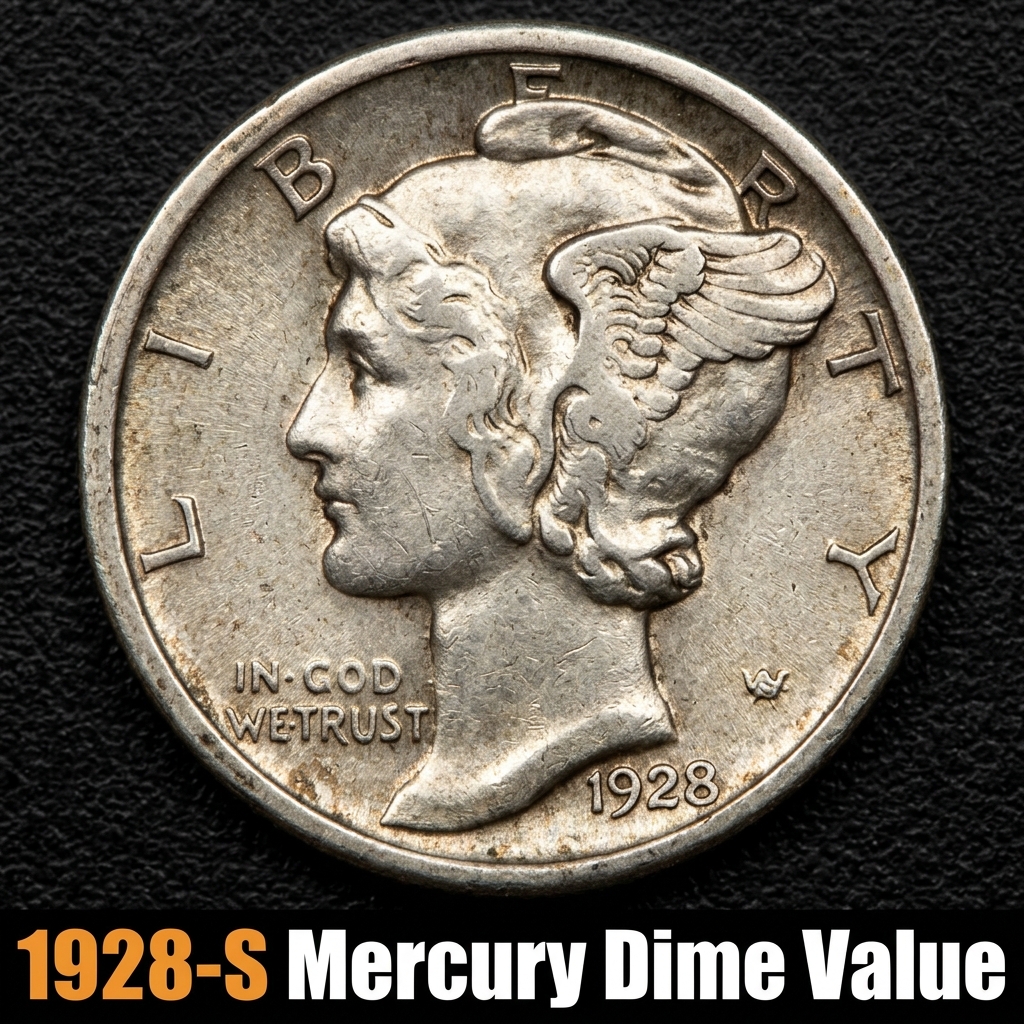
The 1928-S Mercury Dime is worth anywhere from $4 in heavily worn condition to well over $200 or more in higher mint state grades — and certain certified examples have sold for thousands at auction. If you found one of these silver dimes in an old jar, a coin album, or inherited collection, you’re sitting on something genuinely interesting.
What Makes the 1928-S Mercury Dime Special
The 1928-S Mercury Dime was struck at the San Francisco Mint and carries the small “S” mintmark on the reverse, just to the left of the “E” in “ONE.” With a mintage of around 7,400,000 coins, it’s not considered a true rarity, but that doesn’t mean it’s common in nice condition. Most of these dimes circulated for decades, leaving them worn smooth and worth only a few dollars. But original, well-preserved examples — especially those grading MS-65 or higher — become genuinely scarce and command serious collector premiums.
The Mercury Dime series, officially called the Winged Liberty Head Dime, ran from 1916 to 1945. Designed by Adolph A. Weinman, it’s considered one of the most beautiful coins ever struck by the U.S. Mint. The obverse features Liberty wearing a winged cap (often mistaken for the Roman god Mercury — hence the nickname), and the reverse shows a fasces with an olive branch. The 1928-S fits nicely into any Mercury Dime set and attracts both date collectors and type collectors alike.
If you want a fast, reliable way to identify your coin and its grade, the best coin identifier app can help you get started before you visit a dealer or submit to a grading service.
1928-S Mercury Dime Value by Grade
The value of your 1928-S Mercury Dime depends heavily on its condition — what coin collectors call the “grade.” Here’s a straightforward breakdown:
| Grade | Description | Estimated Value |
|---|---|---|
| Good (G-4) | Heavy wear, date and mintmark visible | $4 – $6 |
| Fine (F-12) | Moderate wear, some detail remains | $6 – $10 |
| Extremely Fine (EF-40) | Light wear on high points | $18 – $30 |
| About Uncirculated (AU-55) | Slight trace of wear, most luster present | $35 – $60 |
| Mint State (MS-63) | Uncirculated, minor contact marks | $75 – $120 |
| Mint State (MS-65) | Gem uncirculated, sharp strike and luster | $200 – $400+ |
For a deeper look at certified auction results and real-time pricing across all Mercury Dime dates, you can browse 1928 Mercury Dime MS grade price data on CoinHix — it’s one of the most comprehensive resources available for tracking live market values.
Full Bands — The Detail That Can Double the Value
One of the most important things Mercury Dime collectors look for is something called “Full Bands” or “FB” designation. This refers to the horizontal bands on the fasces (the bundle of rods) on the reverse of the coin being fully separated and sharply struck. A 1928-S Mercury Dime with an FB designation from PCGS or NGC can be worth significantly more than a coin of the same grade without it.
For example, a 1928-S graded MS-65 without Full Bands might sell for around $200–$300, while the same coin with Full Bands (MS-65 FB) could fetch $500, $800, or even more depending on the auction. That’s a meaningful difference, and it explains why serious collectors pay close attention to strike quality, not just wear and luster. CoinHix makes it easy to filter by FB designation when researching values, saving you hours of manual research.
How to Check If Your 1928-S Dime Is the Real Deal
Before you get too excited, it’s worth confirming your coin is genuine and that you’re reading the date and mintmark correctly. The “S” mintmark should be clearly visible on the reverse side. The coin should be 90% silver and feel noticeably heavier and more solid than a modern clad dime. The diameter is 17.9mm and the weight is 2.5 grams — a kitchen scale can help you do a quick check.
If you want a second opinion, CoinHix offers an easy-to-navigate platform where you can compare your coin against certified examples and auction records. You can also find a full breakdown of 1928 dime values across all mint marks and grades to understand exactly where your coin falls in the market.
For hands-on identification in the moment, using a magnifying glass with 5x–10x magnification can help you spot the mintmark and examine surface quality before reaching out to a dealer.
Should You Clean It or Get It Graded?
This is one of the most common questions people ask — and the answer is almost always: do not clean your coin. Cleaning removes the original surface and drastically reduces collector value. Even a gently polished coin can drop in value by 50% or more compared to an original, uncleaned example.
If your 1928-S Mercury Dime appears to be in uncirculated or near-uncirculated condition, it’s absolutely worth considering professional grading through PCGS or NGC. The cost is typically $30–$50 per coin for basic submissions, but for a gem example, certification can add far more than that to the final sale price. CoinHix can help you estimate whether grading costs make sense based on the current market before you commit.
Frequently Asked Questions
Q: How do I find the mintmark on a 1928-S Mercury Dime?
A: Flip the coin to the reverse side and look just to the left of the word “ONE” at the bottom of the coin. The small “S” is the San Francisco mintmark. It can be faint on heavily worn coins, so a magnifying glass helps.
Q: Is the 1928-S Mercury Dime made of silver?
A: Yes. Like all Mercury Dimes, the 1928-S is composed of 90% silver and 10% copper. Even a worn example contains about 0.0723 troy ounces of silver, giving it a base melt value that tracks with the silver spot price.
Q: What’s the most valuable version of the 1928 Mercury Dime?
A: Among the three 1928 Mercury Dimes — the Philadelphia (no mintmark), Denver (D), and San Francisco (S) — the 1928-S in high mint state with Full Bands is generally the most sought after. Top-pop certified examples in MS-67 FB have sold at major auctions for several thousand dollars.