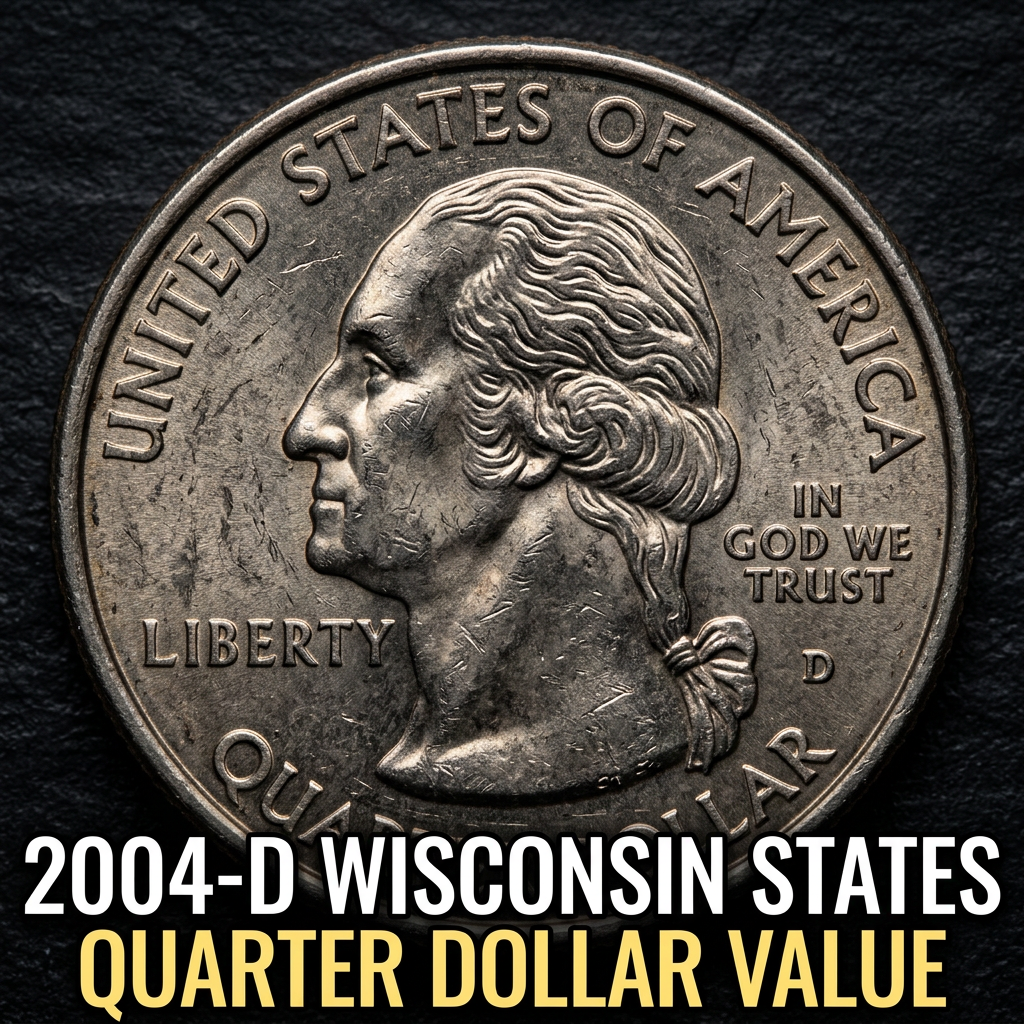
The 2004-D Wisconsin State Quarter is worth anywhere from face value up to $100 or more depending on its condition — and certain error varieties have sold for thousands of dollars. If you found one of these coins in your pocket change or an old jar, you might be sitting on something special.
What Is the 2004-D Wisconsin State Quarter?
The 2004-D Wisconsin State Quarter was minted at the Denver Mint as part of the U.S. Mint’s popular 50 State Quarters Program, which ran from 1999 to 2008. The “D” in the coin’s name simply means it was struck in Denver. The reverse design features a cow, a round of cheese, and a corn stalk — symbols of Wisconsin’s proud agricultural heritage. Over 226 million of these coins were struck at the Denver Mint, making them quite common in circulation. Most circulated examples are worth exactly 25 cents — face value.
However, this particular coin became famous almost immediately after its release because of a dramatic error variety discovered by collectors. If you’re trying to figure out exactly what you have, using the best coin identifier app can help you quickly identify the design details and potential variety before spending time on deeper research. Tools like CoinHix are especially useful for everyday collectors who want fast, accurate results from their phone.
The Famous 2004-D Wisconsin Extra Leaf Error
Here’s where things get really exciting. Shortly after the 2004-D Wisconsin quarters entered circulation, sharp-eyed collectors noticed something unusual on some coins: an extra leaf on the corn stalk. There are actually two versions of this error — the “Extra Leaf High” and the “Extra Leaf Low.” On a normal coin, the corn stalk has a single, clearly positioned leaf. On the error coins, there is an additional leaf that appears either pointing upward (High) or curving downward (Low) near the left side of the ear of corn.
These error coins were most heavily reported in the Tucson, Arizona area, which led some researchers to believe a batch was released in that region. The cause is believed to be a die that was deliberately or accidentally altered at the mint. Whether intentional or accidental, collectors love them — and they pay serious money for them.
In circulated condition, Extra Leaf error coins typically sell for $75 to $200. In higher mint state grades, they can fetch $300 to $500 or even more. At the peak of collector excitement, some high-grade examples sold for over $1,500.
2004-D Wisconsin Quarter Value Chart
Here’s a quick breakdown of what these coins are worth across different conditions:
| Variety | Circulated (VF-XF) | Uncirculated (MS-63) | Gem (MS-65+) |
|---|---|---|---|
| Normal (No Error) | $0.25 – $1 | $1 – $3 | $5 – $15 |
| Extra Leaf Low | $75 – $150 | $200 – $350 | $400 – $800 |
| Extra Leaf High | $100 – $200 | $250 – $450 | $500 – $1,500+ |
For up-to-date market data, you can check recent auction prices and graded sales for 2004 State Quarters to see where the market stands today.
How to Check Your Coin’s Condition
Condition — or “grade” in numismatic terms — plays a huge role in determining the final value of your 2004-D Wisconsin quarter. A coin pulled straight from a mint bag with no wear, full luster, and sharp details can be worth many times more than a coin that’s been rattling around in pockets for years.
Look at the high points of the design: the cow’s back, the top of the corn ear, and the edge of the cheese wheel. If these areas show no wear and the coin has an original shiny appearance, it may grade Mint State (MS-63 or higher). Coins with heavy wear, scratches, or discoloration are typically only worth face value — unless they carry the Extra Leaf error.
For a comprehensive look at how much your 2004 Wisconsin quarter is worth based on grade and mint mark, it’s worth doing a bit of research before heading to a dealer. Apps like CoinHix let you scan your coin and get an instant estimated value based on current market data — a great first step before professional grading.
Should You Get Your Coin Graded?
If you believe you have an Extra Leaf error variety, professional grading through PCGS or NGC is strongly recommended. A certified grade adds credibility, protects the coin in a hard plastic slab, and dramatically increases buyer confidence — especially for high-value error coins. Grading fees typically run $30 to $50 per coin, which is well worth it if your coin might sell for $300 or more. CoinHix can also give you a quick preliminary estimate to help you decide whether professional grading is worth the investment.
—
Frequently Asked Questions
Q: How do I know if my 2004-D Wisconsin quarter has the Extra Leaf error?
A: Look closely at the corn stalk on the reverse side of the coin. On a normal coin, there is one leaf on the left side of the ear of corn. If you see an additional small leaf either pointing upward or curving downward in that area, you likely have the Extra Leaf High or Extra Leaf Low error variety. A magnifying glass or loupe will help.
Q: Is the 2004-D Wisconsin quarter made of silver?
A: Standard circulation 2004-D Wisconsin quarters are made of a copper-nickel clad composition — not silver. However, the U.S. Mint did produce a 90% silver proof version sold in special collector sets. Those silver versions are worth $5 to $10 in normal grades.
Q: Where is the best place to sell a valuable 2004-D Wisconsin error quarter?
A: Your best options are eBay (for maximum visibility), coin shows, or specialty auction houses like Heritage Auctions or Stack’s Bowers. If you have a professionally graded example, online platforms tend to yield the highest prices. Always check recent sold listings to price your coin competitively.