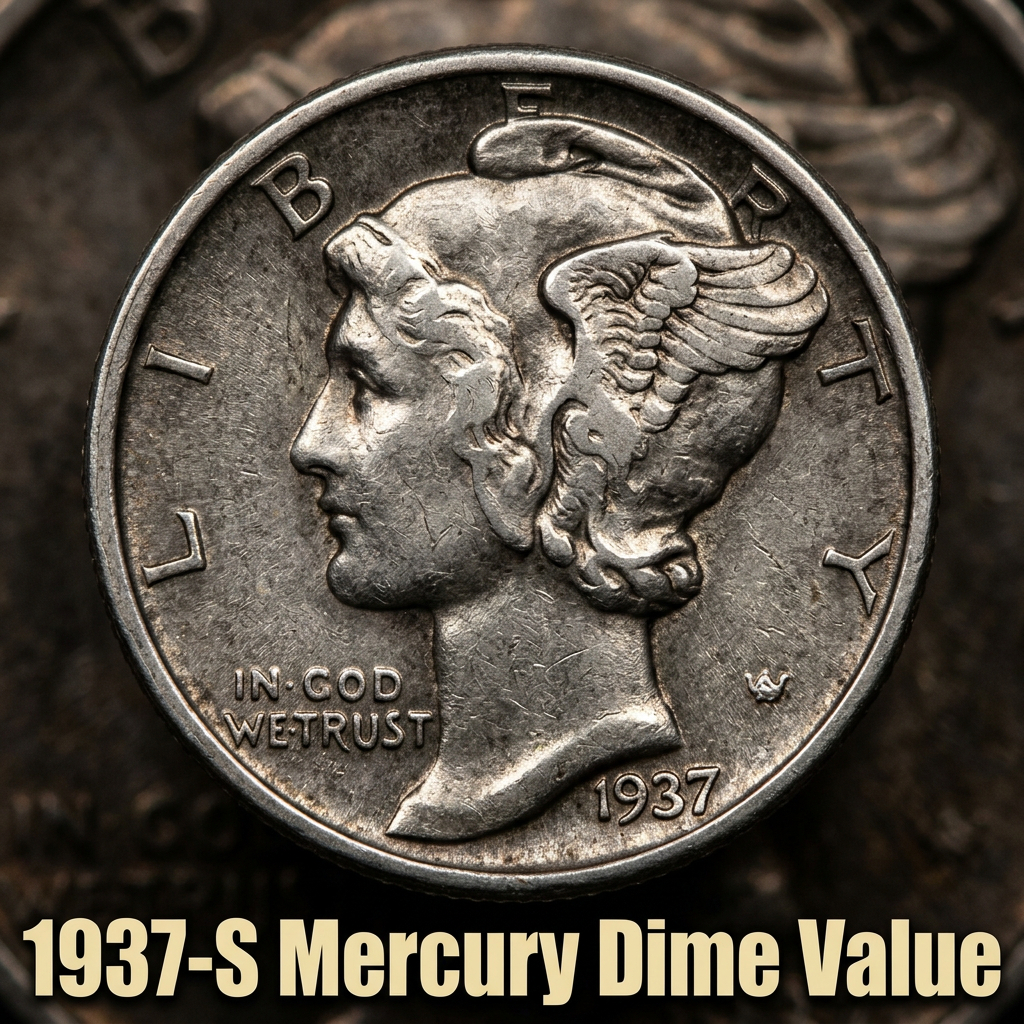
The 1937-S Mercury Dime is worth anywhere from $3 to $5 in well-worn condition, but in higher mint state grades it can sell for $30, $50, or even well over $100 depending on the strike quality and surface preservation. If you found one of these little silver coins in a box of old change or inherited it from a family member, you’re in the right place to learn exactly what it’s worth.
What Makes the 1937-S Mercury Dime Special
The Mercury Dime series ran from 1916 to 1945 and is one of the most beloved in all of American coinage. Designed by Adolph A. Weinman, the obverse features Liberty wearing a winged cap — which many people mistook for the Roman god Mercury, hence the nickname. The reverse shows a fasces and an olive branch, symbolizing strength and peace.
The 1937-S was struck at the San Francisco Mint and carries the small “S” mintmark on the reverse, to the left of the “ONE DIME” inscription. A total of 9,740,000 coins were produced that year at the San Francisco facility. That’s a reasonably solid mintage for the series, meaning 1937-S Mercury Dimes are not considered rare in circulated grades. However, well-struck, fully split bands (FSB) examples in uncirculated condition are genuinely hard to find and command strong premiums. If you want a quick way to identify what you have, using the best coin identifier app can help you confirm the mintmark and grade before you make any decisions about selling or holding.
1937-S Mercury Dime Value by Grade
Coin values depend heavily on condition, and the Mercury Dime is no exception. A coin that has been spent at the corner store a hundred times looks very different — and is worth much less — than one that sat undisturbed in a mint bag for decades. Here’s a general breakdown of what the 1937-S Mercury Dime is worth across different grades:
| Grade | Description | Estimated Value |
|---|---|---|
| G-4 (Good) | Heavy wear, design visible | $3 – $4 |
| VG-8 (Very Good) | Moderate wear, some detail | $4 – $5 |
| F-12 (Fine) | Even wear, letters clear | $5 – $6 |
| EF-40 (Extremely Fine) | Light wear on high points | $8 – $12 |
| MS-63 (Uncirculated) | No wear, some bag marks | $25 – $40 |
| MS-65 FB (Full Bands) | Sharp strike, full split bands | $80 – $150+ |
For the most current auction results and dealer pricing, you can check the live 1937-S Mercury Dime price data in MS grades directly. Markets shift, and knowing real-time values puts you in a better position whether you’re buying or selling.
The Full Bands Designation and Why It Matters So Much
One of the most important value factors for any Mercury Dime — including the 1937-S — is whether the reverse shows Full Bands (FB), sometimes called Full Split Bands (FSB). The fasces on the reverse has horizontal bands running across it. On weakly struck coins, these bands are flat and blended together. On a sharply struck coin, each band is clearly separated with a visible line down the center.
Coins that earn the Full Bands designation from PCGS or NGC can be worth two to five times more than the same coin without it. A typical MS-64 1937-S might bring $35 to $50, but an MS-64 FB example can easily top $75 or more. At the MS-65 FB level, the price jumps even further. This is why strike quality matters so much for this series — more than almost any other 20th-century coin type.
If you’re using CoinHix to research your coin, the app breaks down pricing by both grade and designation, so you can see exactly how much that Full Bands label adds to the value of your specific piece.
Silver Melt Value and Its Role in the Floor Price
Every Mercury Dime contains 0.07234 troy ounces of pure silver. At current silver prices hovering around $28–$30 per troy ounce, that gives the 1937-S Mercury Dime an intrinsic melt value of roughly $2.00 to $2.20. This is considered the absolute floor — the minimum the coin is worth no matter how worn it is.
In practice, even the most heavily circulated 1937-S sells for a bit above melt because collectors and dealers still pay a small premium for identifiable, dateable coins. The silver melt value is a useful baseline, but it’s not where most people’s coins end up selling. Most circulated examples land between $3 and $6 based on collector demand.
To get a full picture of the complete 1937 Mercury Dime value across all mint marks and grades, including the Philadelphia and Denver issues from the same year, it’s worth taking a few minutes to compare all three versions side by side.
How to Sell Your 1937-S Mercury Dime
If you’ve decided you’d rather cash in than collect, you have several solid options. Local coin dealers are convenient and will give you an immediate offer, though they’ll typically pay 60–80% of retail to leave room for their own profit. Online platforms like eBay or Heritage Auctions can net you more, especially for better-grade examples, but they require more effort and patience.
For quick identification and valuation before you walk into any shop, CoinHix is a handy tool to have on your phone. You can scan your coin, get a grade estimate, and see recent comparable sales — all before anyone makes you an offer you’re not sure about. Knowledge is leverage when it comes to selling old coins.
If your coin grades MS-65 or higher with Full Bands, professional certification through PCGS or NGC is almost always worth the submission fee, since it can significantly increase both buyer confidence and final sale price. For anything in circulated grades, raw (uncertified) sales are generally fine.
Frequently Asked Questions
Q: How do I know if my 1937 dime is from San Francisco?
A: Look on the reverse side of the coin, just to the left of the words “ONE DIME.” If you see a small letter “S,” your coin was made at the San Francisco Mint. A “D” means Denver, and no mintmark at all means Philadelphia.
Q: Is the 1937-S Mercury Dime rare?
A: Not in circulated grades — nearly 10 million were made. However, high-grade examples with Full Bands are genuinely scarce and can be hard to find in that condition, which is why they carry such strong premiums with collectors.
Q: Can I use an app to identify and value my Mercury Dime?
A: Yes, and it’s actually a smart first step. CoinHix and other coin identification tools can help you match your coin’s details, estimate the grade, and pull up recent sale prices — all from your smartphone before you ever speak to a dealer.