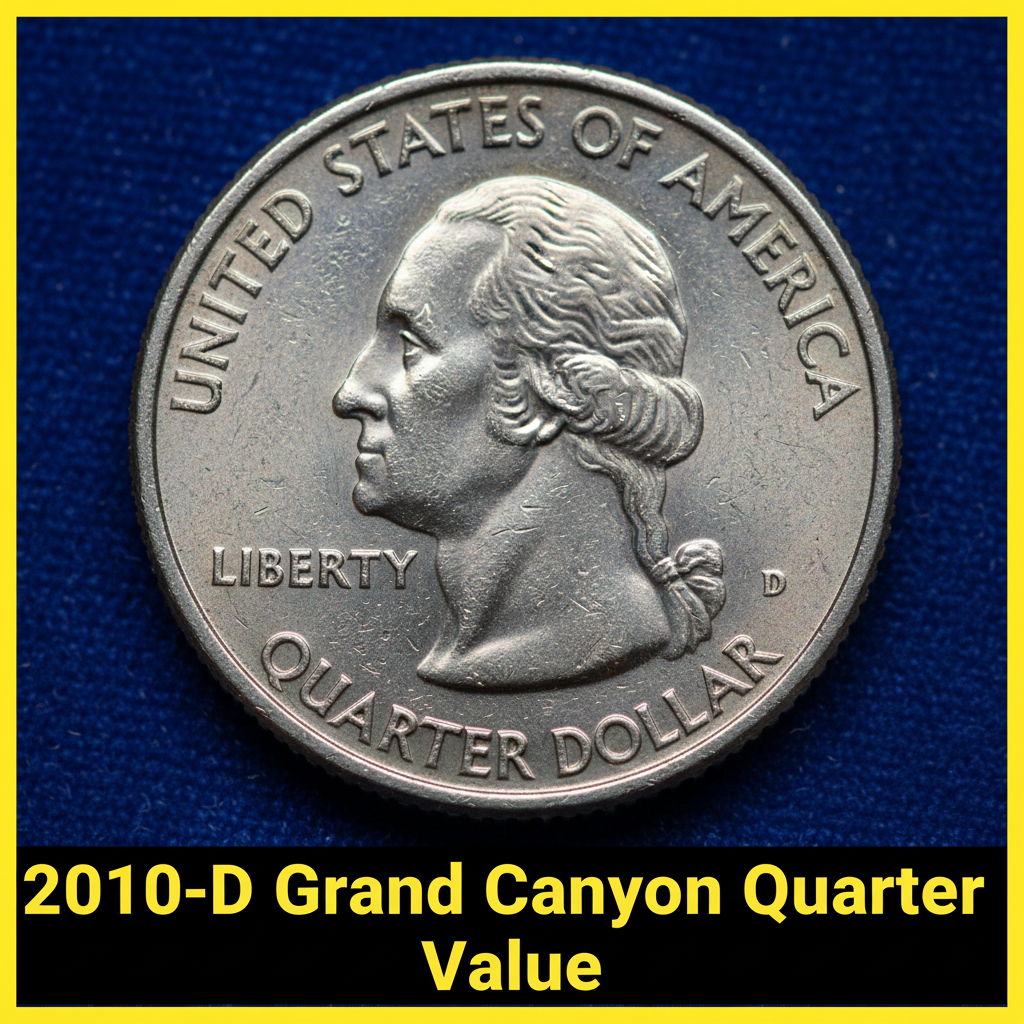
The 2010-D Grand Canyon Quarter is worth anywhere from 25 cents in circulated condition to over $100 or more in top certified mint state grades. If you found one of these coins in your pocket change or a coin jar, you’re in the right place — let’s break down exactly what it’s worth and why.
What Is the 2010-D Grand Canyon Quarter?
The 2010-D Grand Canyon Quarter is part of the America the Beautiful Quarters Program, a series launched by the U.S. Mint in 2009 to honor national parks and historic sites across the country. The “D” mintmark tells you this coin was struck at the Denver Mint. The reverse design features a stunning view of the Grand Canyon in Arizona, complete with the Colorado River winding through the canyon floor — a beautiful design that many collectors seek out.
This quarter was released in 2010 alongside four other state park quarters, and billions were minted for general circulation. Because so many exist, most circulated examples aren’t worth much more than face value. However, coins in pristine uncirculated condition, especially those graded by professional services like PCGS or NGC, can command strong premiums. If you want a quick and easy way to identify your coin and check its grade, try using the best coin identifier app available on your phone — it takes just seconds to scan and identify your coin.
2010-D Grand Canyon Quarter Value by Condition
Condition is everything when it comes to coin values. A worn, heavily circulated 2010-D Grand Canyon Quarter that shows scratches, flat details, and heavy contact marks is essentially worth face value — 25 cents. But as condition improves, value climbs noticeably.
Here’s a quick look at approximate retail values by grade:
| Condition / Grade | Approximate Value |
|---|---|
| Circulated (Good–Fine) | Face value ($0.25) |
| Extremely Fine (EF-45) | $0.50 – $1.00 |
| Mint State 63 (MS-63) | $1.50 – $4.00 |
| Mint State 65 (MS-65) | $5.00 – $15.00 |
| Mint State 67 (MS-67) | $30.00 – $75.00 |
| Mint State 68+ (MS-68 or higher) | $100.00 – $300.00+ |
Coins graded MS-68 or above are extremely rare for this issue and can fetch serious money at auction. For detailed certified coin price data on related America the Beautiful issues, you can explore certified market values for the 2010 America the Beautiful Quarter series to see how prices trend across grades.
Denver Mint Production Numbers and Why They Matter
The Denver Mint produced approximately 222,000,000 (222 million) 2010-D Grand Canyon Quarters for general circulation. That’s a massive mintage, which is one of the main reasons why circulated examples have little to no premium over face value. When hundreds of millions of a coin exist, supply far outweighs collector demand at lower grade levels.
However, the story changes dramatically at the top of the grading scale. Coins graded MS-67 or higher represent only a tiny fraction of the total production. Most quarters picked up from circulation have nicks, bag marks, and contact marks from the coin production and distribution process. Finding a pristine example that survives in superb gem condition is genuinely rare, and that scarcity drives up collector prices significantly.
The CoinHix app is a great tool for tracking real-time certified coin prices if you want to monitor market trends for this coin over time.
How to Tell If Your 2010-D Grand Canyon Quarter Is Worth More
Most people find these quarters in pocket change, old rolls, or coin jars. Here’s what to look for when evaluating yours:
– Mintmark: Flip the coin to the obverse (heads side). Look just to the right of Washington’s ear for the “D” mintmark confirming Denver production.
– Surface quality: Hold the coin under a single light source and tilt it at an angle. Fewer contact marks and scratches mean a higher potential grade.
– Luster: Uncirculated coins have a bright, cartwheel-style shine when rotated under light. If the luster looks flat or worn away, the coin has circulated.
– Strike sharpness: Check the fine details of the canyon walls and river on the reverse. A sharp, well-struck coin is more desirable to collectors.
If your coin looks like it’s never been in circulation and still has strong luster, it may be worth submitting to a professional grading service. For a broader look at what 2010 quarters are worth across all mint marks and conditions, that resource provides a solid overview to help you compare.
Should You Hold, Sell, or Submit Your 2010-D Grand Canyon Quarter?
For most circulated examples, spending or saving them as a casual collection piece is perfectly fine — they won’t make you rich. But if you have rolls of uncirculated 2010-D Grand Canyon Quarters tucked away, it’s worth taking a closer look. Gem and superb gem examples in MS-65 to MS-68 grades do attract genuine collector interest.
If you think you have a high-grade example, consider using CoinHix to research recent auction records before deciding whether to sell raw or submit for professional grading. Grading fees can eat into profits on lower-value coins, so it’s worth doing the math first.
For everyday collectors and curious folks who just found one of these quarters, CoinHix makes it easy to look up current market prices in seconds — no guessing required.
Frequently Asked Questions
Q: How much is a 2010-D Grand Canyon Quarter worth in circulated condition?
A: In average circulated condition, a 2010-D Grand Canyon Quarter is worth face value — just 25 cents. Because over 222 million were minted, circulated examples are very common and carry no significant premium.
Q: What makes a 2010-D Grand Canyon Quarter valuable?
A: The most valuable examples are those graded MS-67 or higher by a professional grading service like PCGS or NGC. Coins in MS-68 and above are genuinely scarce and can sell for $100 to $300 or more depending on the exact grade and current collector demand.
Q: Is the 2010-D Grand Canyon Quarter a rare coin?
A: As a general circulation coin, it is not rare at all. However, examples surviving in superb gem mint state condition (MS-67+) are quite scarce relative to the total mintage, and those pieces are considered genuinely collectible among America the Beautiful Quarter enthusiasts.