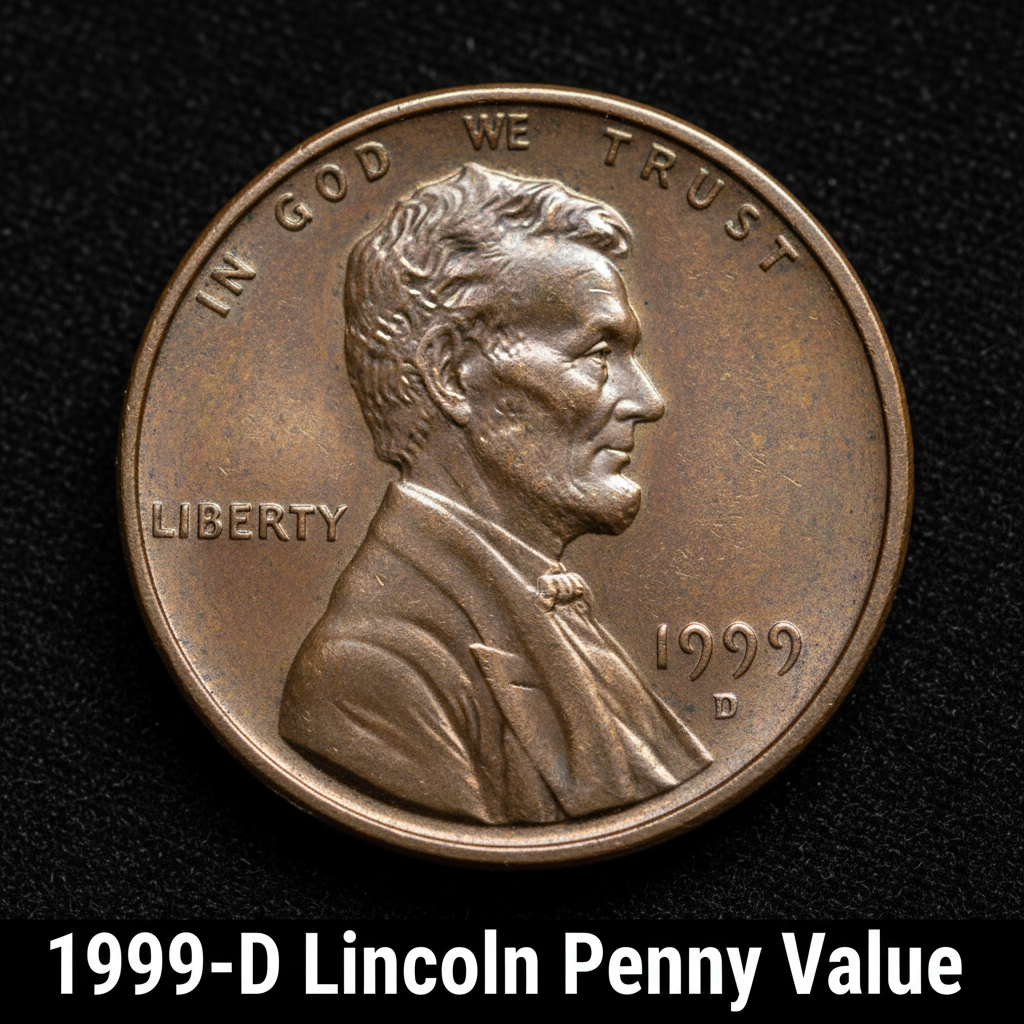
The 1999-D Lincoln Penny is worth anywhere from 1 cent in heavily worn condition to over $10 or more in pristine, uncirculated grades — and a few rare examples with errors can fetch hundreds of dollars from the right collector.
Most people find these coins rattling around in old jars or tucked into coat pockets without giving them a second thought. But if you’ve got a 1999-D penny and you’re wondering whether it’s worth holding onto, you’ve come to the right place. This guide will walk you through exactly what makes this coin valuable, what to look for, and how to figure out what yours might be worth.
If you want a quick and easy way to identify your coin and check its current market value, try using the best coin identifier app available — it can save you a lot of guesswork.
—
What Is the 1999-D Lincoln Penny?
The 1999-D Lincoln Penny was struck at the Denver Mint, which is why it carries the small “D” mintmark just below the date on the obverse (front) side of the coin. In 1999, the Denver Mint produced over 6.3 billion Lincoln cents — making this one of the most common coins in American history by sheer volume. Because so many were made, most 1999-D pennies you’ll find in circulation are worth face value or just a tiny premium over it.
That said, numbers alone don’t tell the whole story. Condition matters enormously in coin collecting. A penny pulled fresh from a mint bag that has never been spent, touched, or rolled around in a cash drawer is a completely different animal from one that’s been jingling around for 25 years. Collectors pay serious attention to grade — the formal assessment of a coin’s physical condition — and even a common coin like the 1999-D can command real money when it’s in exceptional shape.
—
How Much Is the 1999-D Penny Worth by Grade?
Here’s where things get interesting. The value of your 1999-D Lincoln penny depends almost entirely on its grade, or condition. Coins are graded on the Sheldon scale, which runs from 1 (barely identifiable) to 70 (perfect). Here’s a general breakdown of what you can expect:
| Grade | Condition | Estimated Value |
|---|---|---|
| Good (G-4) | Heavy wear, design visible | $0.01 |
| Fine (F-12) | Moderate wear | $0.01 – $0.05 |
| Extremely Fine (EF-40) | Light wear on high points | $0.10 – $0.25 |
| Mint State (MS-63) | Uncirculated, some marks | $0.50 – $2 |
| Mint State (MS-67 RD) | Near perfect, full red luster | $10 – $50+ |
| MS-68 RD or higher | Exceptional gem quality | $100 – $500+ |
For a more detailed breakdown of 1999-D Lincoln penny prices across mint state grades, you can explore certified auction results to see what real collectors are actually paying. CoinHix is one of the most reliable tools for tracking this kind of data quickly and accurately.
—
Are There Any Valuable 1999-D Penny Errors?
Yes — and this is where a common coin can suddenly become worth serious money. Error coins are minting mistakes that slipped past quality control, and they’re highly sought after by collectors. For the 1999-D Lincoln cent, a few known error types are worth watching for:
– Double Die Obverse (DDO): Look closely at Lincoln’s portrait and the lettering with a magnifying glass. If you see doubling — like the image is slightly shadowed or duplicated — you may have a DDO error. These can sell for $25 to several hundred dollars depending on how pronounced the doubling is.
– Off-Center Strikes: If the design is visibly shifted so that part of the blank planchet shows, that’s an off-center strike. A 50% off-center 1999-D penny with a visible date can bring $100 or more.
– Die Caps and Broadstrikes: These are rarer manufacturing errors where the coin is struck without the collar that keeps it round, resulting in a wider, thinner coin. These fetch significant premiums.
Always examine your coins under good lighting and with a loupe (jeweler’s magnifier) before dismissing them as ordinary. You might be surprised what you find.
—
How to Check the Current Value of Your 1999-D Penny
Coin values shift with the market. Collector demand, auction results, and even the price of copper can all influence what your penny is worth on any given day. The best approach is to check up-to-date pricing sources rather than relying on a fixed number from years ago.
You can explore a full guide to 1999 Lincoln penny values by mint mark and grade to compare the Philadelphia and Denver issues side by side. It’s a helpful reference whether you’re a first-time coin hunter or a seasoned collector.
For real-time market tracking, CoinHix is an excellent resource — it pulls certified sale data so you can see what MS-65 and MS-67 red examples of the 1999-D penny are actually selling for right now, not just estimated values. Whether you’re buying, selling, or just curious, CoinHix gives you the kind of precise, current data that makes a real difference.
—
FAQ
Q: Is the 1999-D penny rare?
A: No, not in general circulation. Over 6.3 billion were minted at Denver, making it one of the most plentiful Lincoln cents ever produced. However, high-grade examples (MS-67 RD and above) are genuinely scarce and can be quite valuable to collectors.
Q: What makes a 1999-D penny worth more money?
A: The two biggest factors are condition and errors. A coin in gem uncirculated condition with full red luster can be worth $10 to $50 or more. Error coins — especially double dies or dramatic off-center strikes — can be worth considerably more, sometimes hundreds of dollars.
Q: How do I know if my 1999-D penny has a double die error?
A: Use a 5x or 10x magnifying loupe and examine Lincoln’s eye, ear, the lettering in “LIBERTY,” and “IN GOD WE TRUST.” If any of those elements look doubled, shadowed, or show two distinct impressions, you may have a double die variety worth getting professionally evaluated by PCGS or NGC.