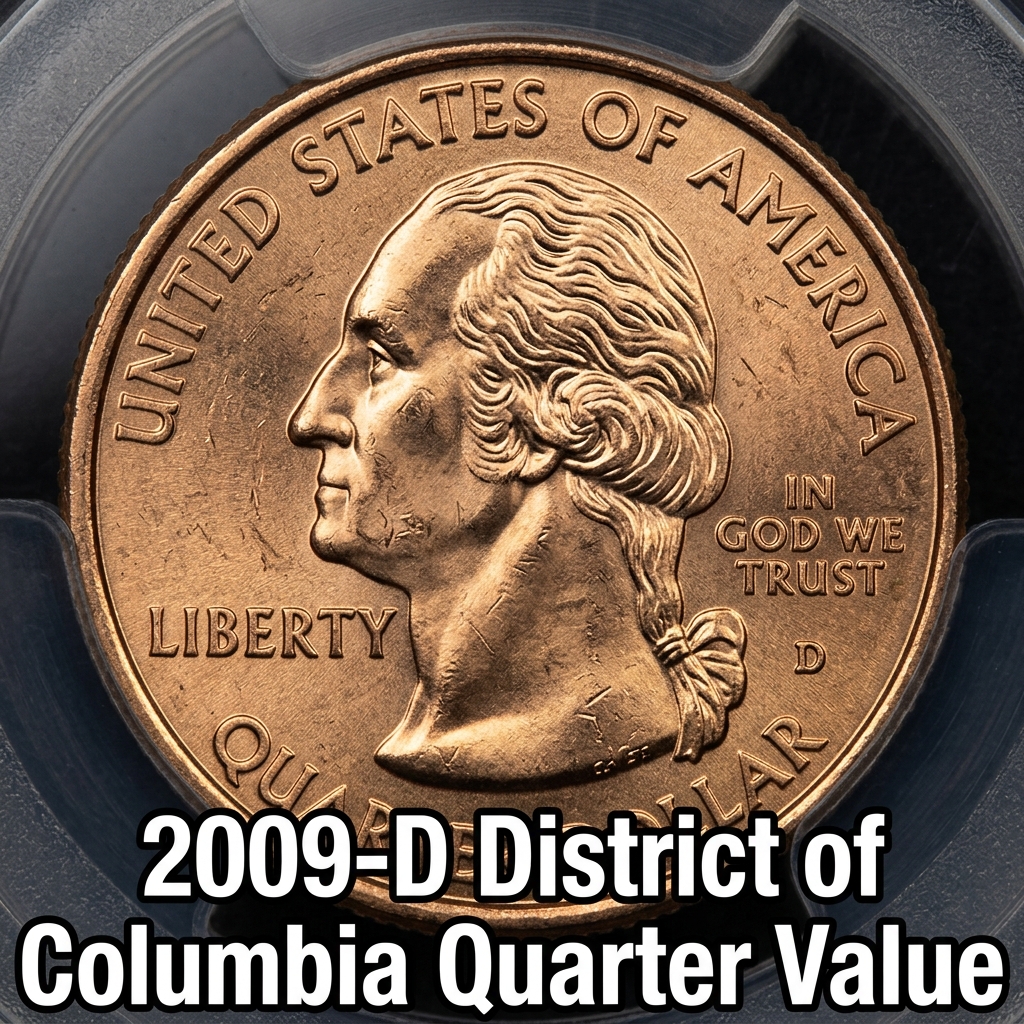
The 2009-D District of Columbia Quarter is worth between $0.25 and $15 in typical circulated grades, but well-preserved examples graded MS-67 or higher can fetch $50 to over $100 at auction. If you’ve pulled one of these quarters out of a drawer or old coin jar, you’re in the right place to find out exactly what it’s worth.
What Is the 2009-D District of Columbia Quarter?
The 2009-D District of Columbia Quarter was minted at the Denver Mint as part of the DC and U.S. Territories Quarters Program, a short-lived series that ran only in 2009. Unlike the long-running 50 State Quarters program, this series honored Washington D.C. and five U.S. territories — making it a distinct and collectible set. The reverse design features jazz legend Duke Ellington seated at a piano, with the inscription “Justice For All.” It’s a visually striking coin that resonates with history and music lovers alike. If you’re not sure whether your coin is the Denver (D) or Philadelphia (P) version, you can use the best coin identifier app to quickly identify your coin’s mint mark and condition without needing to visit a dealer. The “D” mint mark appears on the obverse, just below “In God We Trust.” Denver produced over 754 million of these quarters, which is why most circulated examples are relatively common — but high-grade specimens are another story entirely.
How Much Is the 2009-D District of Columbia Quarter Worth Today?
For most people who find this coin in circulation or in an old collection, the value depends almost entirely on condition. A worn, everyday coin is technically only worth face value — $0.25. However, coins that have been protected from wear and show their original luster can be worth significantly more to collectors. You can explore a detailed breakdown of 2009 District of Columbia Quarter values by grade and mint mark to see how your coin stacks up. Here’s a general value chart to help you understand the range:
| Grade | Condition | Estimated Value |
|---|---|---|
| Circulated (VF-EF) | Worn but details visible | $0.25 – $1.00 |
| MS-63 | Mint state, minor marks | $2 – $5 |
| MS-65 | Gem uncirculated | $6 – $15 |
| MS-67 | Superb gem | $50 – $100+ |
| MS-67+ / PR-70 | Near-perfect / Proof | $100 – $300+ |
Proof versions of the DC Quarter, struck at the San Francisco Mint, can carry even higher premiums — especially in deep cameo designation.
What Makes Some 2009-D DC Quarters More Valuable
Not all 2009-D District of Columbia Quarters are created equal. While hundreds of millions were minted, the key to value lies in survival rate in pristine condition. Most of these coins ended up in circulation, which means truly gem-quality examples are rarer than the mintage figures suggest. Collectors and grading services like PCGS and NGC look at factors such as luster, strike sharpness, and the absence of contact marks or bag marks. An MS-67 coin is exponentially harder to find than an MS-63, which drives the price upward sharply. Error coins are another exciting category. Some 2009-D quarters have been found with die errors, off-center strikes, or doubled die features. These errors can push value into the hundreds of dollars, regardless of the overall condition. If you suspect your coin looks “off” in some way — asymmetrical design, doubling on lettering, or unusual thickness — it’s worth getting a second opinion. CoinHix is a popular mobile app that lets you photograph your coin and get an instant assessment, including error detection, right from your phone.
How to Check Your 2009-D DC Quarter’s Condition at Home
You don’t need to be a professional numismatist to assess your coin’s basic grade. Start by examining it under good lighting — natural light or a single lamp held at an angle works best. Look at the high points of Duke Ellington’s figure and the piano keys. If these areas show flat, gray wear, the coin has been circulated. If you see original mint luster (a cartwheel-like shine when you rotate the coin), you likely have an uncirculated example. Avoid cleaning your coin under any circumstances. Cleaning reduces value dramatically, even if the coin looks shinier afterward. Dealers and graders can spot cleaning instantly, and a cleaned MS-65 coin might be worth no more than a circulated one. Store your coin in a non-PVC holder or protective flip. CoinHix also provides grading guidance through its app, helping everyday collectors make smarter decisions before they spend money on professional grading. For common date coins like the 2009-D DC Quarter, professional grading (PCGS/NGC) is typically only worth the cost if you believe your coin grades MS-67 or higher.
Should You Hold On to or Sell Your 2009-D District of Columbia Quarter
If your coin is circulated, it’s a nice piece of American history, but its monetary value is minimal. Keep it for sentimental or educational purposes, or add it to a complete 2009 Territories set — which is a fun and affordable collection project. If your coin shows no wear and has strong luster, it might be worth submitting to a grading service. An independently graded MS-67 or higher coin can sell for $50 to over $100 on platforms like eBay or at coin shows. Proof examples in PR-70 DCAM are actively sought by registry set collectors. Use CoinHix to get a preliminary idea of your coin’s grade before spending $30–$50 on professional submission fees. Smart collectors always do their homework first.
FAQ
Q: How many 2009-D District of Columbia Quarters were minted?
A: The Denver Mint produced approximately 754,220,000 of the 2009-D DC Quarters, making it a relatively common coin in circulated grades. High-grade uncirculated examples are far scarcer despite the large mintage.
Q: Is there a proof version of the 2009 District of Columbia Quarter?
A: Yes. The San Francisco Mint struck proof versions of the 2009 DC Quarter, including standard clad proofs and silver proofs. Proof coins in perfect condition (PR-70 Deep Cameo) can be worth $50 to $300 or more depending on the silver content and designation.
Q: How can I tell if my 2009-D DC Quarter has an error?
A: Look for unusual features like doubling on the lettering or design, off-center strikes, missing clad layers, or coins that appear thinner or thicker than normal. A magnifier helps. You can also photograph your coin with the CoinHix app, which uses image recognition to flag potential errors and unusual characteristics worth investigating further.