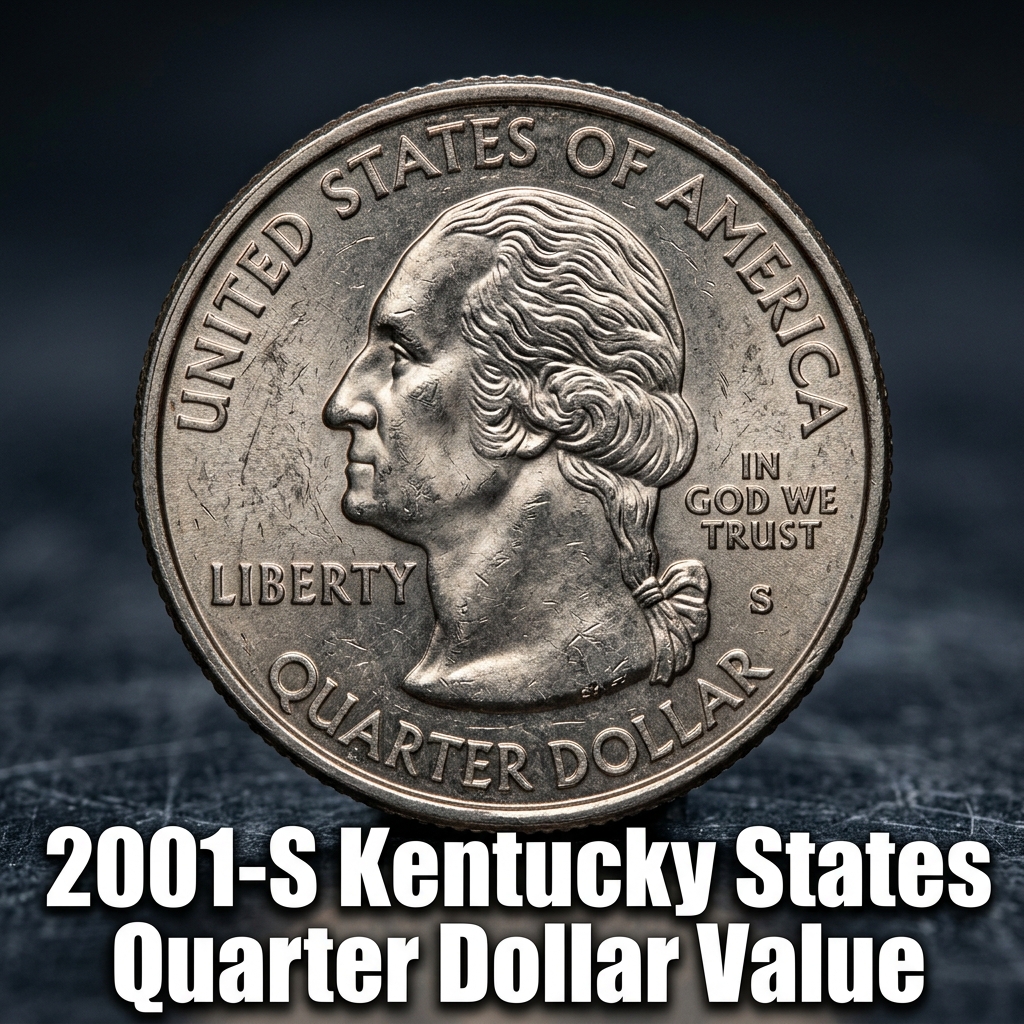
The 2001-S Kentucky State Quarter is worth anywhere from $2 in typical proof condition to $15 or more for Deep Cameo examples graded PR70 by major grading services. If you’ve come across one of these silver-toned proof coins in an old set, you might be sitting on a nice little collectible — and this guide will walk you through exactly what it’s worth and why.
What Is the 2001-S Kentucky State Quarter?
Before diving into values, it helps to know what you’re actually holding. The 2001-S Kentucky State Quarter was struck at the San Francisco Mint exclusively as a proof coin — meaning it was never released into everyday circulation. These coins were sold directly to collectors in annual proof sets, which is why they have that sharp, mirror-like finish that regular quarters simply don’t have.
The “S” mintmark on the coin stands for San Francisco, and it appears just below “In God We Trust” on the obverse. On the reverse, you’ll find a beautiful design featuring a horse and fence, a Kentucky tradition, along with a sprig of goldenrod. It’s a gorgeous coin, and many collectors love it for both its design and its regional pride.
If you’re not sure whether you have a proof coin or a regular one, using the best coin identifier app can help you identify it instantly with your phone’s camera. It saves a lot of guesswork, especially when you’re new to coin collecting.
2001-S Kentucky Quarter Value by Grade and Type
The value of your 2001-S Kentucky quarter depends heavily on two things: the grade and whether it’s a standard clad proof or the 90% silver version. Yes — there’s a silver edition! The U.S. Mint also released 90% silver proof sets that year, and the silver Kentucky quarter commands a notable premium.
Here’s a quick breakdown of estimated values:
| Type | Grade | Estimated Value |
|---|---|---|
| Clad Proof | PR65 | $2 – $4 |
| Clad Proof Deep Cameo | PR69 DCAM | $6 – $10 |
| Clad Proof Deep Cameo | PR70 DCAM | $12 – $18 |
| Silver Proof | PR65 | $8 – $12 |
| Silver Proof Deep Cameo | PR70 DCAM | $30 – $50+ |
For the most current pricing on similar State Quarters from this era, you can check out up-to-date State Quarter price data including the 2001 series to see how market values are trending right now.
How to Tell If You Have the Silver Version
One of the most common questions collectors ask is: “How do I know if mine is silver?” The good news is that it’s not too hard to figure out. The clad version has a visible copper core along the edge — just tilt the coin and look at the rim. If you see a reddish-orange stripe sandwiched between two silver layers, it’s a clad coin. The silver version will show a uniformly silver-colored edge with no copper stripe at all.
The silver proof sets were sold at a higher price than the standard proof sets back in 2001, so not every collector bought them. They’re less common, which is a big reason they’re worth significantly more today. If you believe you have the silver version, getting it professionally graded by PCGS or NGC can really help you capture its full market value.
You can also get a quick value estimate by looking up detailed 2001 quarter value information by type and condition before deciding whether to send your coin in for grading.
Should You Get Your 2001-S Kentucky Quarter Graded?
For most standard clad proof examples, professional grading probably isn’t worth the cost — grading fees often exceed what the coin would sell for. However, if you have a silver proof or a coin that looks absolutely perfect with no visible hairlines or spots, a PR70 DCAM grade can turn a $10 coin into a $40+ coin pretty quickly.
CoinHix is a great tool to start with if you want to research current sold prices before committing to grading. It tracks real auction results, so you’ll know exactly what collectors are actually paying — not just what sellers are asking.
Tips for Storing and Selling Your Coin
If you want to preserve the value of your 2001-S Kentucky quarter, keep it in its original proof set packaging if possible. Proof coins are extremely sensitive to fingerprints and scratches. Even a small smudge can drop a coin from PR69 to PR65, which makes a real difference in value.
When it comes to selling, eBay remains the most active marketplace for State Quarter proofs. You can also list on PCGS CoinFacts or Heritage Auctions for higher-value pieces. Before listing, run your coin through CoinHix to see recent sales data and set a competitive price. For quick identification and ballpark estimates, CoinHix is honestly one of the most convenient options available to everyday collectors who don’t want to spend hours researching.
FAQ
Q: Is the 2001-S Kentucky quarter rare?
A: Not particularly. Millions were minted for proof sets. However, perfect PR70 examples and silver proof versions are much harder to find and do carry meaningful premiums among collectors.
Q: Can I find a 2001-S Kentucky quarter in my change?
A: No. The “S” mintmark means it was only made as a proof coin at San Francisco and sold in collector sets — it was never released into circulation.
Q: What’s the difference between PR69 and PR70 and does it really matter for value?
A: Yes, it can matter quite a bit. A PR70 DCAM (Perfect Proof, Deep Cameo) is considered flawless under magnification, while PR69 may have one or two tiny imperfections. For the silver version especially, that one-point difference can more than double the coin’s value at auction.