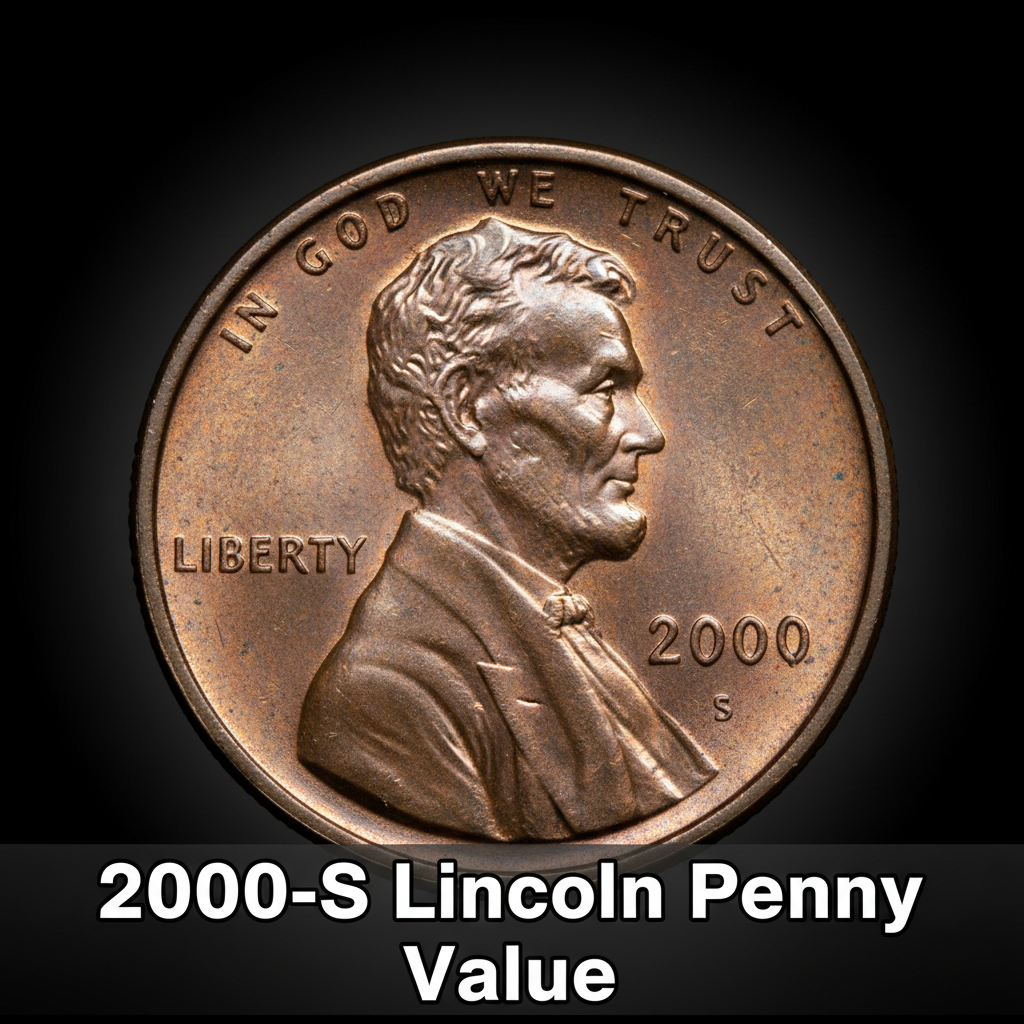
The 2000-S Lincoln Penny is worth anywhere from $1.50 to over $6 in typical circulated or proof grades, but top-tier certified examples can fetch $20 or more depending on condition and eye appeal. If you found one of these in your change jar or inherited a coin collection, you’re in the right place to find out exactly what you’ve got.
Understanding the 2000-S Lincoln Penny
The “S” mintmark on this penny tells you something important right away — it was struck at the San Francisco Mint, not Philadelphia or Denver. The San Francisco Mint doesn’t produce coins for everyday circulation. Instead, it makes special proof coins that are sold directly to collectors in annual proof sets. That means the 2000-S Lincoln Penny was never meant to end up in your pocket change. It was carefully struck with polished dies and specially prepared planchets to produce a coin with mirror-like fields and sharp, frosted details.
If you’re holding one of these and wondering whether it’s valuable, the first step is figuring out exactly what version you have. Using the best coin identifier app can help you quickly identify the mintmark, variety, and condition of your coin without needing to be an expert. A good app will walk you through everything from the basics to more advanced details like surface quality and eye appeal.
What Makes the 2000-S Penny Special
There are actually two distinct versions of the 2000-S Lincoln Penny, and that distinction matters a lot for value.
The first is the standard 2000-S Proof, which has a copper-plated zinc composition — the same material used on modern pennies since 1982. This version is the more common of the two and typically sells for around $1.50 to $4 in PR65 or PR66 grades.
The second — and far more interesting — is the 2000-S Silver Proof Lincoln Penny. Wait, a silver penny? Yes. The U.S. Mint offered a special Silver Proof Set in 2000 that included a cent made with a 95% copper composition instead of the standard zinc core. This version is sometimes called the “copper clad” or “silver set” penny, and it’s more desirable to collectors. A well-preserved example of this type can sell for $5 to $20 or more depending on grade.
Both versions were produced at San Francisco and carry the same design — the classic Lincoln Memorial reverse and Vic Brenner’s iconic Lincoln portrait on the obverse.
2000-S Lincoln Penny Value by Grade
Grading is everything with proof coins. A coin that grades PR70 (perfect) is worth significantly more than one that grades PR65. Here’s a general breakdown of what you can expect:
| Grade | Type | Estimated Value |
|---|---|---|
| PR65 RD | Standard Proof | $1.50 – $3.00 |
| PR67 RD | Standard Proof | $4.00 – $6.00 |
| PR69 DC RD | Standard Proof | $10.00 – $18.00 |
| PR70 DC RD | Standard Proof | $20.00 – $35.00+ |
| PR67 RD | Silver Set Proof | $6.00 – $12.00 |
| PR70 DC RD | Silver Set Proof | $25.00 – $50.00+ |
For a deeper look at certified sale prices and auction records, you can browse the 2000 Lincoln Penny price data by grade and surface quality to see exactly what buyers have paid at recent auctions.
How to Check Your Coin’s Condition
If you’re not sure what grade your 2000-S Lincoln Penny might be, don’t guess — use the right tools. CoinHix is a fantastic resource that lets you research coin values, compare grades, and track market trends all in one place. Whether you’re a seasoned collector or just getting started, CoinHix makes it easy to understand what your coin is worth before you sell or trade it.
When inspecting a proof coin, look for:
– Hairlines or scratches — even tiny ones can drop a grade significantly
– Fingerprints or smudges — oils from skin damage the surface quickly
– Full cameo contrast — the frosty raised design against mirror-like fields is what makes a proof beautiful and valuable
– Original color — a deep red (RD) designation commands a premium over red-brown (RB) or brown (BN)
Never clean your coin. Even a gentle wipe can introduce tiny scratches that professional graders will spot immediately.
Where to Sell or Get More Information
If you’re ready to find out the full picture on your 2000-S Lincoln Penny’s worth, it helps to get a second opinion from multiple sources. For a comprehensive breakdown that’s easy to understand, the detailed 2000 penny value guide with current market pricing is a great starting point for everyday collectors trying to make sense of the numbers.
And if you want to track your collection over time, list coins for sale, or simply stay updated on Lincoln cent values, CoinHix offers a clean and user-friendly platform that serious and casual collectors alike have come to rely on.
—
Frequently Asked Questions
Q: How do I know if my 2000-S penny is from the Silver Proof Set?
A: The easiest way is to check the composition. A standard 2000-S proof penny weighs 2.5 grams and has a zinc core with copper plating. The Silver Set version weighs slightly differently and has a 95% copper composition. If your coin came in a sealed government-issued set, check the packaging for “Silver Proof Set” labeling. When in doubt, a professional coin dealer or PCGS/NGC grading service can confirm the variety.
Q: Is a 2000-S penny valuable if it’s not in a proof set?
A: Loose proof coins can still be valuable, but condition matters enormously. If the coin has been mishandled or cleaned, it may only be worth face value to most buyers. However, a well-preserved loose 2000-S proof in PR65 or higher can still bring $2 to $10 depending on the buyer and the specific grade.
Q: Should I get my 2000-S penny graded by PCGS or NGC?
A: It depends on the coin’s condition and what you think it might be worth. Grading fees typically run $20 to $50 per coin, so it only makes financial sense if your coin looks like it could grade PR68 or higher, or if you believe you have a Silver Proof version. If the coin has visible hairlines or damage, the grading cost likely won’t be recovered in resale value.