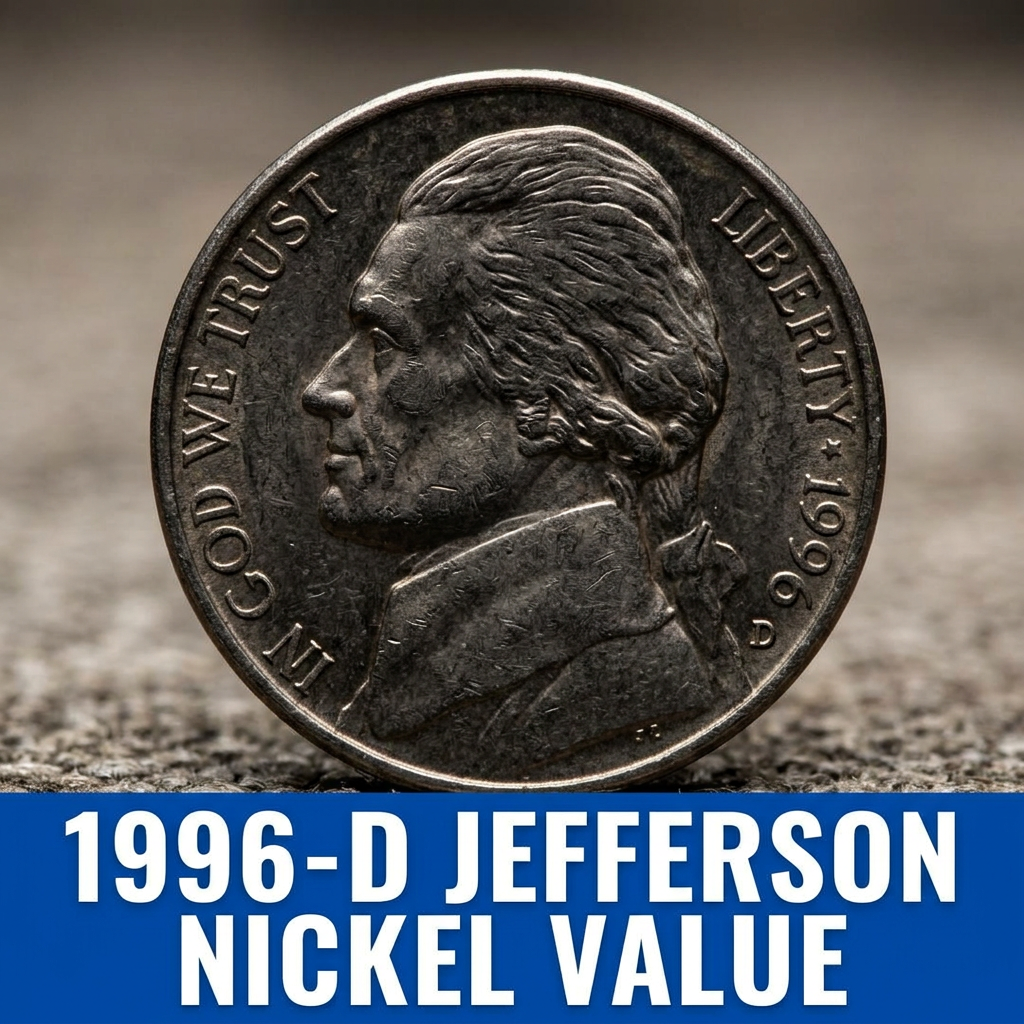
The 1996-D Jefferson Nickel is worth anywhere from 5 cents in heavily circulated condition to around $10 or more in pristine mint state grades. Most examples you find in pocket change are worth face value, but a well-preserved specimen can surprise you.
What Makes the 1996-D Jefferson Nickel Special
The 1996-D Jefferson Nickel was struck at the Denver Mint, identified by the small “D” mintmark on the coin’s obverse. That year, Denver produced over 401 million nickels — a high mintage that generally keeps values modest for circulated examples. Still, the coin holds a place in the hearts of collectors who pursue complete Jefferson Nickel sets by date and mintmark.
If you’ve pulled one of these out of an old jar or a coin roll, you’re in good company. Millions of Americans stumble upon coins like this every day and wonder whether they’re sitting on hidden treasure. The honest answer: most 1996-D nickels are worth face value unless they’re in exceptional uncirculated condition. But that doesn’t mean you should toss it aside without a closer look. Condition, luster, and eye appeal all factor into a coin’s value — and a sharp strike with full steps on Monticello can push the price much higher.
Using the best coin identifier app on your phone is a great first step when you find an old coin and want a quick, reliable identification and value estimate without visiting a dealer.
1996-D Jefferson Nickel Value by Grade
Coin values are tied closely to grade — the official scale that measures a coin’s condition from Poor (P-1) all the way to Perfect Mint State (MS-70). Here’s a general breakdown of what a 1996-D Jefferson Nickel is worth across different grades:
| Grade | Condition | Estimated Value |
|---|---|---|
| Good (G-4) | Heavily worn | Face value ($0.05) |
| Fine (F-12) | Moderate wear | $0.05 – $0.10 |
| Extremely Fine (EF-40) | Light wear | $0.10 – $0.50 |
| Mint State (MS-63) | Uncirculated, minor marks | $1 – $3 |
| Mint State (MS-65) | Gem uncirculated | $4 – $8 |
| MS-66 Full Steps | Premium gem, full steps | $50 – $150+ |
For the most current auction data, you can check recent Jefferson Nickel mint state price records to see what collectors are actually paying right now.
Understanding the Full Steps Designation
One of the most important — and often overlooked — factors in Jefferson Nickel valuation is the “Full Steps” (FS) designation. This refers to the steps at the base of Monticello on the reverse of the coin. If five or six complete, uninterrupted steps are visible with no weakness or flatness, the coin qualifies as Full Steps, and its value can jump dramatically.
A 1996-D Jefferson Nickel graded MS-65 Full Steps, for example, can sell for $50 to $150 or even more at auction, compared to just $4–$8 for a standard MS-65. The reason is simple: striking Full Steps on Jefferson Nickels has always been challenging because the design requires a lot of metal flow to fill the steps detail. When a coin achieves it perfectly, collectors pay a premium.
If your coin looks bright and untouched, hold it under a magnifying glass or loupe and examine those steps carefully. You might have something more valuable than you think. CoinHix is a great tool to help you track down comparable sales for Full Steps examples so you don’t sell yourself short.
How to Check If Your 1996-D Nickel Is Worth More
So you’ve got a 1996-D Jefferson Nickel and you’re wondering if it’s worth grading or selling. Here are a few practical tips:
Check the mintmark. The “D” mintmark should appear on the obverse (front) of the coin, near Jefferson’s portrait. No mintmark means it came from Philadelphia; an “S” means it’s a proof coin from San Francisco, which carries different value entirely.
Look at the luster. An uncirculated coin will have a frosty or cartwheel sheen when tilted under light. If the surfaces look dull or show wear on the high points (Jefferson’s cheekbone, the top of Monticello), it’s circulated.
Examine the steps. As mentioned above, the Monticello steps on the reverse are the big value factor for uncirculated examples. Count them carefully.
Use reliable resources. The 1996 nickel value guide offers a helpful breakdown of what these coins are worth across all grades and varieties, which is perfect for beginners trying to understand the market.
You can also download CoinHix on your smartphone to quickly look up recent sales, compare grades, and get a realistic sense of your coin’s market value before deciding whether to hold, sell, or submit it for professional grading.
FAQ
Q: Is a 1996-D Jefferson Nickel rare?
A: No, the 1996-D Jefferson Nickel is not rare. The Denver Mint produced over 401 million of them, making it a common date. However, high-grade examples — especially those with the Full Steps designation — are genuinely scarce and can command strong premiums from collectors.
Q: Should I get my 1996-D nickel professionally graded?
A: It depends on the condition. If your coin appears to be uncirculated with sharp detail and strong luster, it may be worth submitting to PCGS or NGC for grading. Coins that come back as MS-66 Full Steps or higher can be worth far more than the grading fee. For circulated coins, professional grading isn’t cost-effective.
Q: Where is the best place to sell a 1996-D Jefferson Nickel?
A: For common circulated examples, a local coin shop is the easiest option. For higher-grade coins, eBay or major auction houses like Heritage Auctions tend to attract serious collectors willing to pay market prices. Always research recent comparable sales first — CoinHix makes this easy with its up-to-date pricing database — so you know what your coin is actually worth before listing it.