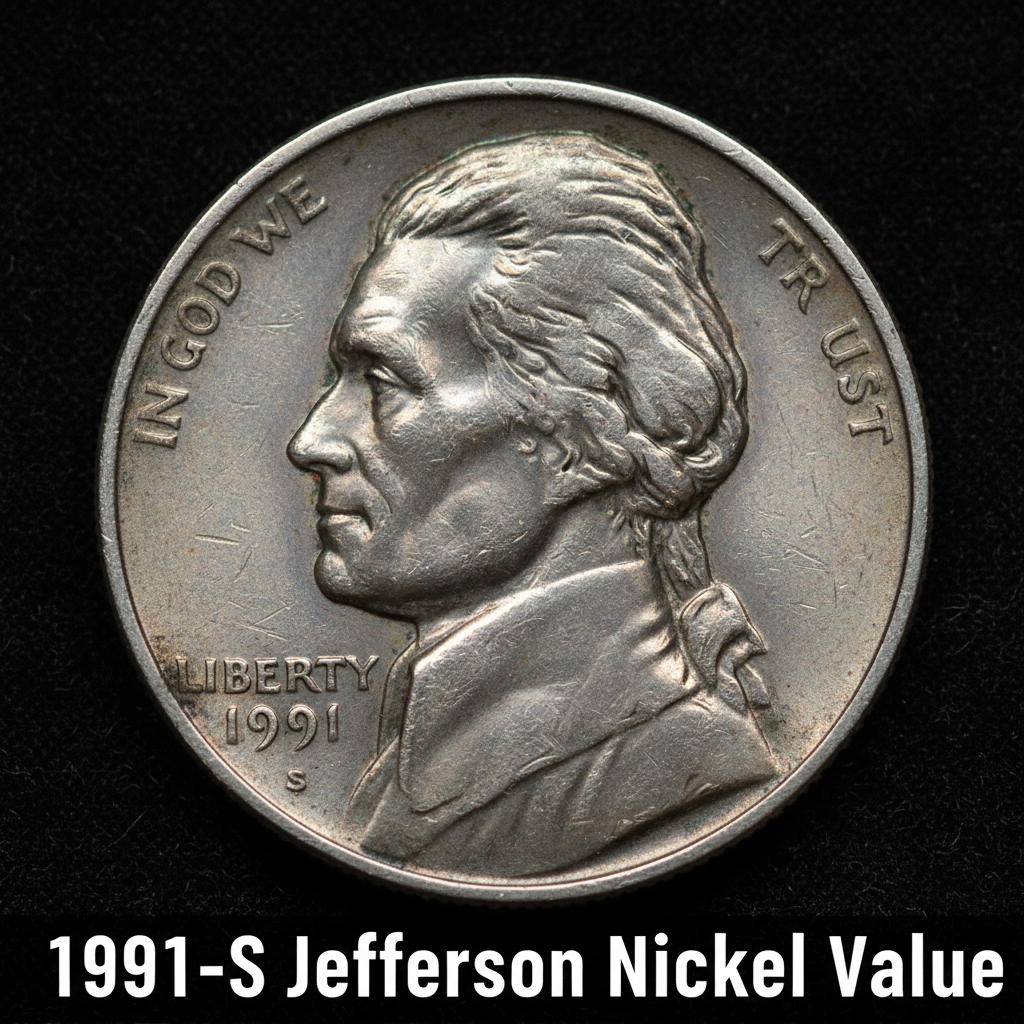
The 1991-S Jefferson Nickel is worth anywhere from $3 to $10 for a typical proof example, but top-grade specimens graded PR-70 Deep Cameo can fetch $50 or more. If you found one of these coins in an old collection or proof set, you might be sitting on more than just five cents.
What Is the 1991-S Jefferson Nickel?
The “S” mint mark on this coin tells you it was struck at the San Francisco Mint — and that’s a big deal. The San Francisco Mint doesn’t produce nickels for everyday circulation. Instead, it makes proof coins specifically for collectors. These are struck using specially polished dies and planchets, giving them that sharp, mirror-like finish you’ll notice right away.
The 1991-S Jefferson Nickel was included in the U.S. Mint’s annual proof set, which was a popular gift item throughout the late 1980s and early 1990s. As a result, millions of proof sets were sold, and many of these nickels are still out there in original government packaging. If yours is still sealed in its original blue box, that’s a great sign for value.
Using the best coin identifier app available today can help you quickly identify whether your coin is a genuine proof strike or just a regular nickel that happens to look shiny. The difference matters quite a bit when it comes to pricing.
How Much Is the 1991-S Jefferson Nickel Worth?
Value depends heavily on condition and whether the coin has been graded by a professional service like PCGS or NGC. Here’s a general breakdown:
| Grade | Type | Estimated Value |
|---|---|---|
| PR-65 | Proof | $3 – $5 |
| PR-67 | Proof | $6 – $12 |
| PR-69 Deep Cameo | Proof Deep Cameo | $15 – $30 |
| PR-70 Deep Cameo | Proof Deep Cameo | $40 – $75+ |
The “Deep Cameo” designation refers to coins with a strong frosted finish on the raised design and a deeply mirrored background — visually stunning and more desirable to collectors. You can explore detailed 1991 Jefferson Nickel price data across multiple grades and mint marks to compare values side by side before making any buying or selling decisions.
Understanding Proof Coin Grades and Why They Matter
If you’re new to coin collecting, grading might seem overwhelming — but it’s simpler than it looks. Coins are graded on a scale from 1 to 70. For proof coins like the 1991-S Jefferson Nickel, grades typically start around PR-60 and go up to the perfect PR-70.
What separates a $5 coin from a $60 coin? It often comes down to tiny contact marks, hairline scratches, or slight haziness in the fields (the flat mirrored areas). Even fingerprints from handling can drop a coin from a PR-69 to a PR-65.
This is exactly why professional grading services like PCGS and NGC exist. If you believe your 1991-S nickel is in exceptional condition — particularly if it’s still in its original proof set packaging — it might be worth spending a few dollars to have it professionally graded. A verified PR-70 Deep Cameo can sell for many times the value of an ungraded coin.
CoinHix is a fantastic resource for tracking current market prices on graded coins, making it easy to see whether the investment in grading is worthwhile for your specific coin.
Mint Mark Comparison: 1991-S vs 1991-P and 1991-D
While the 1991-S is the proof coin, the Philadelphia (P) and Denver (D) mint marks represent coins made for everyday circulation. These are far more common and generally worth face value unless they’re in pristine uncirculated condition.
| Mint Mark | Mintage | General Value Range |
|---|---|---|
| 1991-P | 614,104,000 | $0.05 – $2 (circulated); $5–$15 (MS-65+) |
| 1991-D | 436,496,678 | $0.05 – $2 (circulated); $5–$15 (MS-65+) |
| 1991-S | 2,867,787 | $3 – $75+ (proof grades) |
Notice how the 1991-S had a much lower mintage? That’s partly why it holds more collector interest. For a complete picture of what your 1991 nickel is worth based on mint mark and condition, comparing all three versions side by side is the smartest approach.
Tips for Selling or Collecting the 1991-S Jefferson Nickel
If you’re thinking about selling, the best platforms include eBay, coin shows, and reputable coin dealers. Raw (ungraded) proof coins typically sell in the $3–$10 range, while professionally graded Deep Cameo examples command significantly more.
For collectors, the 1991-S is an affordable and attractive entry point into Jefferson Nickel proof sets. Assembling a full run of “S” mint proof nickels from the late 1980s through the 1990s is a popular and budget-friendly goal.
CoinHix makes it easy to monitor price trends over time, so whether you’re buying or selling, you always know what the market looks like. And if you’re just starting out and want a quick coin identification tool in your pocket, CoinHix also offers a streamlined app experience that’s perfect for beginners.
—
FAQ
Q: Is the 1991-S Jefferson Nickel rare?
A: It’s not rare in the traditional sense — nearly 2.9 million were minted. However, it’s less common than circulation strikes, and high-grade examples graded PR-70 Deep Cameo are genuinely scarce and worth collecting.
Q: How do I tell if my 1991 nickel is a proof coin?
A: Look for a sharp, mirror-like background (the flat fields of the coin) combined with a frosted, matte texture on Jefferson’s portrait and Monticello. Proof coins also typically have squared-off edges on the lettering. If it came in a blue U.S. Mint proof set box, it’s almost certainly a proof.
Q: Should I clean my 1991-S Jefferson Nickel before selling it?
A: Absolutely not. Cleaning a coin — even gently — almost always reduces its value significantly in the eyes of collectors and graders. A cleaned coin shows altered surfaces under magnification and will be labeled as such by PCGS or NGC, which dramatically lowers what buyers will pay.