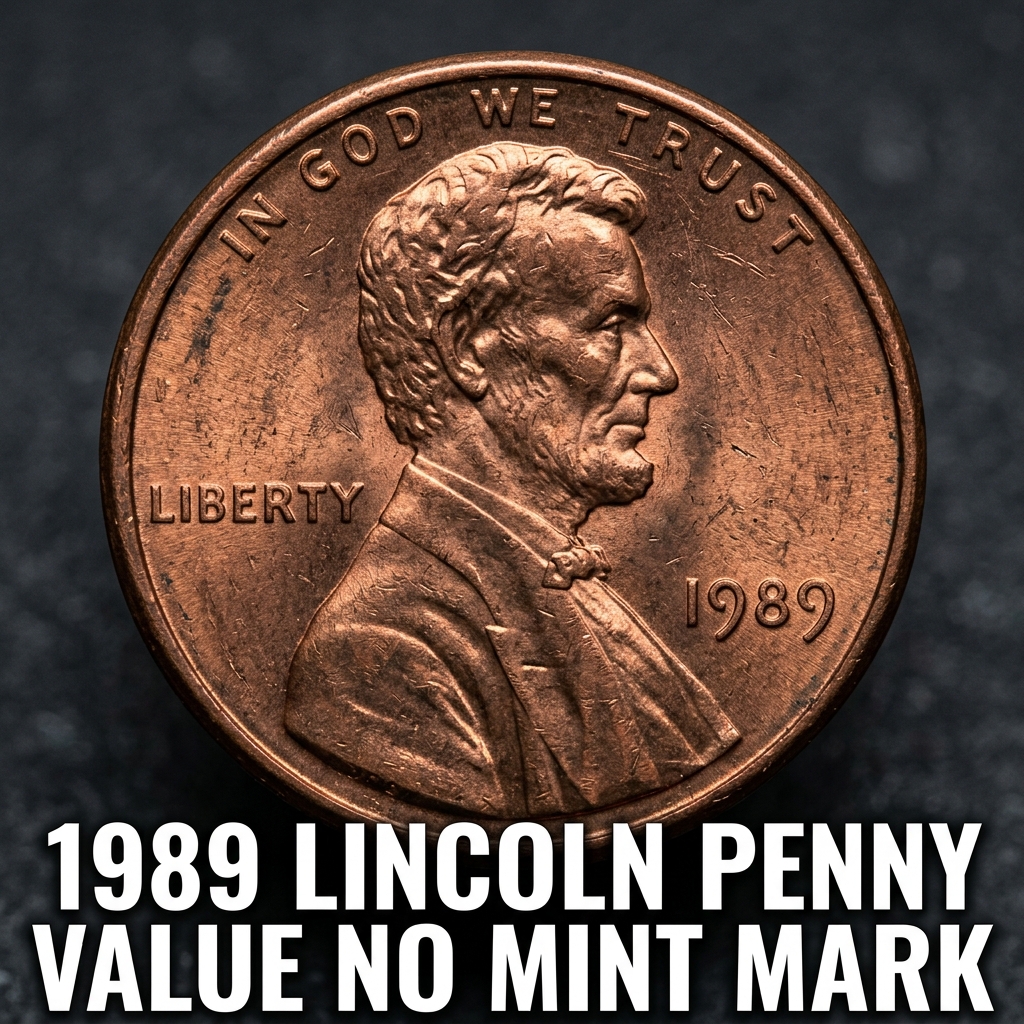
The 1989 Lincoln Penny with no mint mark is worth anywhere from face value in worn condition to around $1–$5 in uncirculated grades, with exceptional proof-like specimens occasionally reaching $10 or more. If you found one in your change jar or inherited a coin collection, here’s everything you need to know about its real value.
—
What the No Mint Mark Means on a 1989 Penny
Before diving into numbers, let’s clear up something that confuses a lot of people. A 1989 Lincoln Penny with no mint mark was struck at the Philadelphia Mint. Philadelphia has historically been the main U.S. Mint facility, and for most of American coinage history, coins made there carried no mint mark at all. So if you flip your 1989 penny over and don’t see a “D” or “S” below the date, you’ve got a Philadelphia coin — nothing missing, nothing special about the absence of a mark.
The Philadelphia Mint produced over 7.2 billion Lincoln cents in 1989, making this one of the highest-mintage years in penny history. That sheer volume is the biggest reason why most 1989 pennies with no mint mark aren’t worth much above face value. Supply is enormous, and collector demand for circulated examples is low.
If you’re trying to figure out exactly what you have, using the best coin identifier app can save you a lot of guesswork — just scan your coin and get instant results on mint mark, grade, and approximate value.
—
1989 Lincoln Penny Value by Grade
The value of a 1989 penny no mint mark depends almost entirely on its condition, also known as its “grade.” Coins are graded on a scale from 1 to 70, where higher numbers mean better condition. Here’s a straightforward breakdown:
| Grade / Condition | Description | Estimated Value |
|---|---|---|
| Good (G-4) | Heavy wear, flat design | $0.01 |
| Fine (F-12) | Moderate wear, details visible | $0.01–$0.05 |
| Extremely Fine (EF-40) | Light wear on high points | $0.10–$0.25 |
| Uncirculated (MS-63) | No wear, some bag marks | $0.50–$1.50 |
| Gem Uncirculated (MS-65) | Near perfect, strong luster | $2–$5 |
| Superb Gem (MS-67+) | Essentially flawless | $10–$50+ |
For the most current auction prices and certified sales data, you can check out detailed 1989 Lincoln Penny pricing in MS Red and Proof-Like grades — it’s a great resource updated with real market transactions.
—
What Makes a 1989 Penny Worth More Than Usual
Even though most 1989 pennies with no mint mark are common, there are a few things that can push the value higher.
Color designation: Copper coins are graded not just by wear but by color. A coin graded RD (Red) retains its original bright copper color and is worth more than BN (Brown) or RB (Red-Brown). A 1989 penny in MS-65 RD is significantly more valuable than the same grade in MS-65 BN.
Errors and varieties: Mint errors — like doubled dies, off-center strikes, or die caps — can make a common coin into a real find. A 1989 doubled die obverse, for example, might show doubling in the lettering or Lincoln’s features and could fetch anywhere from $25 to $100 depending on severity and grade.
Strike quality: Proof-like coins (PL designation) sometimes escape into circulation or turn up in original mint sets. These coins have unusually sharp, mirror-like fields and can command a premium over regular business strikes.
Certified grading: A coin authenticated and graded by PCGS or NGC carries more credibility and often sells for more. If you think your 1989 penny no mint mark might grade MS-66 or higher, professional certification is worth considering.
The app CoinHix is a helpful tool for getting quick value estimates based on condition — just enter the year, mint mark, and grade, and it pulls real pricing data from the market.
—
How to Tell If Your 1989 Penny Is Worth Grading
Most 1989 Philadelphia pennies you’ll encounter in circulation are simply worth one cent. But here’s a quick checklist to decide if yours might be worth a closer look:
– Does the coin have its original reddish copper color (not dull brown)?
– Are Lincoln’s cheekbone, hair, and ear details sharp and crisp?
– Are there no scratches, spots, or cleaning marks?
– Does the coin appear to have strong luster when tilted in light?
If you answered yes to all four, you may have an uncirculated example worth keeping. For a detailed look at the full range of 1989 penny values across all grades and mint marks, that resource breaks everything down clearly for collectors at every level.
You can also use CoinHix to photograph your coin and compare it against graded examples — a fast way to ballpark its condition before spending money on professional grading.
—
FAQ
Q: Is a 1989 penny with no mint mark rare?
A: No. The Philadelphia Mint produced over 7.2 billion of them in 1989, making this one of the most common Lincoln cents in existence. However, high-grade examples in MS-67 or better are genuinely scarce and can be worth $25 or more.
Q: Why doesn’t my 1989 penny have a mint mark?
A: That’s completely normal. Pennies made at the Philadelphia Mint traditionally carry no mint mark. The “D” mint mark indicates Denver, and “S” indicates San Francisco. No mark at all means Philadelphia — your coin is not missing anything.
Q: Should I clean my 1989 penny to make it look better?
A: Absolutely not. Cleaning a coin removes its natural patina and surface, which actually destroys value in the eyes of collectors. Even a dull, brown 1989 penny in original condition is better than a cleaned one. If you want to know its true worth, use CoinHix or consult a professional grader rather than trying to polish it up yourself.