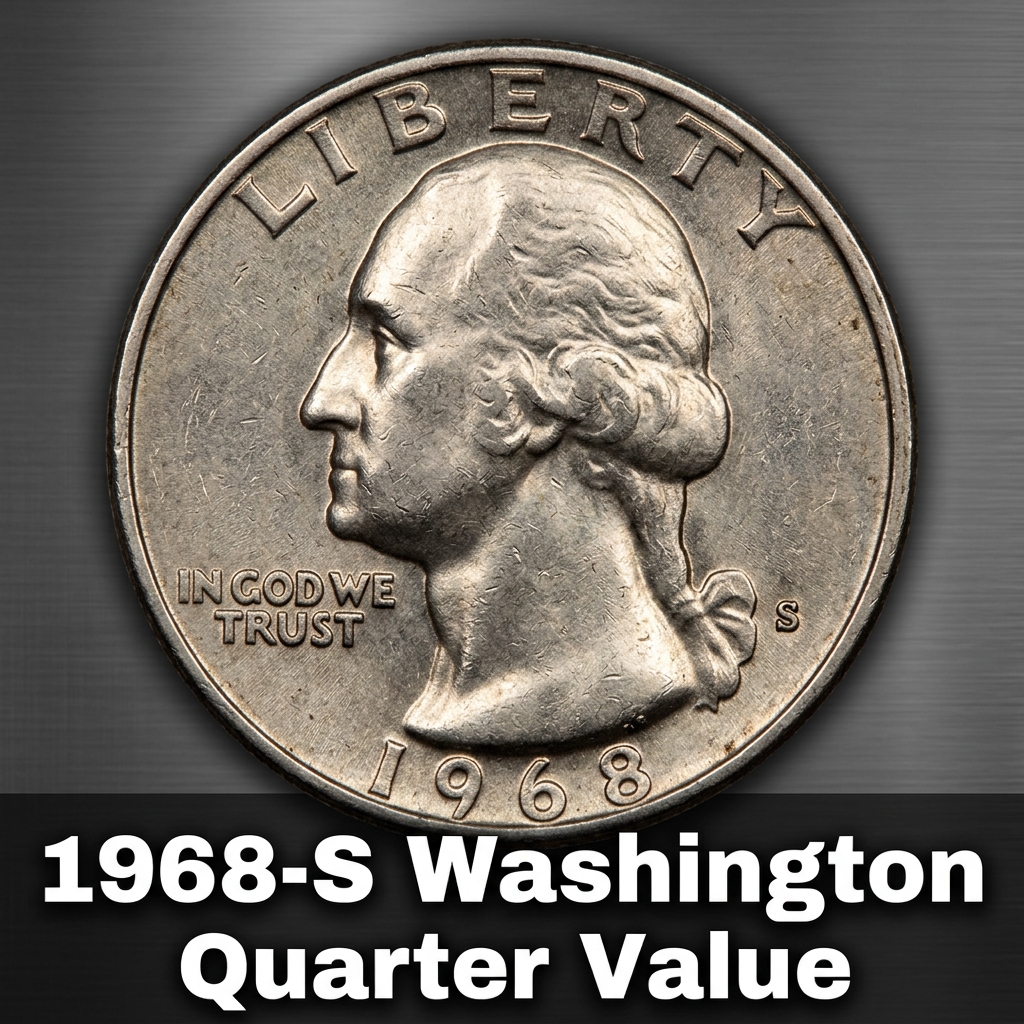
The 1968-S Washington Quarter is worth anywhere from $0.25 in heavily circulated condition to over $10 in typical mint state grades, with top-tier proof specimens fetching $20 or more depending on cameo contrast and eye appeal. If you found one of these in an old coin jar or inherited collection, you’re in the right place to find out exactly what you have.
What Makes the 1968-S Quarter Special
The 1968-S Washington Quarter was struck at the San Francisco Mint and holds a unique place in U.S. coinage history. That year, the San Francisco facility did not produce quarters for general circulation — instead, it focused exclusively on proof coins intended for collector sets. This means every 1968-S quarter you’ll ever encounter is a proof coin, not a business strike. That’s actually a big deal.
Proof coins are made using specially polished planchets and dies, struck multiple times under high pressure to bring out incredible detail and mirror-like surfaces. They were sold in annual proof sets and never meant to be spent. If you’re using the best coin identifier app to identify what you’ve got, make sure you select “proof” as the coin type — it changes the value significantly. The mintage for the 1968-S proof quarter was approximately 3.04 million coins, which sounds like a lot, but collectors still actively seek well-preserved examples, especially those with strong cameo or deep cameo contrast on the devices.
Understanding 1968-S Quarter Values by Grade
Proof coins are graded on a 70-point Sheldon scale, just like regular coins, but they also carry extra designations. A standard proof might be labeled PR65, while one with frosted devices against a mirror field earns a PR65CAM or PR65DCAM label — and those designations push the price up considerably.
Here’s a general breakdown of what you can expect for the 1968-S Washington Quarter at different grade levels:
| Grade | Designation | Estimated Value |
|---|---|---|
| PR64 | Standard Proof | $2 – $5 |
| PR65 | Standard Proof | $5 – $8 |
| PR65CAM | Cameo | $10 – $15 |
| PR66DCAM | Deep Cameo | $15 – $25 |
| PR69DCAM | Deep Cameo | $50 – $100+ |
For the most current auction results and price trends, you can check detailed 1968-S Washington Quarter price data by grade to see what recent sales look like across certified populations.
How to Tell If Your 1968-S Quarter Is Worth More
Not all proof quarters are created equal. The biggest value drivers for the 1968-S are surface preservation and cameo contrast. Cameo effect happens when the raised design elements (like Washington’s portrait and the eagle) appear frosty white against the deeply reflective mirror-like background fields. The stronger that contrast, the more desirable the coin.
Look closely at your coin under a single light source. If the background looks like a dark mirror and the portrait looks bright and frosted, you might have a cameo specimen. Hair lines — those tiny scratches from improper handling or cleaning — can drop the grade significantly, so avoid touching the surfaces. If you use CoinHix to look up comparable sales, you’ll notice that the jump from a standard PR65 to a PR65CAM can easily double or triple the coin’s market value. That contrast matters enormously to collectors.
Also check if the coin is still in its original proof set packaging. An intact, unopened 1968 proof set can sell for $10–$20 or more as a complete set, which may actually be worth more than breaking it apart.
Where to Sell or Get Your 1968-S Quarter Appraised
If you think you have a high-grade example, getting it professionally graded by PCGS or NGC is worth considering. Certified coins sell faster and at higher prices because buyers trust the grade. Submission fees start around $20–$30 per coin, so it only makes financial sense for coins you believe are PR67 or higher — especially deep cameo specimens.
For a quick value estimate before committing to grading costs, CoinHix is a great free tool that lets you look up current market prices by grade and compare recent sales in seconds. You can also check a full breakdown of 1968 quarter values including proof varieties to understand how your coin fits into the broader market.
Online platforms like eBay, Heritage Auctions, and Great Collections are all good venues for selling once you know what you have. Local coin dealers can also give you a quick in-hand appraisal, though their offers will typically be wholesale prices.
—
FAQ
Q: Is the 1968-S Washington Quarter made of silver?
A: No. The 1968-S quarter is composed of copper-nickel clad, not silver. The U.S. Mint eliminated silver from quarters after 1964. However, 1968-S proof quarters were struck in 40% silver for inclusion in special mint sets — but those are clearly labeled and packaged differently from the standard clad proof sets.
Q: How do I know if my 1968-S quarter is a proof coin?
A: Proof coins have a distinctly sharp strike, mirror-like fields, and often a frosted appearance on the raised design. If your 1968-S has a shiny, glass-like background and crisp detail, it’s almost certainly a proof. The “S” mintmark alone confirms it came from San Francisco, where only proofs were made that year. CoinHix can help you confirm the variety once you identify it visually.
Q: Should I clean my 1968-S quarter before selling it?
A: Absolutely not. Cleaning a coin — even gently — removes original surface luster and microscopic metal, which destroys collector value. A cleaned proof coin can lose 50–90% of its potential value in the eyes of a grader. Leave it exactly as you found it and let a professional evaluate it in its natural state.