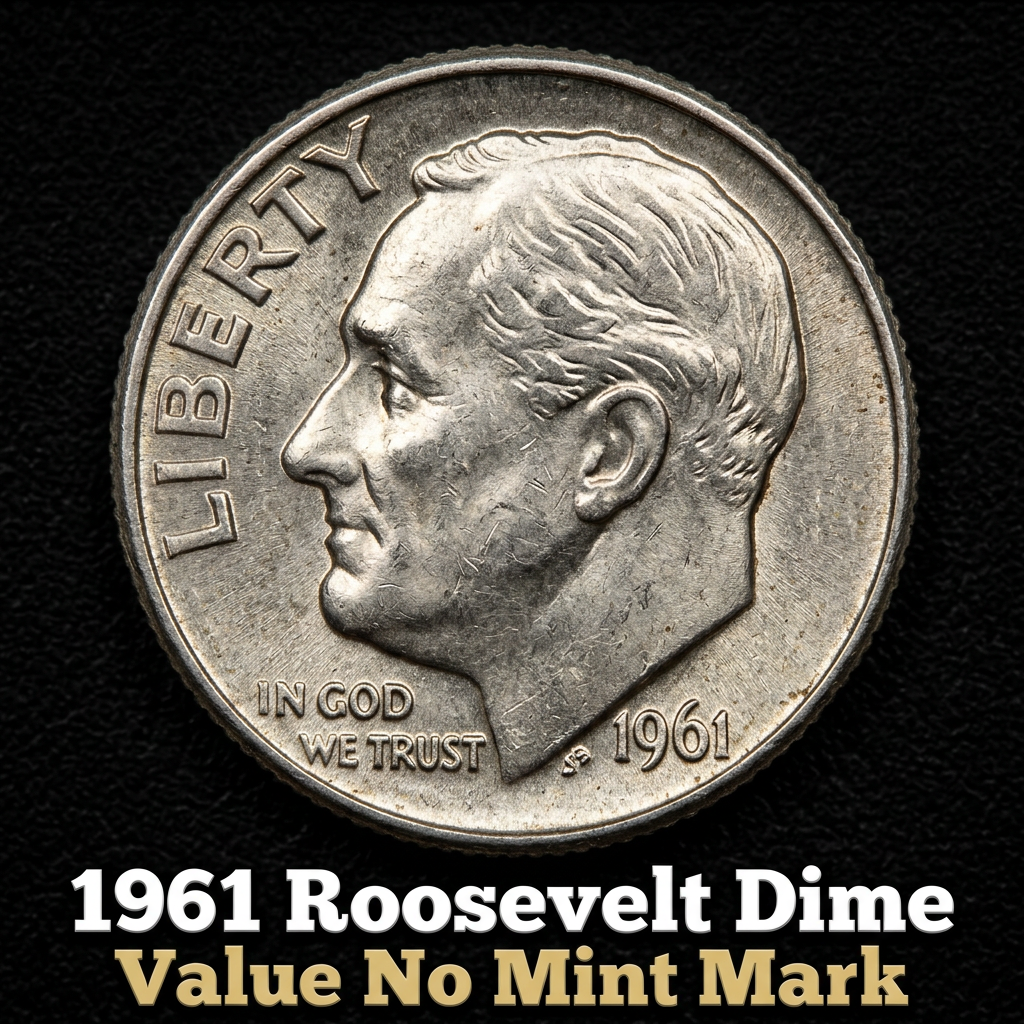
The 1961 Roosevelt Dime with no mint mark is worth anywhere from $2 to $3 in well-worn condition, but can fetch $10 to $30 or more in uncirculated grades — and top specimens have sold for over $100 at auction. If you’ve just found one of these silver dimes in an old jar or inherited coin collection, you’re in the right place to find out exactly what you’ve got.
What Makes the 1961 Roosevelt Dime Special
The 1961 Roosevelt Dime with no mint mark was struck at the Philadelphia Mint, which in those days did not place a mint mark on its coins. Roughly 96,758,244 of these dimes were produced that year, making them relatively common — but here’s the thing: they’re made of 90% silver. That alone gives every single one a baseline value above face value, no matter the condition.
Silver content is the starting point for most people who ask about this coin. Each 1961 dime contains approximately 0.07234 troy ounces of silver. With silver prices fluctuating around $25–$30 per ounce in recent years, the melt value alone sits between $1.80 and $2.20. That’s why even a heavily circulated example is worth keeping.
If you want a fast way to identify what you have, using the best coin identifier app can instantly scan your coin and give you a starting point before you dive deeper into grading.
1961 Roosevelt Dime Value by Grade
Condition is everything in coin collecting. A coin that looks shiny and detailed is worth far more than one that’s been rattling around in a cash drawer for decades. Here’s a breakdown of typical market values for the 1961 Roosevelt Dime No Mint Mark:
| Grade | Description | Estimated Value |
|---|---|---|
| Good (G-4) | Heavy wear, major details visible | $2.00 – $2.50 |
| Fine (F-12) | Moderate wear, all features clear | $2.50 – $3.00 |
| Extremely Fine (EF-45) | Light wear on high points | $3.00 – $5.00 |
| Mint State (MS-63) | Uncirculated, minor blemishes | $10 – $20 |
| Mint State (MS-65) | Gem uncirculated, sharp details | $25 – $50 |
| Mint State (MS-67) | Superb gem, near perfect | $75 – $150+ |
For the most current auction results and certified coin sales, you can check out detailed 1961 Roosevelt Dime price data in mint state grades to see real-time market trends and recent sale prices.
How to Tell If Your 1961 Dime Is Worth More
Not all 1961 dimes are created equal. A few key things can push the value significantly higher. First, check for Full Bands (FB) — this refers to the horizontal bands on the torch on the reverse side of the coin. When these bands are sharply and completely struck, the coin earns a Full Bands designation, which can double or even triple its value at the MS-65 level.
Second, look for any errors or varieties. A doubled die obverse, off-center strike, or die crack can turn an ordinary coin into a collector’s prize. These are rare, but they exist.
Third, original luster matters. If your uncirculated coin still has that bright, cartwheel shine from the mint, that’s a great sign. Cleaned coins lose significant value because collectors prize originality above everything else.
A handy tool like CoinHix can help you compare your coin’s appearance against certified examples to give you a better sense of where it lands in the grading scale.
Proof Versions of the 1961 Dime
Philadelphia also struck proof coins in 1961 for collector sets. These were specially made with polished dies and highly reflective fields, giving them a mirror-like finish. The 1961 Proof Roosevelt Dime is worth roughly $5 to $15 in standard proof grades (PR-63 to PR-65), but a PR-68 or PR-69 Deep Cameo can sell for $50 to $200 or more at major auctions.
Proof coins typically came in original mint sets and have a distinctly different look from business-strike coins. If your dime looks mirror-bright with frosted design elements, it might be a proof — worth having a second look.
Should You Get It Graded or Just Sell It?
If your 1961 Roosevelt Dime no mint mark appears to be in uncirculated condition, professional grading from PCGS or NGC can add real credibility and potentially increase what collectors will pay. That said, grading costs money (typically $20–$40 per coin minimum), so it usually only makes sense for coins that appear to grade MS-65 or better.
For everyday worn examples, your best bet is to sell to a local coin dealer, list on eBay, or use a reputable coin buying service. You can also review a complete breakdown of 1961 dime values across all grades and varieties to understand your coin’s worth before you sell.
CoinHix is also a great resource to track live silver prices and see how the base melt value of your 1961 dime shifts day by day — useful if you’re deciding when to sell.
FAQ
Q: Is the 1961 Roosevelt Dime no mint mark made of silver?
A: Yes. All Roosevelt Dimes minted before 1965, including the 1961 Philadelphia issue, are made of 90% silver and 10% copper. This gives every example a melt value well above its face value of 10 cents.
Q: How do I know if my 1961 dime is uncirculated?
A: Look for original mint luster — that flowing, cartwheel shine across the coin’s surface. An uncirculated coin will have no signs of wear on Roosevelt’s cheekbone, hair, or the torch on the reverse. Any rubbing or dullness in those areas usually means the coin has circulated.
Q: What is the most valuable 1961 Roosevelt Dime no mint mark ever sold?
A: A 1961 Roosevelt Dime graded MS-68 Full Bands by PCGS has sold for several hundred dollars at major coin auctions. These top-grade examples are extremely rare and represent the finest known survivors from that year’s Philadelphia mintage.