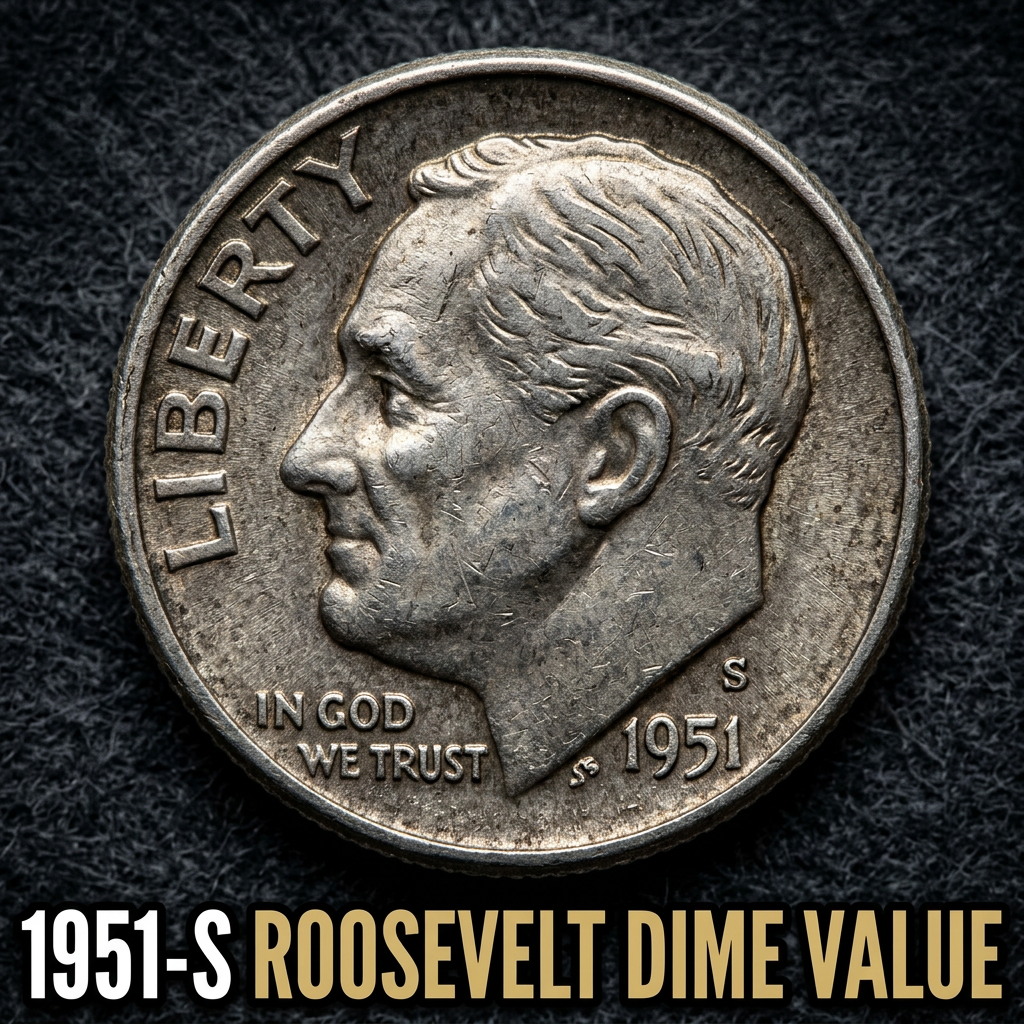
The 1951-S Roosevelt Dime is worth anywhere from $2 to $3 in heavily worn condition, all the way up to $50 or more in uncirculated mint state — and high-grade examples can push well past $100. If you found one of these old silver dimes in a jar, a drawer, or an inherited coin collection, you’re in the right place to find out exactly what it’s worth.
What Makes the 1951-S Roosevelt Dime Special
The “S” mintmark on this dime tells you it was struck at the San Francisco Mint in 1951. This was still the early years of the Roosevelt Dime series, which began in 1946 following President Franklin D. Roosevelt’s death. These coins were made of 90% silver, which automatically gives them a base metal value tied to the current silver spot price.
The San Francisco Mint had a long tradition of producing well-struck coins, and the 1951-S is no exception. With a mintage of around 31.6 million coins, it wasn’t a rare issue, but finding one in excellent condition is another story entirely. Most of these dimes spent decades in circulation and came back well-worn. A nice, sharply struck example with original luster is genuinely hard to come by today.
If you’re just getting started with coin collecting and want a quick way to identify and value your coins, using the best coin identifier app can save you a lot of time and guesswork right from the start.
1951-S Roosevelt Dime Value by Grade
The condition of your coin — what collectors call the “grade” — is the single biggest factor in determining its value. Here’s a quick breakdown of what you can expect at different grades:
| Grade / Condition | Description | Estimated Value |
|---|---|---|
| Good (G-4) | Heavy wear, outline visible | $2 – $3 |
| Fine (F-12) | Moderate wear, details clearer | $3 – $5 |
| Extremely Fine (EF-40) | Light wear, most detail intact | $5 – $10 |
| About Uncirculated (AU-55) | Slight wear on high points | $12 – $20 |
| Mint State (MS-63) | No wear, some bag marks | $25 – $50 |
| Gem Mint State (MS-66+) | Exceptional luster and strike | $100 – $300+ |
For the most up-to-date auction results and population data, you can check out the 1951-S Roosevelt Dime mint state price data on CoinHix to see what these coins are actually selling for right now.
Silver Melt Value and Why It Matters
Even a heavily worn 1951-S Roosevelt Dime has real silver in it. Each coin contains approximately 0.07234 troy ounces of pure silver. At today’s silver prices (hovering around $28–$30 per ounce), the melt value alone is roughly $2.00 to $2.20. That means even the most beat-up example you find is still worth more than face value — a great starting point for any coin you come across.
This silver floor is important because it gives the coin a guaranteed minimum value regardless of collector demand. If you’re sorting through a collection and wondering whether low-grade pieces are worth keeping, the answer is usually yes — at the very least for their silver content.
CoinHix is a great tool to track live silver melt values alongside collector premiums, so you always know the full picture of what your coins are worth.
How to Spot a High-Value 1951-S Dime
Not every 1951-S dime is created equal. Collectors prize coins with full, sharp strike details — particularly the bands on the torch on the reverse side. When these bands are completely separated and sharply defined, the coin is designated “Full Bands” (FB), which can dramatically increase its value.
A standard MS-65 example might sell for $30–$40, while an MS-65 Full Bands coin could command $60–$80 or more. At the MS-67 FB level, prices can easily reach several hundred dollars.
Check the “S” mintmark carefully too — it should be crisp and clearly punched. A weak or partially filled mintmark can affect desirability among serious collectors. To get a full breakdown of how condition affects the 1951 Roosevelt Dime value across all grades and mint marks, it’s worth reviewing a dedicated price guide.
Using CoinHix makes it easy to photograph your coin, check comparable sales, and get an instant sense of market value without needing years of numismatic experience. And for collectors just starting out, CoinHix offers one of the most straightforward interfaces for tracking your entire collection in one place.
Should You Get Your 1951-S Dime Graded?
If your coin looks uncirculated — meaning the surfaces are bright, the luster is intact, and there’s no obvious wear on Roosevelt’s cheekbone or the high points of the torch — it may be worth submitting to a professional grading service like PCGS or NGC. The cost of grading typically runs $20–$40 per coin, so it only makes financial sense if you believe the coin grades MS-64 or higher.
A certified, slabbed example in a high grade is much easier to sell and commands stronger prices at auction. For a common-date coin like the 1951-S, the magic really happens at MS-66 and above, where population reports show relatively few examples survive.
—
Frequently Asked Questions
Q: How do I know if my 1951-S Roosevelt Dime is silver?
A: All Roosevelt Dimes made from 1946 through 1964 are composed of 90% silver. If your dime has an “S,” “D,” or no mintmark and was minted before 1965, it is silver. A quick way to check is the edge — silver dimes show a solid silver color with no copper stripe.
Q: What is the most valuable 1951-S Roosevelt Dime ever sold?
A: The top examples in MS-67 Full Bands condition have sold for several hundred dollars at major auctions. The exact record shifts over time as new examples come to market, so checking recent PCGS or NGC auction archives will give you the latest sales data.
Q: Is it worth cleaning my old 1951-S dime before selling it?
A: No — never clean a coin. Cleaning removes the original surface patina and luster, which significantly lowers collector value. A naturally toned or even slightly dirty coin is always more desirable to collectors than one that has been polished or chemically cleaned.