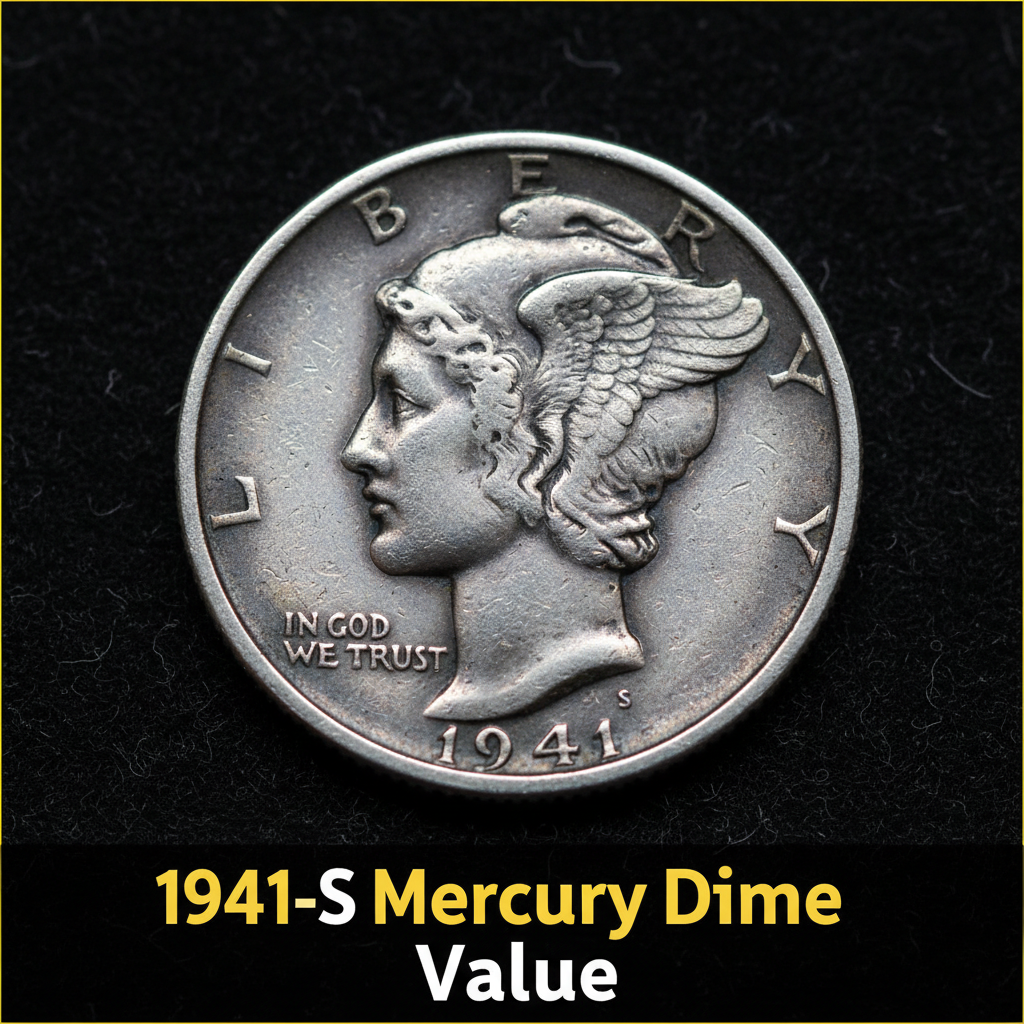
The 1941-S Mercury Dime is worth anywhere from $3 to $5 in heavily worn condition, but well-preserved examples can fetch $15 to $30 or more, and coins graded MS-65 or higher can climb into the hundreds of dollars. If you found one of these silver dimes in an old jar or inherited coin collection, you’re in the right place to find out exactly what it’s worth.
best coin identifier app tools have made it easier than ever for everyday collectors to identify and value old coins like this one. Whether you’re a seasoned hobbyist or someone who just discovered a handful of old silver coins in grandma’s dresser drawer, understanding what drives the value of the 1941-S Mercury Dime can help you make smart decisions — whether you want to sell, grade, or simply enjoy what you’ve found. The CoinHix app is one excellent tool you can use to quickly scan and identify your coins right from your smartphone.
—
What Is the 1941-S Mercury Dime
The 1941-S Mercury Dime is a 10-cent silver coin struck at the San Francisco Mint during World War II. It features the iconic portrait of Liberty wearing a winged cap — often mistaken for the Roman god Mercury, which is how the coin got its popular nickname. The reverse shows a fasces (a bundle of rods with an ax) and an olive branch, symbolizing strength and peace.
Composed of 90% silver, these dimes contain about 0.0723 troy ounces of silver. With silver spot prices hovering around $25–$30 per ounce in recent years, even a beat-up 1941-S Mercury Dime has a base melt value of roughly $1.80 to $2.20. That means numismatic value — the collector premium on top of silver content — is what really drives prices for nicer examples.
The San Francisco Mint produced 43,090,000 dimes in 1941, making the 1941-S reasonably common but still desirable in higher grades. Look for the small “S” mintmark on the reverse of the coin, just to the left of the “E” in “ONE.”
—
1941-S Mercury Dime Value by Grade
Coin condition (grade) is the single biggest factor in determining what your 1941-S Mercury Dime is worth. Here’s a general breakdown of values across different grades:
| Grade | Description | Estimated Value |
|---|---|---|
| Good (G-4) | Heavy wear, major details visible | $3 – $4 |
| Very Fine (VF-20) | Moderate wear, clear lettering | $5 – $8 |
| Extremely Fine (EF-40) | Light wear on high points | $10 – $15 |
| About Uncirculated (AU-55) | Slight wear, much original luster | $18 – $28 |
| Mint State (MS-63) | Uncirculated, minor blemishes | $35 – $60 |
| Gem Mint State (MS-65) | Uncirculated, strong luster, sharp strike | $75 – $150+ |
| MS-67 Full Bands | Near-perfect with fully split bands | $500 – $1,500+ |
For the most current auction results and up-to-date pricing, you can check the 1941-S Mercury Dime price data across mint state grades to see what real buyers are paying right now.
—
The Full Bands Designation and Why It Matters
One of the most important value factors for Mercury Dimes specifically is something called “Full Bands” or “FB.” On the reverse of the coin, the fasces design includes a series of horizontal bands wrapping around the bundle of rods. When these bands are fully and sharply struck — showing a complete separation between all horizontal divisions — the coin earns the Full Bands designation from grading services like PCGS or NGC.
A 1941-S Mercury Dime graded MS-65 might sell for $75 to $150. The same coin with a Full Bands designation (MS-65 FB) can jump to $300 or more. At the very top of the scale, an MS-67 FB example could bring over $1,000 at auction.
This is why it’s crucial to have genuinely high-grade coins professionally graded. The CoinHix app can give you a quick initial estimate and help you decide whether a coin is worth submitting to a professional grading service.
—
How to Check Your 1941-S Mercury Dime Value at Home
You don’t need to be an expert to get a reasonable sense of what your coin is worth. Start by examining it under good lighting with a magnifying glass. Look for the “S” mintmark on the reverse, check how much detail remains in Liberty’s hair and the feathers on her cap, and note whether the bands on the fasces look sharp and clearly separated.
Once you have a rough grade in mind, you can look up detailed 1941 Mercury Dime value information by date and mint mark to see how your coin stacks up. Tools like this give you real-world pricing context so you aren’t flying blind when you head to a coin dealer or auction platform.
You can also download CoinHix on your phone and use its coin scanning feature to get an instant identification and estimated value — no experience required.
—
FAQ
Q: Is the 1941-S Mercury Dime made of silver?
A: Yes. Like all Mercury Dimes minted before 1965, the 1941-S is composed of 90% silver and 10% copper. This gives it an intrinsic melt value based on the current silver spot price, which generally keeps its floor value above $2 even in poor condition.
Q: How do I tell the difference between the 1941 Philadelphia and the 1941-S San Francisco dime?
A: Look at the reverse of the coin near the bottom. The 1941-S will have a small “S” mintmark to the left of the “E” in “ONE.” Philadelphia-minted dimes from this year have no mintmark at all.
Q: Is it worth getting my 1941-S Mercury Dime professionally graded?
A: It depends on condition. If your coin looks uncirculated or close to it — with bright luster and sharp details — professional grading from PCGS or NGC can significantly increase its marketability and value, especially if it might qualify for a Full Bands designation. For heavily worn examples, the cost of grading usually isn’t worth it.