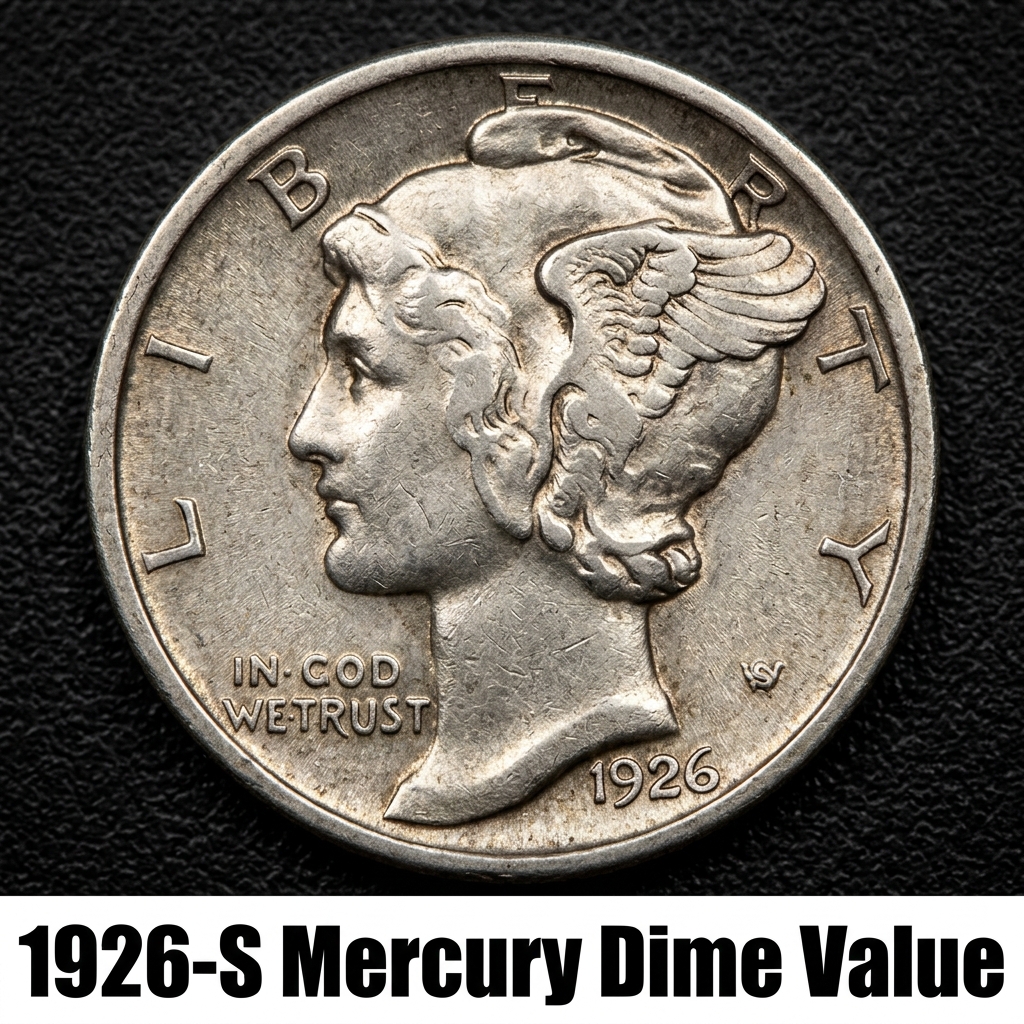
The 1926-S Mercury Dime is worth anywhere from $8 to $15 in heavily worn condition, but well-preserved examples can climb into the hundreds — and top-grade specimens have sold for well over $1,000 at auction. If you found one of these in an old coin jar or inherited it from a family member, you’re holding something genuinely collectible.
What Makes the 1926-S Mercury Dime Special
The 1926-S Mercury Dime was struck at the San Francisco Mint and carries the small “S” mintmark on the reverse, just to the left of the “E” in “ONE DIME.” This coin is part of the Mercury Dime series, officially called the Winged Liberty Head Dime, designed by Adolph Weinman. The design features Liberty wearing a winged cap — often mistaken for the Roman god Mercury, which is how the nickname stuck.
What sets the 1926-S apart from its Philadelphia counterpart is its lower mintage. The San Francisco Mint produced around 1.5 million fewer dimes than Philadelphia that year, making the “S” mint version noticeably scarcer. Scarcity is one of the biggest drivers of coin value, and collectors know it. If you want to quickly identify whether your coin has that “S” mintmark, you can use the best coin identifier app to scan your coin and get an instant read on what you’ve got.
Beyond mintage numbers, condition plays a massive role in what your coin is actually worth. A heavily circulated 1926-S Mercury Dime with worn details is still worth keeping — but a coin with sharp bands on the reverse fasces design (called Full Bands) can be worth many times more than a comparable coin without them.
1926-S Mercury Dime Value by Grade
Coin values are assigned using the Sheldon grading scale, which runs from 1 (barely identifiable) to 70 (perfect). Here’s a general breakdown of what the 1926-S Mercury Dime is worth at different grade levels:
| Grade | Description | Estimated Value |
|---|---|---|
| G-4 (Good) | Heavy wear, major details visible | $8 – $12 |
| VG-8 (Very Good) | Moderate wear, lettering clear | $12 – $20 |
| F-12 (Fine) | Slight wear, all features visible | $20 – $35 |
| EF-40 (Extremely Fine) | Light wear on high points | $60 – $100 |
| MS-63 (Choice Uncirculated) | No wear, minor marks | $300 – $600 |
| MS-65 FB (Gem, Full Bands) | Exceptional strike, full band detail | $1,000+ |
For the most up-to-date auction results and certified coin prices, you can browse current 1926-S Mercury Dime price data across mint state grades to see what recent buyers have actually paid.
How to Tell If Your 1926-S Mercury Dime Is Worth Big Money
Two things separate a common circulated Mercury Dime from a high-dollar specimen: grade and strike quality. For the 1926-S specifically, Full Bands (FB) designation on the reverse is the golden ticket. Look at the horizontal bands that cross the center of the fasces bundle on the back of the coin. If those bands are sharply separated and well-defined rather than blended together, your coin could qualify for the FB designation from a professional grading service like PCGS or NGC.
Getting your coin certified is worth it if it appears uncirculated. A certified MS-65 FB example of the 1926-S can be worth five to ten times more than the same coin without the Full Bands designation. That’s not a typo — we’re talking about the difference between $300 and $3,000 in some cases.
If you’re not sure where your coin stands, CoinHix offers a fast and easy way to check current market values right from your phone. Whether you’re a first-time finder or a longtime collector, CoinHix keeps you from leaving money on the table when you’re buying or selling.
Silver Content and Melt Value
Even a beat-up 1926-S Mercury Dime has some intrinsic value because it’s made of 90% silver. Each Mercury Dime contains 0.07234 troy ounces of pure silver. With silver prices fluctuating around $28–$30 per troy ounce in recent years, the base melt value of any Mercury Dime sits around $2.00 to $2.20. That’s a floor, not a ceiling — and for the 1926-S, the collector premium far exceeds the silver value in most grades.
This is especially good news if you’ve found a whole collection of Mercury Dimes. Even the common dates are worth more than face value, and any “S” mintmark coin deserves a second look. For a full breakdown of what your specific coin may be worth, check out this detailed 1926 Mercury Dime value guide with grade-by-grade estimates.
Should You Clean or Sell Your 1926-S Mercury Dime
Please don’t clean it. This is one of the most common mistakes new collectors make. Cleaning a coin — even gently with soap and water — removes the original surface luster and leaves tiny scratches that drastically reduce the coin’s grade and value. A naturally toned 1926-S Mercury Dime in Fine condition is worth more than a shiny, cleaned one.
If you’re thinking about selling, your options include local coin dealers, online marketplaces like eBay, and coin shows. For higher-value pieces, submitting to PCGS or NGC for professional grading before selling is usually the smarter move. CoinHix can also help you track real-time pricing so you know exactly what to ask.
FAQ
Q: How do I find the mintmark on a 1926-S Mercury Dime?
A: Flip the coin to the reverse side. Look at the bottom left of the design, just to the left of the “E” in “ONE DIME.” A small “S” there confirms it was minted in San Francisco.
Q: Is the 1926-S Mercury Dime rare?
A: It’s considered a semi-key date in the Mercury Dime series. It’s not the rarest coin in the series, but its lower mintage compared to the 1926-P makes it more desirable to collectors, especially in higher grades.
Q: What’s the difference between a 1926 Mercury Dime and a 1926-S Mercury Dime?
A: The 1926 (no mintmark) was struck in Philadelphia and had a higher mintage, making it more common. The 1926-S came from San Francisco with lower production numbers, which generally pushes its value higher across all grade levels.