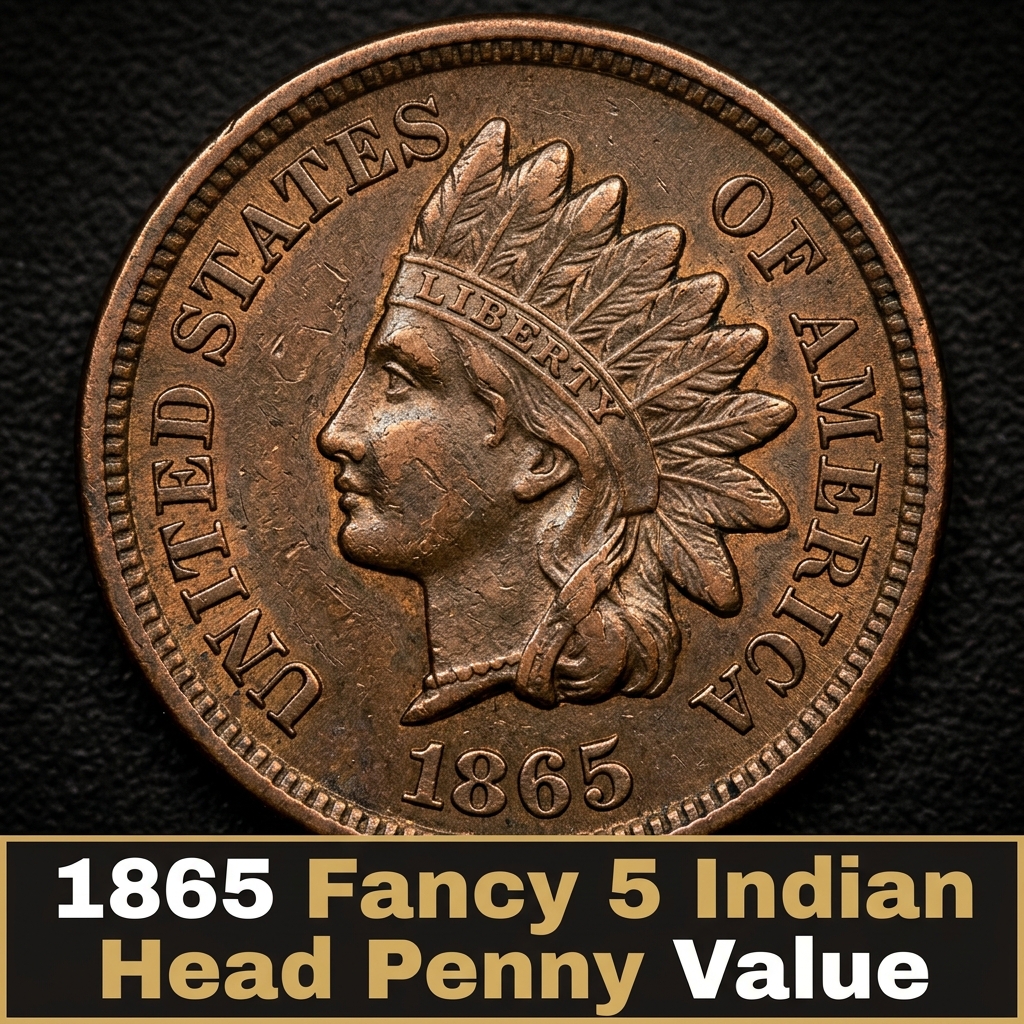
The 1865 Fancy 5 Indian Head Penny is worth anywhere from $20 in heavily worn condition to over $500 or more in high-grade mint state — and certain certified examples have sold for thousands. If you found one of these in an old coin jar or inherited collection, you may be holding something genuinely exciting.
What Makes the 1865 Fancy 5 Different from a Regular 1865 Penny
Not all 1865 Indian Head Pennies are created equal. The U.S. Mint produced two distinct varieties that year: the “Plain 5” and the much more sought-after “Fancy 5.” The Fancy 5 variety features a distinctive serif-style numeral “5” in the date, with a curved flag at the top, giving it a more ornate appearance compared to the simpler Plain 5.
This distinction might seem minor, but to collectors, it’s a big deal. The Fancy 5 is generally considered the scarcer of the two varieties, and that scarcity translates directly into higher market value. If you’re not sure which variety you have, look closely at the bottom of the “5” in the date — the Fancy 5 has a curved, almost decorative tail, while the Plain 5 looks flat and plain.
If you’re struggling to tell them apart, using the best coin identifier app can help you zoom in and compare your coin’s details against verified examples. Technology has made it easier than ever for everyday collectors to identify subtle variety differences without needing a magnifying glass and a reference book.
1865 Fancy 5 Indian Head Penny Value by Grade
The value of your 1865 Fancy 5 Indian Head Penny depends heavily on its condition, or “grade.” Coin grading runs from Poor (P-1) all the way up to Mint State 70 (MS-70), though most circulated coins fall somewhere in the middle.
Here’s a general value breakdown based on current market trends:
| Grade | Description | Estimated Value |
|---|---|---|
| Good (G-4) | Heavy wear, major design visible | $20 – $35 |
| Very Good (VG-8) | Moderate wear, some detail | $35 – $60 |
| Fine (F-12) | Even wear, clear lettering | $60 – $90 |
| Extremely Fine (EF-40) | Light wear on high points | $125 – $200 |
| About Uncirculated (AU-50) | Slight wear, mostly sharp | $200 – $300 |
| Mint State (MS-63+) | No wear, varying luster | $400 – $1,000+ |
For the most up-to-date auction results and certified coin prices, you can check the 1865 Fancy 5 Indian Head Penny price data in mint red condition to see exactly what top-grade examples are selling for right now.
How to Assess Your Coin’s Condition at Home
Before you run to a coin dealer, take a few minutes to evaluate your coin yourself. Start by examining it under good light — natural daylight or a bright lamp works well. Look at the cheek of Lady Liberty on the obverse and the wreath on the reverse. These are the highest points and the first areas to show wear.
A coin with sharp feather detail in Liberty’s headdress and clear, crisp lettering in “ONE CENT” on the reverse is likely in Fine to Extremely Fine condition. If the design is flat and details are barely visible, you’re looking at a Good or Very Good grade.
One tool many collectors now rely on is CoinHix, which lets you look up real-time price data for specific varieties and grades. Instead of guessing, you can see what the market is actually paying for a coin like yours. It’s especially handy when you’re dealing with variety coins like the Fancy 5, where grade and variety together determine value.
What Affects the Value Beyond Grade
Grade is the biggest factor, but it’s not the only one. Here are a few other things that can push your 1865 Fancy 5 Indian Head Penny value up or down:
Color designation: Copper coins are graded not just by wear, but by color — Red (RD), Red-Brown (RB), or Brown (BN). A Mint State coin with full original red color can be worth significantly more than the same grade in brown.
Certification: Coins graded and certified by PCGS or NGC tend to sell for stronger prices because buyers trust the grade. Raw (uncertified) coins often trade at a discount.
Eye appeal: Coins with no distracting spots, cleaning marks, or damage simply look better and sell for more. Even two coins at the same grade can have very different prices based on overall appearance.
Demand: Indian Head Pennies from the Civil War era are perennially popular with collectors. The 1865 Fancy 5 has a loyal following, which helps support consistent demand.
If you’re comparing your 1865 Fancy 5 to other Indian Head Penny dates, it’s worth knowing how other issues from this era stack up — for example, the 1898 Indian Head Penny value guide gives a great sense of how late-series cents are priced by grade, which can help you put the 1865 Fancy 5’s value in context.
Should You Sell, Hold, or Get It Graded?
This is the question most people end up asking. If your coin is in Good to Fine condition, it’s a nice piece of history worth $20 to $90, and you might simply enjoy keeping it. But if it looks sharp — minimal wear, bright surfaces, no cleaning — it could be worth sending to PCGS or NGC for professional grading.
The cost of certification typically runs $30 to $50 per coin for standard service. If your coin grades MS-63 or better, that investment can pay off many times over.
Not sure whether it’s worth the cost? CoinHix makes it easy to check current certified coin prices before you commit to anything. Just look up the 1865 Fancy 5 variety and see what graded examples are selling for at auction. That alone can help you make a smarter decision.
—
Frequently Asked Questions
Q: How do I know if my 1865 penny is the Fancy 5 variety?
A: Look at the numeral “5” in the date. The Fancy 5 has a curved, decorative serif at the top and a curled tail at the bottom, giving it an ornate appearance. The Plain 5 has a flat, simple top with no curved flag. A loupe or magnifier makes this much easier to see clearly.
Q: Is the 1865 Fancy 5 Indian Head Penny rare?
A: It’s scarcer than the Plain 5 variety from the same year, which makes it more desirable to collectors. It’s not considered an extreme rarity, but finding one in high grade is genuinely uncommon, and that’s where the real value lies.
Q: Should I clean my 1865 Fancy 5 penny before selling it?
A: Absolutely not. Cleaning a coin — even gently with a cloth — removes the original surface and drastically reduces its value. Collectors and grading services can detect cleaning, and a cleaned coin is worth far less than an unclean one in the same grade. Leave it exactly as you found it.