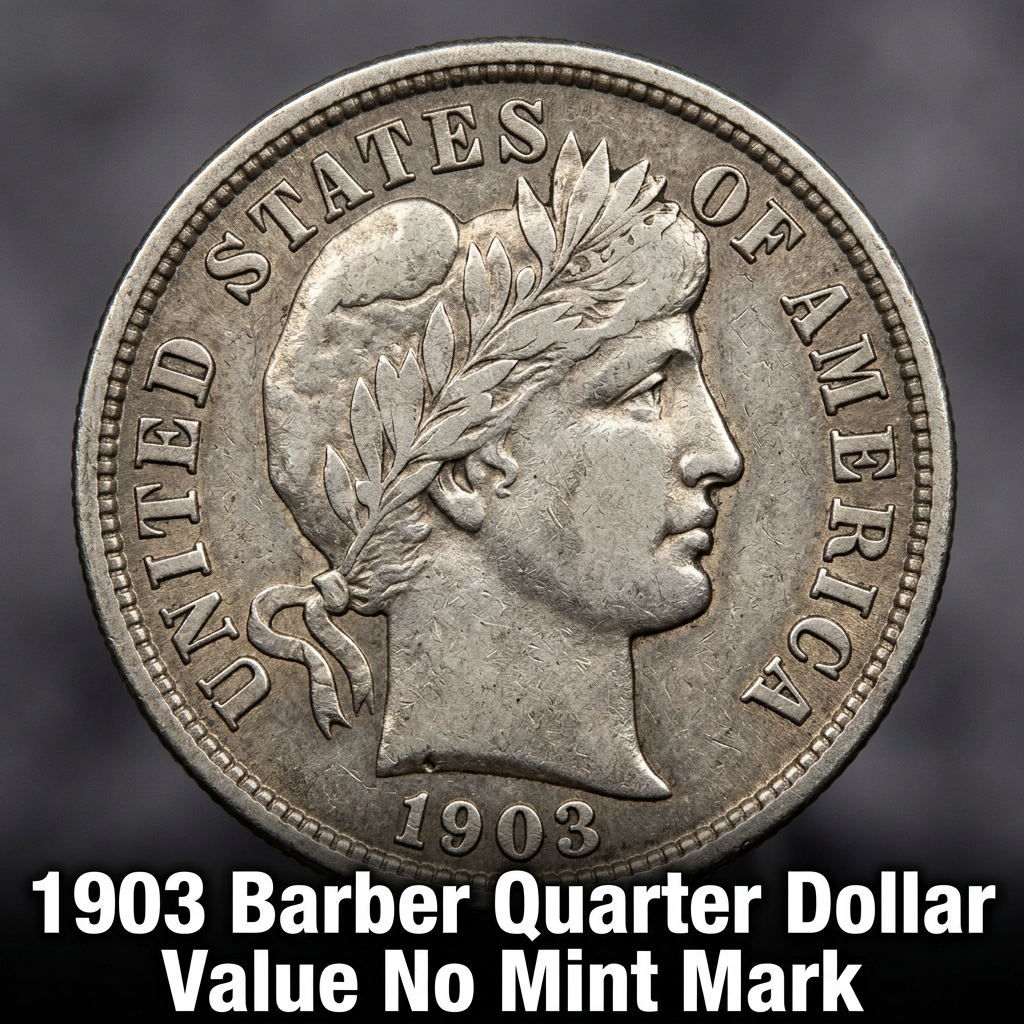
The 1903 Barber Quarter Dollar with no mint mark is worth anywhere from $7 in heavily worn condition to well over $500 in high-grade mint state examples. If you found one of these old silver coins in a drawer or jar, you’re holding a piece of American history that could be worth more than you think.
What Is the 1903 Barber Quarter?
The 1903 Barber Quarter is part of a series designed by U.S. Mint Chief Engraver Charles E. Barber, who gave the coins their nickname. The obverse features Lady Liberty wearing a laurel wreath and a cap, while the reverse shows a heraldic eagle. These quarters were minted in Philadelphia, New Orleans, and San Francisco. A coin with no mint mark means it was struck at the Philadelphia Mint, which was the main production facility at the time.
If you’re trying to identify your coin quickly and accurately, using the best coin identifier app can save you a lot of time. Just snap a photo and get instant results without needing to dig through price guides manually.
Philadelphia struck 9,670,064 Barber Quarters in 1903, making it one of the higher-mintage years in the series. Higher mintage generally means more survivors, which keeps values for average circulated examples relatively modest. However, well-preserved specimens are still quite desirable among collectors.
How Condition Affects the 1903 Barber Quarter No Mint Mark Value
Condition — or grade — is everything when it comes to old coins. A heavily worn 1903 Barber Quarter where the design details are nearly flat might fetch $7 to $10 at a coin shop. Move up to a coin in Fine condition with clear lettering and visible hair details on Liberty, and you’re looking at $20 to $40. In Very Fine or Extremely Fine grades, values climb to $60–$150.
CoinHix is a great tool for getting a quick grade estimate before you walk into a dealer. Many everyday coin finders are surprised to learn how much condition affects the final number — sometimes dramatically.
Mint state examples, meaning coins that were never circulated and still show their original luster, are where values really jump. An MS-63 example can sell for $300 or more, and top-grade specimens certified by PCGS or NGC can exceed $1,000 at auction.
| Grade | Description | Estimated Value |
|---|---|---|
| Good (G-4) | Heavy wear, flat design | $7 – $10 |
| Fine (F-12) | Moderate wear, some detail visible | $20 – $40 |
| Very Fine (VF-20) | Light wear on high points | $50 – $80 |
| Extremely Fine (EF-40) | Slight wear, sharp detail | $90 – $150 |
| Mint State (MS-63) | No wear, original luster | $300 – $500+ |
Silver Content and Melt Value of the 1903 Barber Quarter
Even the most worn 1903 Barber Quarter has real intrinsic value because it’s made of 90% silver. Each coin contains approximately 0.1808 troy ounces of pure silver. With silver prices fluctuating around $25–$30 per ounce in recent years, the melt value of any Barber Quarter sits around $4.50 to $5.50 at minimum.
This means even a coin too worn to interest most collectors still has a floor value based purely on its silver content. It’s one reason coin dealers are always interested in buying these pieces regardless of grade.
If you enjoy learning about silver coin values from this era, you might also want to check out how much the 1903 Morgan Dollar is worth, another stunning silver coin from the same year that tells a similar story of American craftsmanship.
How to Get the Best Price for Your 1903 Barber Quarter
If you think your coin might be in high grade, it’s worth having it professionally certified by PCGS or NGC. Certified coins sell for significantly more on platforms like eBay or at major coin shows. For lower-grade pieces, local coin dealers and coin shows are your best options for a quick and fair sale.
CoinHix makes it easy to research current market prices before you sell, so you never walk into a negotiation blind. Simply enter your coin details and see what comparable examples have recently sold for.
Don’t forget to check for any errors or varieties, such as doubled dies or repunched dates, as these can multiply the value of an otherwise common coin significantly.
—
FAQ
Q: How do I know if my 1903 quarter is from Philadelphia?
A: Philadelphia-minted Barber Quarters carry no mint mark. Look on the reverse of the coin near the bottom of the eagle — if there is no letter, it was made in Philadelphia.
Q: Is the 1903 Barber Quarter rare?
A: The no mint mark Philadelphia issue is not considered rare due to its relatively high mintage of nearly 9.7 million coins. However, finding one in Mint State condition is genuinely uncommon and collectible.
Q: Can I use an app to value my 1903 Barber Quarter?
A: Yes — CoinHix is a popular choice for quickly estimating coin values and checking recent sales data. It’s especially helpful if you’re new to coin collecting and want a reliable starting point before visiting a dealer.